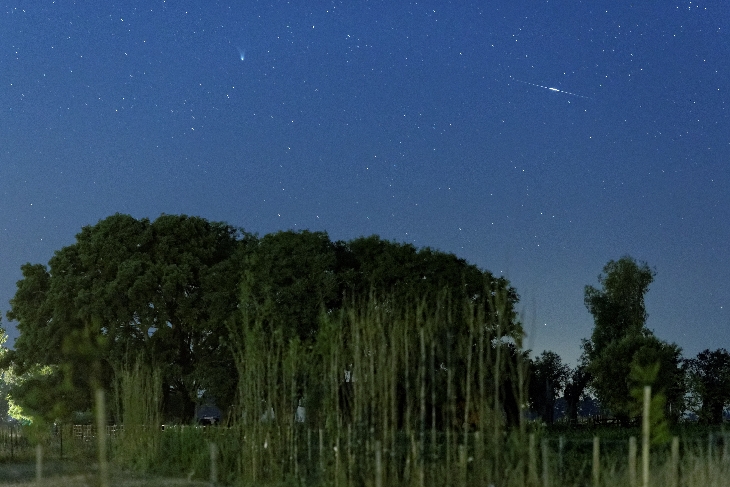
Comet NEOWISE (C/2020 F3) from West Seattle

This comet is visible a couple hours before sunrise for the next few days (July 9, 10, 11) and shortly after sunset after July 12 or so. All dates and times I mention are for West Seattle, Washington, USA. We’re in Pacific Time and at latitude 47.5°. Most of the times will be approximately true for your local time if you’re between 30-50° latitude in the Northern Hemisphere.

The problem with Comet NEOWISE is, even though it is fairly bright for a comet, it is still very close to the Sun from our point of view. When the Sun is in the sky, or even not in the sky but near the horizon, the sky itself is bright, washing out dimmer stars and sky objects. So you have to find the balance point between the peak of the comet’s brightness (which seems to be today July 9) and its distance from the Sun in the sky. Starting July 12 it will get farther and farther from the Sun in our sky, and be visible later and later after sunset.

NEOWISE is currently approximately visual magnitude 2 (smaller numbers are brighter), which is easily visible in a semi-dark sky. You can use these star charts to estimate whether or not a magnitude 2 object will be visible where you are. If you can see as many stars as are in the magnitude 3 chart, or more, then the comet will be visible. If you’re reading this after July 10, check the current magnitude of the comet, and look for the chart for stars dimmer than that.
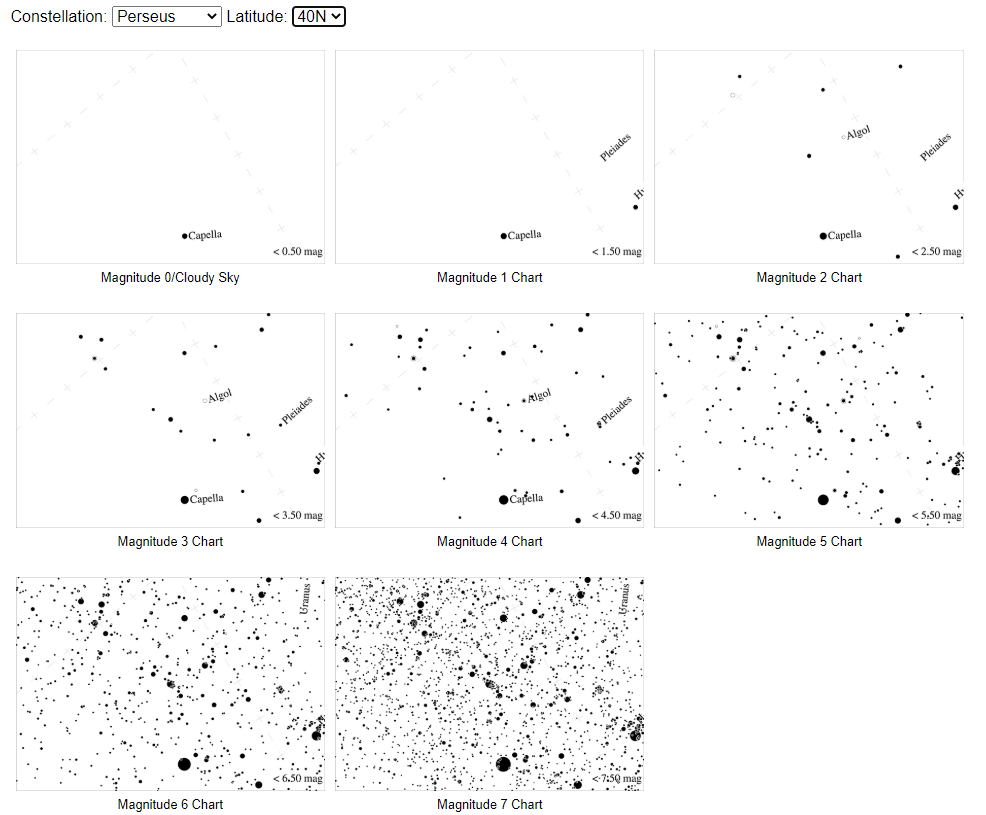
an image of 8 different sky maps showing different numbers of stars. Magnitude 0 shows only one star, Magnitude 1 shows a few. Magnitude 7 is very dense with stars.

Image from Globe at Night

Morning Sky

Your best chance for July 10 and July 11, 2020 will be around 3-3:40 am looking towards the Northeastern horizon.
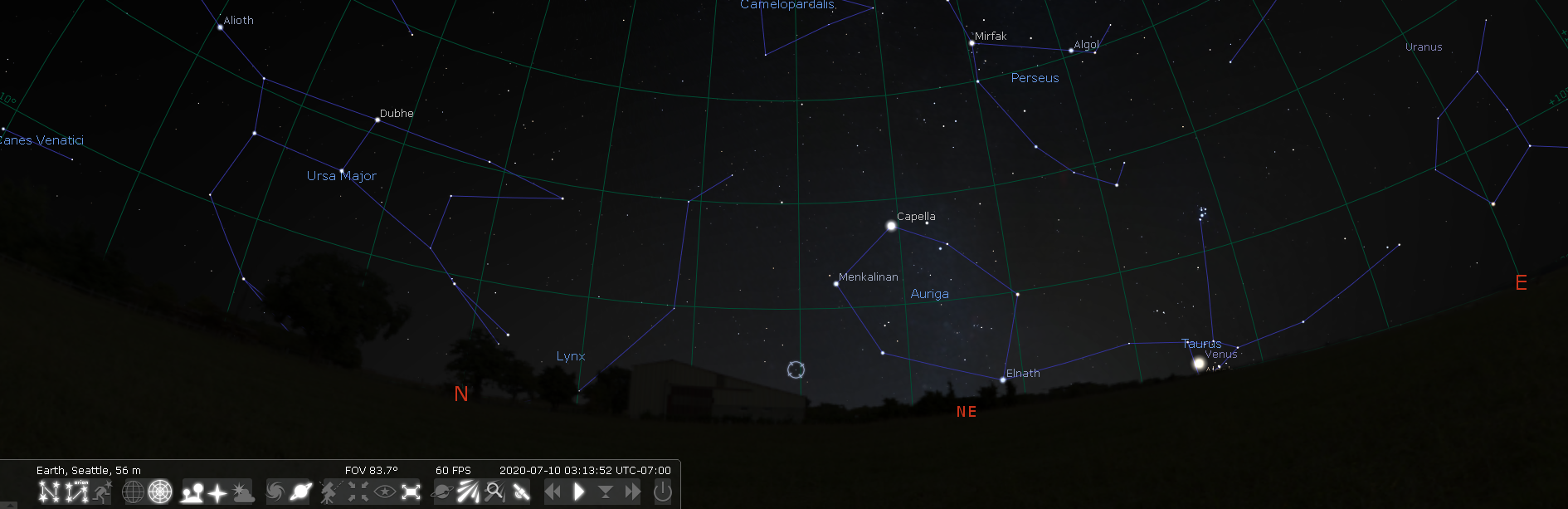
a Seattle horizon view from Stellarium here for July 10th at 3am. It will show a small marker next to the Northeast horizon between the constellations of Auriga to the right/North and Ursa Major (the Big Dipper) to the left/South. The marker is about 1/4 of the from Auriga to Ursa Major, it is much closer to Auriga.

Image from Stellarium

The Northeast horizon is our worst horizon in West Seattle, because that’s directly over Seattle proper. Lots of light pollution. If you want to see this comet, you’ll have to go to the other side of the city. Consider the peninsula or the East side of the Cascades. Wherever you choose, please wear a mask and stay more than 6 feet away from stargazers who aren’t part of your household.

Evening Sky

In a few days, after July 12, it will start to be visible after the Sun sets. You’re welcome to try for it before July 12, but since it sets just an hour after sunset, the odds aren’t good. You’ll be looking north of the Northwest horizon.
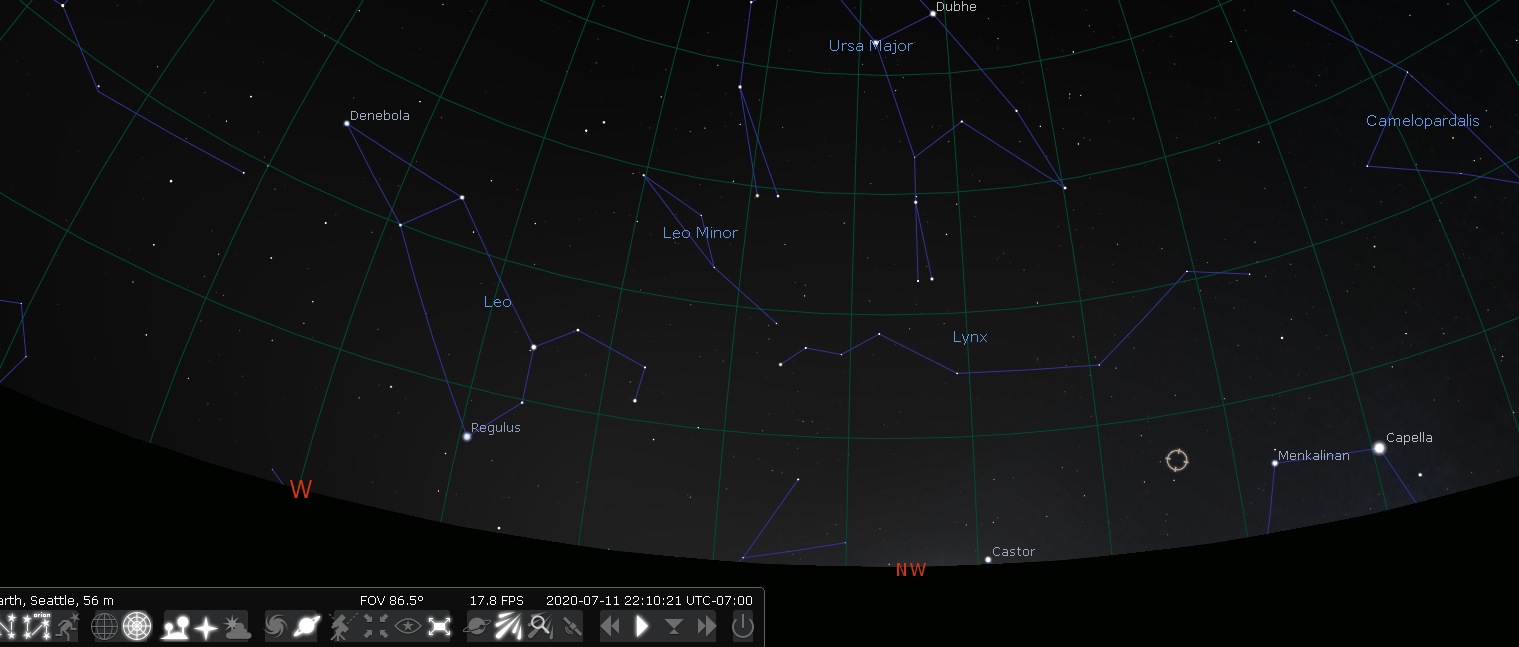
a Seattle horizon view from Stellarium here for July 11 at 10pm. It will show a small marker next to the Northwest horizon between the constellations of Auriga to the right/North, Ursa Major (the Big Dipper) above, and Leo to the left/South. The marker is about an eighth of the from Auriga to Leo, it is much closer to Leo. It is about a quarter of the way from Auriga to Ursa Major, closer to Auriga

Image from Stellarium

This is a much better horizon from West Seattle, you can view it from most place on the West side of West Seattle. I recommend trying for this one starting July 12 or so, and watch the news to see if other Northern Hemisphere folks have sighted it in their evening skies yet. Wherever you choose, please wear a mask and stay more than 6 feet away from stargazers who aren’t part of your household.

Binoculars

STOP! READ THIS!

If you use binoculars to see this, you must promise me you’ll put them down about 20 minutes before sunrise is predicted to happen. Please. This object is too close to the Sun for me to risk your eyes. Similarly, don’t begin looking for it until at least 5 minutes after you see the Sun finally set below the horizon.

This comet is going to be much more spectacular in binoculars or if you take a long-exposure photograph. A number of phones have “night sight” settings in the camera now, that will also bring out a little more detail, but you’ll need to hold the phone still: rest it on a stable surface.

Any old binoculars will work, they don’t need to be specific to astronomy.

Some useful sources:

  • Sky and Telescope has a map of NEOWISE’s positions over the course of July, and some photos by amateur astronomers.
  • Globe at Night has some reference star charts so you know how bright the stars are that you’re able to see.
  • Earth and Sky has tips on comet viewing, and the picture from Alexander Krivenyshev in Guttenberg, New Jersey is the most like what you’ll see.
  • Aerith.net by Seiichi Yoshida is full of detailed information about this comet, along with its most recent brightness.

Keep Looking Up!

-Alice

Comet ISON from Seattle, after Perihelion (November 28)

Latest Updates on Comet ISON
by Alan MacRobert
“Only a dim “ghost of ISON” survived the comet’s November 28th passage around the Sun. The comet’s head dwindled away as it raced through the Sun’s greatest heat, but a headless streak emerged into spacecraft view out from the other side of the encounter. It’s traveling along the comet’s originally prescribed track but fading steadily, with no sign of cometary activity. Very little or nothing is likely to become visible from Earth.”

From: http://www.skyandtelescope.com/community/skyblog/observingblog/193909261.html which is a good, trustworthy general observing resource

Me again:

So as we come out of the blind period today and tomorrow, we are not going to be able to observe Comet ISON from Seattle unless something unexpected and unprecedented happens. Comets are notably unpredictable, but that unpredictability peaks as they pass the Sun, and then they are usually much more normal and not so erratic in their brightness and tail-length after their closest approach.

So, the “Comet of the Century” is relegated to being “the most-anticipated comet of the decade.” Not to worry, we still have two other visible comets in our night sky: Lovejoy and Encke. There’s also Comet LINEAR, but that one is also for experienced viewers.

Advanced viewers can use the finding charts at Waiting For ISON to find Comet ISON with telescopes: http://waitingforison.wordpress.com/november-2013/Text Block 1

~ A l i c e !

Comet ISON from Seattle

Ready to view Comet ISON? Here’s useful rise, set, and estimated magnitude for viewing from Seattle between now and March. I’ve color-coded it according to east of viewing. Magnitude (brightness) will change as we get more observations of ISON and see how it is responding to the Sun.

This is a useful table if you know what visual magnitude is. If you don’t, just go out too look for it on days that are highlighted yellow. Also, check out the “Special circumstances” for great viewing opportunities.

In this, I’m assuming a generic pair of binoculars can see down to about magnitude 10, and have a 5-7 degree field of view. Your binoculars may be different, but if you pull out a random pair that’s in your closet these assumptions probably aren’t that far off.

Local Date Sun Sun C/2012 S1 (ISON) C/2012 S1 (ISON) C/2012 S1 (ISON) How should you see it? Special circumstances
Rise Time Set Time Rise Time Set Time Visual Magnitude
9/4/2013 6:32 19:44 3:16 18:48 11.9 Telescope
9/5/2013 6:34 19:42 3:14 18:45 11.8 Telescope
9/6/2013 6:35 19:40 3:12 18:42 11.8 Telescope
9/7/2013 6:36 19:38 3:10 18:39 11.7 Telescope
9/8/2013 6:38 19:36 3:09 18:36 11.7 Telescope
9/9/2013 6:39 19:34 3:07 18:33 11.6 Telescope
9/10/2013 6:40 19:31 3:06 18:29 11.6 Telescope
9/11/2013 6:42 19:29 3:04 18:26 11.5 Telescope
9/12/2013 6:43 19:27 3:03 18:23 11.5 Telescope
9/13/2013 6:44 19:25 3:01 18:20 11.4 Telescope
9/14/2013 6:46 19:23 3:00 18:17 11.4 Telescope
9/15/2013 6:47 19:21 2:58 18:14 11.3 Telescope
9/16/2013 6:48 19:19 2:57 18:11 11.3 Telescope
9/17/2013 6:50 19:17 2:55 18:08 11.2 Telescope
9/18/2013 6:51 19:15 2:54 18:05 11.2 Telescope
9/19/2013 6:52 19:13 2:53 18:02 11.1 Telescope
9/20/2013 6:54 19:11 2:51 17:59 11 Telescope
9/21/2013 6:55 19:09 2:50 17:56 11 Telescope
9/22/2013 6:56 19:07 2:49 17:53 10.9 Telescope
9/23/2013 6:58 19:05 2:48 17:50 10.9 Telescope About 2 degrees from Mars, about 1 degree from the asteroid Eros (take a photo with your telescope)
9/24/2013 6:59 19:03 2:47 17:48 10.8 Telescope Conjunction: about 2 degrees from Mars, about 1 degree from the asteroid Eros (take a photo with your telescope)
9/25/2013 7:00 19:01 2:46 17:45 10.7 Telescope About 2 degrees from Mars, about 1 degree from the asteroid Eros (take a photo with your telescope)
9/26/2013 7:02 18:59 2:45 17:42 10.7 Telescope
9/27/2013 7:03 18:57 2:44 17:39 10.6 Telescope
9/28/2013 7:05 18:55 2:43 17:36 10.5 Telescope
9/29/2013 7:06 18:53 2:42 17:33 10.5 Telescope
9/30/2013 7:07 18:51 2:41 17:30 10.4 Telescope
10/1/2013 7:09 18:49 2:40 17:27 10.3 Telescope
10/2/2013 7:10 18:47 2:40 17:24 10.3 Telescope
10/3/2013 7:11 18:45 2:39 17:22 10.2 Telescope
10/4/2013 7:13 18:43 2:38 17:19 10.1 Telescope
10/5/2013 7:14 18:41 2:38 17:16 10 Telescope
10/6/2013 7:16 18:39 2:37 17:13 10 Telescope
10/7/2013 7:17 18:37 2:37 17:10 9.9 Good binoculars
10/8/2013 7:18 18:35 2:37 17:08 9.8 Good binoculars
10/9/2013 7:20 18:33 2:37 17:05 9.7 Good binoculars
10/10/2013 7:21 18:31 2:37 17:02 9.6 Good binoculars
10/11/2013 7:23 18:29 2:37 16:59 9.6 Good binoculars
10/12/2013 7:24 18:27 2:37 16:57 9.5 Good binoculars
10/13/2013 7:26 18:25 2:37 16:54 9.4 Good binoculars About 1 degree from Mars, about 2 degrees from Regulus (all three fit within a binocular’s field of view)
10/14/2013 7:27 18:23 2:37 16:51 9.3 Good binoculars About 1 degree from Mars, about 2 degrees from Regulus (all three fit within a binocular’s field of view)
10/15/2013 7:28 18:21 2:38 16:49 9.2 Good binoculars Conjunction: about 1 degree from Mars, about 2 degrees from Regulus (all three fit within a binocular’s field of view)
10/16/2013 7:30 18:19 2:38 16:46 9.1 Good binoculars About 1 degree from Mars, about 2 degrees from Regulus (all three fit within a binocular’s field of view)
10/17/2013 7:31 18:18 2:39 16:44 9 Binoculars About 1 degree from Mars, about 2 degrees from Regulus (all three fit within a binocular’s field of view)
10/18/2013 7:33 18:16 2:40 16:41 8.9 Binoculars
10/19/2013 7:34 18:14 2:41 16:39 8.8 Binoculars
10/20/2013 7:36 18:12 2:42 16:36 8.7 Binoculars
10/21/2013 7:37 18:10 2:43 16:34 8.6 Binoculars
10/22/2013 7:39 18:09 2:44 16:31 8.5 Binoculars
10/23/2013 7:40 18:07 2:46 16:29 8.4 Binoculars
10/24/2013 7:42 18:05 2:48 16:27 8.3 Binoculars About 2 degrees from M95, M96, about 3 degrees from M105 (Beautiful photo opportunity, all four fit in a binocular’s field of view)
10/25/2013 7:43 18:03 2:50 16:24 8.2 Binoculars About 2 degrees from M95, M96, about 3 degrees from M105 (Beautiful photo opportunity, all four fit in a binocular’s field of view)
10/26/2013 7:45 18:02 2:52 16:22 8.1 Binoculars
10/27/2013 6:46 17:00 1:55 15:20 7.9 Binoculars Earliest morning rise time
10/28/2013 6:48 16:58 1:58 15:18 7.8 Binoculars
10/29/2013 6:49 16:57 2:01 15:16 7.7 Binoculars
10/30/2013 6:51 16:55 2:04 15:14 7.6 Binoculars
10/31/2013 6:52 16:54 2:08 15:12 7.4 Binoculars
11/1/2013 6:54 16:52 2:12 15:10 7.3 Binoculars
11/2/2013 6:55 16:50 2:16 15:09 7.2 Binoculars
11/3/2013 6:57 16:49 2:21 15:07 7 Binoculars
11/4/2013 6:58 16:47 2:26 15:06 6.9 Binoculars
11/5/2013 7:00 16:46 2:32 15:04 6.7 Binoculars
11/6/2013 7:01 16:45 2:38 15:03 6.6 Binoculars
11/7/2013 7:03 16:43 2:44 15:02 6.4 Binoculars About 4 degrees from asteroid Vesta (both fit in binocular field of view)
11/8/2013 7:04 16:42 2:51 15:01 6.2 Binoculars
11/9/2013 7:06 16:41 2:59 15:00 6.1 Binoculars
11/10/2013 7:07 16:39 3:07 14:59 5.9 Eyes in dark skies
11/11/2013 7:09 16:38 3:16 14:59 5.7 Eyes in dark skies
11/12/2013 7:10 16:37 3:26 14:59 5.5 Eyes in dark skies
11/13/2013 7:12 16:36 3:36 14:59 5.3 Eyes in dark skies
11/14/2013 7:13 16:34 3:47 14:59 5.1 Eyes in dark skies
11/15/2013 7:15 16:33 3:59 14:59 4.9 Eyes in Seattle
11/16/2013 7:16 16:32 4:12 15:00 4.7 Eyes in Seattle
11/17/2013 7:18 16:31 4:25 15:01 4.5 Eyes in Seattle About 1 degree from Spica — makes it easy to find ISON
11/18/2013 7:19 16:30 4:39 15:03 4.2 Eyes in Seattle About 1 degree from Spica — makes it easy to find ISON
11/19/2013 7:20 16:29 4:54 15:05 3.9 Eyes in Seattle
11/20/2013 7:22 16:28 5:10 15:08 3.6 Eyes in Seattle
11/21/2013 7:23 16:27 5:26 15:11 3.3 Eyes in Seattle
11/22/2013 7:25 16:26 5:43 15:15 2.9 Eyes in Seattle
11/23/2013 7:26 16:26 6:01 15:19 2.5 Eyes in Seattle
11/24/2013 7:27 16:25 6:19 15:25 2 Eyes in Seattle About 2 degrees from Comet Encke (estimated magnitude 5, at the edge of visibility in Seattle with just your eyes) — Great photo opportunity
11/25/2013 7:29 16:24 6:37 15:31 1.3 Eyes in Seattle
11/26/2013 7:30 16:23 6:56 15:40 0.2 Only up during daylight
11/27/2013 7:32 16:23 7:16 15:53 -1.8 Only up during daylight
11/28/2013 7:33 16:22 7:38 16:33 -4.8 Only up during daylight Perihelion (closest approach to the Sun)
11/29/2013 7:34 16:22 7:14 16:45 -0.7 Only up during daylight
11/30/2013 7:35 16:21 6:56 16:50 0.7 Only up during daylight
12/1/2013 7:37 16:21 6:40 16:54 1.5 Eyes in Seattle
12/2/2013 7:38 16:20 6:25 16:57 2 Eyes in Seattle Begins to be visible briefly after sunset/twilight as well as in the morning
12/3/2013 7:39 16:20 6:12 17:01 2.5 Eyes in Seattle
12/4/2013 7:40 16:20 5:58 17:04 2.8 Eyes in Seattle
12/5/2013 7:41 16:19 5:45 17:07 3.1 Eyes in Seattle
12/6/2013 7:42 16:19 5:33 17:11 3.3 Eyes in Seattle
12/7/2013 7:43 16:19 5:20 17:15 3.5 Eyes in Seattle
12/8/2013 7:44 16:19 5:07 17:19 3.7 Eyes in Seattle
12/9/2013 7:45 16:19 4:54 17:24 3.8 Eyes in Seattle
12/10/2013 7:46 16:19 4:41 17:29 4 Eyes in Seattle Visible in the evening as well as the morning
12/11/2013 7:47 16:19 4:28 17:35 4.1 Eyes in Seattle
12/12/2013 7:48 16:19 4:14 17:41 4.2 Eyes in Seattle
12/13/2013 7:49 16:19 3:59 17:48 4.3 Eyes in Seattle
12/14/2013 7:50 16:19 3:44 17:57 4.3 Eyes in Seattle
12/15/2013 7:51 16:19 3:28 18:06 4.4 Eyes in Seattle
12/16/2013 7:51 16:19 3:11 18:18 4.5 Eyes in Seattle
12/17/2013 7:52 16:20 2:53 18:31 4.6 Eyes in Seattle
12/18/2013 7:53 16:20 2:33 18:46 4.6 Eyes in Seattle
12/19/2013 7:53 16:20 2:10 19:05 4.7 Eyes in Seattle
12/20/2013 7:54 16:21 1:45 19:28 4.8 Eyes in Seattle
12/21/2013 7:54 16:21 1:15 19:59 4.8 Eyes in Seattle
12/22/2013 7:55 16:22 0:37 20:48 4.9 Eyes in Seattle About 5 degrees from M31 (photo opportunity)
12/23/2013 7:55 16:22 NoRis NoSet 5 Eyes in Seattle Becomes circumpolar (visible all night, also up all day though not visible then)
12/24/2013 7:56 16:23 CirPl CirPl 5 Eyes in Seattle
12/25/2013 7:56 16:24 CirPl CirPl 5.1 Eyes in dark skies
12/26/2013 7:56 16:24 CirPl CirPl 5.2 Eyes in dark skies
12/27/2013 7:57 16:25 CirPl CirPl 5.3 Eyes in dark skies
12/28/2013 7:57 16:26 CirPl CirPl 5.4 Eyes in dark skies
12/29/2013 7:57 16:27 CirPl CirPl 5.5 Eyes in dark skies
12/30/2013 7:57 16:28 CirPl CirPl 5.6 Eyes in dark skies
12/31/2013 7:57 16:29 CirPl CirPl 5.7 Eyes in dark skies
1/1/2014 7:57 16:30 CirPl CirPl 5.8 Eyes in dark skies
1/2/2014 7:57 16:31 CirPl CirPl 5.9 Eyes in dark skies
1/3/2014 7:57 16:32 CirPl CirPl 6 Eyes in dark skies
1/4/2014 7:57 16:33 CirPl CirPl 6.1 Binoculars
1/5/2014 7:57 16:34 CirPl CirPl 6.3 Binoculars
1/6/2014 7:56 16:35 CirPl CirPl 6.4 Binoculars About 3 degrees from Polaris (both fit in binocular field of view)
1/7/2014 7:56 16:36 CirPl CirPl 6.5 Binoculars
1/8/2014 7:56 16:37 CirPl CirPl 6.6 Binoculars
1/9/2014 7:55 16:38 CirPl CirPl 6.8 Binoculars
1/10/2014 7:55 16:40 CirPl CirPl 6.9 Binoculars
1/11/2014 7:55 16:41 CirPl CirPl 7 Binoculars
1/12/2014 7:54 16:42 CirPl CirPl 7.1 Binoculars
1/13/2014 7:54 16:44 CirPl CirPl 7.2 Binoculars
1/14/2014 7:53 16:45 CirPl CirPl 7.4 Binoculars
1/15/2014 7:52 16:46 CirPl CirPl 7.5 Binoculars
1/16/2014 7:52 16:48 CirPl CirPl 7.6 Binoculars
1/17/2014 7:51 16:49 CirPl CirPl 7.7 Binoculars
1/18/2014 7:50 16:50 CirPl CirPl 7.8 Binoculars
1/19/2014 7:49 16:52 CirPl CirPl 8 Binoculars
1/20/2014 7:48 16:53 CirPl CirPl 8.1 Binoculars
1/21/2014 7:48 16:55 CirPl CirPl 8.2 Binoculars
1/22/2014 7:47 16:56 CirPl CirPl 8.3 Binoculars
1/23/2014 7:46 16:58 CirPl CirPl 8.4 Binoculars
1/24/2014 7:45 16:59 CirPl CirPl 8.5 Binoculars
1/25/2014 7:44 17:01 CirPl CirPl 8.6 Binoculars
1/26/2014 7:43 17:02 CirPl CirPl 8.7 Binoculars
1/27/2014 7:41 17:04 CirPl CirPl 8.8 Binoculars
1/28/2014 7:40 17:05 CirPl CirPl 8.9 Binoculars
1/29/2014 7:39 17:07 CirPl CirPl 9 Good binoculars
1/30/2014 7:38 17:08 CirPl CirPl 9.1 Good binoculars
1/31/2014 7:37 17:10 CirPl CirPl 9.2 Good binoculars
2/1/2014 7:35 17:12 CirPl CirPl 9.2 Good binoculars
2/2/2014 7:34 17:13 CirPl CirPl 9.3 Good binoculars
2/3/2014 7:33 17:15 CirPl CirPl 9.4 Good binoculars
2/4/2014 7:31 17:16 CirPl CirPl 9.5 Good binoculars
2/5/2014 7:30 17:18 CirPl CirPl 9.6 Good binoculars
2/6/2014 7:28 17:19 CirPl CirPl 9.7 Good binoculars
2/7/2014 7:27 17:21 CirPl CirPl 9.8 Good binoculars
2/8/2014 7:26 17:23 CirPl CirPl 9.8 Good binoculars
2/9/2014 7:24 17:24 CirPl CirPl 9.9 Good binoculars
2/10/2014 7:22 17:26 CirPl CirPl 10 Good binoculars
2/11/2014 7:21 17:27 CirPl CirPl 10.1 Telescope
2/12/2014 7:19 17:29 CirPl CirPl 10.1 Telescope
2/13/2014 7:18 17:30 CirPl CirPl 10.2 Telescope
2/14/2014 7:16 17:32 CirPl CirPl 10.3 Telescope
2/15/2014 7:14 17:34 CirPl CirPl 10.3 Telescope
2/16/2014 7:13 17:35 CirPl CirPl 10.4 Telescope
2/17/2014 7:11 17:37 CirPl CirPl 10.5 Telescope
2/18/2014 7:09 17:38 CirPl CirPl 10.6 Telescope
2/19/2014 7:08 17:40 CirPl CirPl 10.6 Telescope
2/20/2014 7:06 17:41 CirPl CirPl 10.7 Telescope
2/21/2014 7:04 17:43 CirPl CirPl 10.8 Telescope
2/22/2014 7:02 17:44 CirPl CirPl 10.8 Telescope
2/23/2014 7:00 17:46 CirPl CirPl 10.9 Telescope
2/24/2014 6:59 17:47 CirPl CirPl 10.9 Telescope
2/25/2014 6:57 17:49 CirPl CirPl 11 Telescope
2/26/2014 6:55 17:50 CirPl CirPl 11.1 Telescope
2/27/2014 6:53 17:52 CirPl CirPl 11.1 Telescope
2/28/2014 6:51 17:54 CirPl CirPl 11.2 Telescope
3/1/2014 6:49 17:55 CirPl CirPl 11.3 Telescope
3/2/2014 7:47 18:57 CirPl CirPl 11.3 Telescope
3/3/2014 7:46 18:58 CirPl CirPl 11.4 Telescope
3/4/2014 7:44 19:00 CirPl CirPl 11.4 Telescope
3/5/2014 7:42 19:01 CirPl CirPl 11.5 Telescope
3/6/2014 7:40 19:02 CirPl CirPl 11.5 Telescope
3/7/2014 7:38 19:04 CirPl CirPl 11.6 Telescope
3/8/2014 7:36 19:05 CirPl CirPl 11.7 Telescope
3/9/2014 7:34 19:07 CirPl CirPl 11.7 Telescope
3/10/2014 7:32 19:08 CirPl CirPl 11.8 Telescope
3/11/2014 7:30 19:10 CirPl CirPl 11.8 Telescope
3/12/2014 7:28 19:11 CirPl CirPl 11.9 Telescope
3/13/2014 7:26 19:13 CirPl CirPl 11.9 Telescope
3/14/2014 7:24 19:14 CirPl CirPl 12 Telescope
3/15/2014 7:22 19:16 CirPl CirPl 12 Telescope
3/16/2014 7:20 19:17 CirPl CirPl 12.1 Telescope
3/17/2014 7:18 19:19 CirPl CirPl 12.1 Telescope
3/18/2014 7:16 19:20 CirPl CirPl 12.2 Telescope
3/19/2014 7:14 19:21 CirPl CirPl 12.2 Telescope
3/20/2014 7:12 19:23 CirPl CirPl 12.2 Telescope
3/21/2014 7:10 19:24 CirPl CirPl 12.3 Telescope

Yay!

This chart was created for viewing in Seattle by Jason Enevoldsen using XEphem and ephemeris data from NASA JPL.

~ A l i c e !

Where is Comet PanSTARRS? (Estimating the Sky in Degrees)

**This is an old post I thought you’d like.**

Okay. So. You’re trying to find the comet. This is a basic primer on how to estimate where things are in the sky without stars to help you.

Estimating Degrees on the Sky

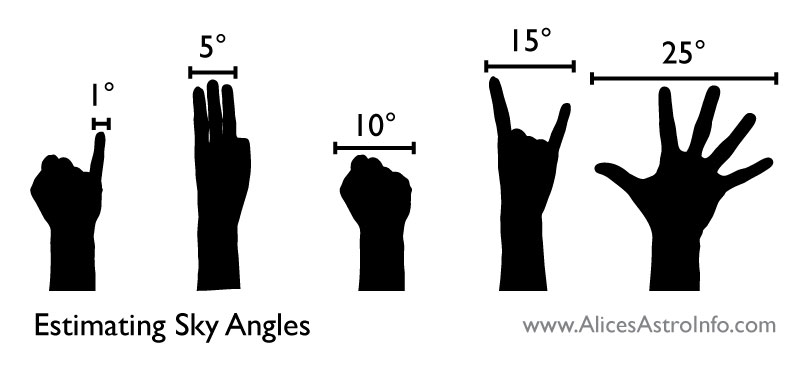
Use Your Hands

Hold your hand at arms' length. This works for any size hands, but only if you completely extend your arm.

Hold your hand at arms’ length. This works for any size hands assuming you are close to average human proportions, but only if you completely extend your arm.

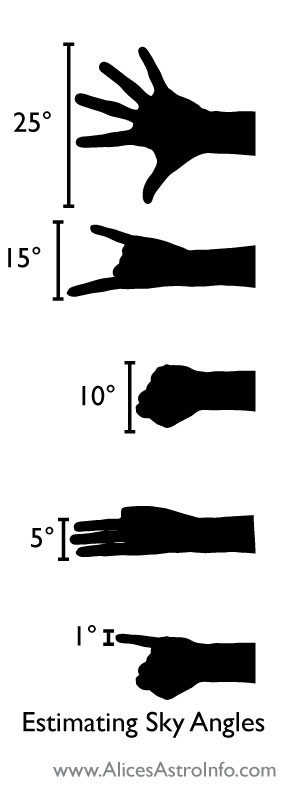
Actually, this graphic pretty much says it all.

Your fist at arms’ length is about ten degrees wide. Your pinkie finger is one or one and a half.

Know Where You Are and What You Can See

The rest of this article is specific to finding the comet from near Seattle. If you’d like to find it in another location, you’ll need to know exactly where due West is, and the altitude (height) and aziumuth (direction, 270 degrees is due West, and north of West is larger numbers) of the comet for the specific day and time of observation. Try Sky & Telescope for observing data.

Believe it or not, we’ve had good luck seeing this cute little comet from Seattle, between the clouds. You’ll need binoculars.

From the point of Lincoln Park you can easily see Blake Island. It’s the dark one north of Vashon. The South end of Blake Island is at 269°–almost due West (270°). The North end of Blake Island is 15° (the distance of your pointer to your pinkie) towards North, at 284°.

From Alki Point (the one with the lighthouse, not the one with the Statue of Liberty) due West (again, 270°) is the South end of Bainbridge Island.

From the far south side of West Seattle: Arbor Heights, 270° is the North end of Vashon Island.

You can figure this out for yourself pretty quick with a Puget Sound map of your choice. Pinpoint your viewing location and what visible marker on a nearby island or the peninsula is exactly West from you?

Height

Don’t forget, you can uses these to estimate vertical degrees too.

To determine how many degrees up into the sky something is, you’re measuring from the perfectly flat horizon. Using the far edge of the water of Puget Sound is a great estimate for this.

Finding the Comet (from Seattle)

Comet becomes visible in binoculars about half an hour after sunset. Forty-five minutes after sunset you might see it with just your eyes.

Monday, March 18, 2013 — Sunset: 7:20pm

  • 7:50pm at 280° (one fist North of  due West)

13° up (A little less than your pinkie-to-index finger distance).

  • 8:25pm at 286° (your pinkie-to-index finger distance North of due West)

7.5° up (between the height of your fist and the height of three fingers)

  • 9:00pm at 292° (not quite your full-spread hand North of due West)

2° up (a bit more than your pinkie-width)

Tuesday, March 19, 2013 — Sunset: 7:22pm

  • 7:52pm at 282° (between a fist and your pinkie-to-index finger distance North of  due West)

13.5° up (A little less than your pinkie-to-index finger distance).

  • 8:29pm at 288° (your pinkie-to-index finger distance North of due West)

7.5° up (between the height of your fist and the height of three fingers)

  • 9:06pm at 295° (Your full-spread hand North of due West)

2° up (a bit more than your pinkie-width)

Wednesday, March 20, 2013 — Sunset: 7:23pm (Come to the Sunset Watch!)

  • 7:53pm at 284.5° (between a fist and your pinkie-to-index finger distance North of  due West)

14° up (A little less than your pinkie-to-index finger distance).

  • 8:32pm at 291° (Almost your full-spread hand North of due West)

8° up (between the height of your fist and the height of three fingers)

  • 9:11pm at 298° (Your full-spread hand plus three fingers North of due West)

2° up (a bit more than your pinkie-width)

Thursday, March 21, 2013 — Sunset: 7:25pm

  • 7:55pm at 286.5° (Your pinkie-to-index finger distance North of  due West)

14.5° up (Your pinkie-to-index finger distance).

  • 8:36pm at 294° (Your full-spread hand North of due West)

8° up (between the height of your fist and the height of three fingers)

  • 9:17pm at 301° (Your full-spread hand plus three fingers North of due West)

2° up (a bit more than your pinkie-width)

Friday, March 22, 2013 — Sunset: 7:26pm

  • 7:56pm at 289° (Between your pinkie-to-index finger and your full-spread hand distance North of  due West)

15° up (Your pinkie-to-index finger distance).

  • 8:39pm at 296° (Your full-spread hand North of due West)

8° up (between the height of your fist and the height of three fingers)

  • 9:22pm at 304° (Your full-spread hand plus your fist North of due West)

2° up (a bit more than your pinkie-width)

Saturday, March 23, 2013 — Sunset: 7:28pm

  • 7:58pm at 291° (Between your pinkie-to-index finger and your full-spread hand distance North of  due West)

15° up (Your pinkie-to-index finger distance).

  • 8:43pm at 299° (Your full-spread hand plus your fist North of due West)

8° up (between the height of your fist and the height of three fingers)

  • 9:27pm at 306.5° (Your full-spread hand plus your pinkie-to-index finger distance North of due West)

2° up (a bit more than your pinkie-width)

Sunday, March 24, 2013 — Sunset: 7:29pm

  • 7:59pm at 293° (Your full-spread hand distance North of  due West)

15.5° up (Your pinkie-to-index finger distance).

  • 8:46pm at 301° (Your full-spread hand plus your fist North of due West)

8.5° up (between the height of your fist and the height of three fingers)

  • 9:33pm at 309.5° (Your full-spread hand plus your pinkie-to-index finger distance North of due West)

2° up (a bit more than your pinkie-width)

Basics

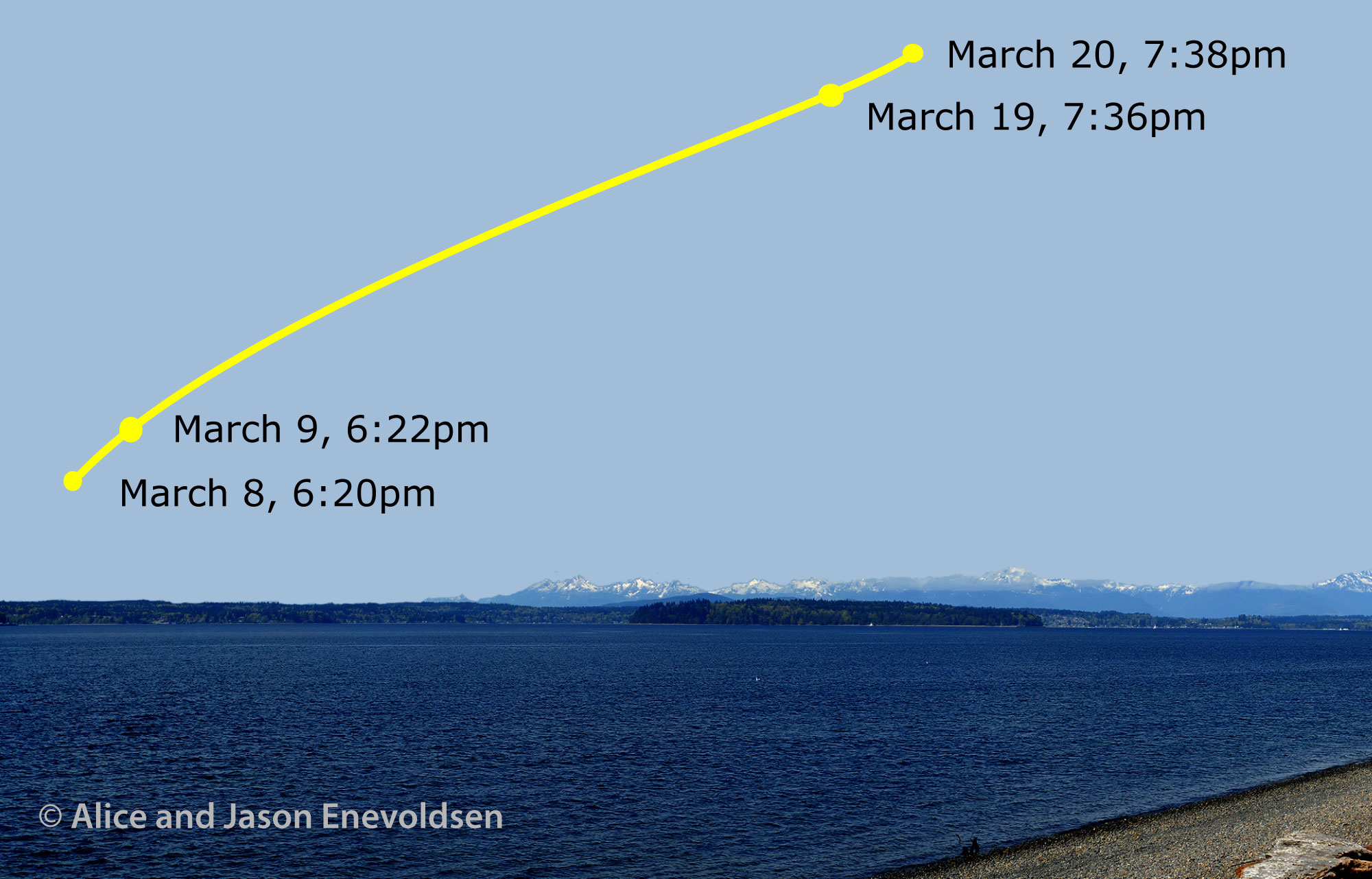
I made this graphic for West Seattle Blog. It’ll help you in a general sense, but not on a daily basis.

PanStarrs-West-Seattle-Finder-Chart---2000

Want More?

One Minute Astronomer also has a good general write-up about estimating the sky. It is more detailed than mine, more general than mine, and outlines the basics that most amateur astronomers use every night.

I also want to give credit where credit is due. I used hand images, with permission, from all-silhouettes.com. I modified them significantly to suit my purpose. Stanislav makes cool images, but the website is full of links to spam and malware.

~ A l i c e !

Photo of Comet PanSTARRS from West Seattle: Through the Clouds

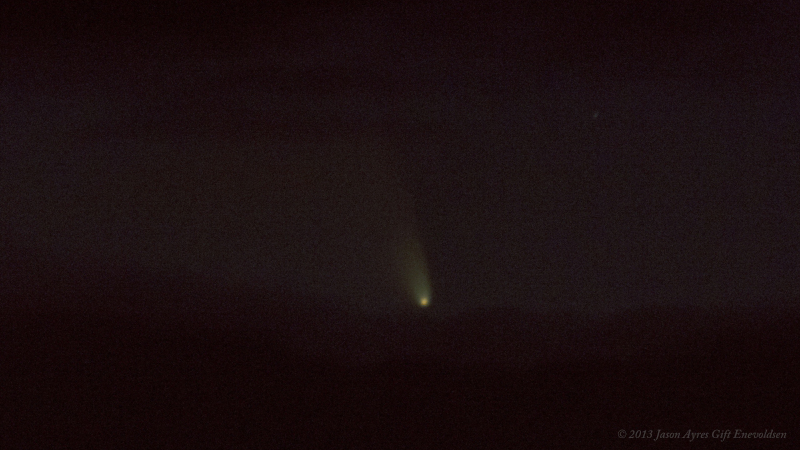
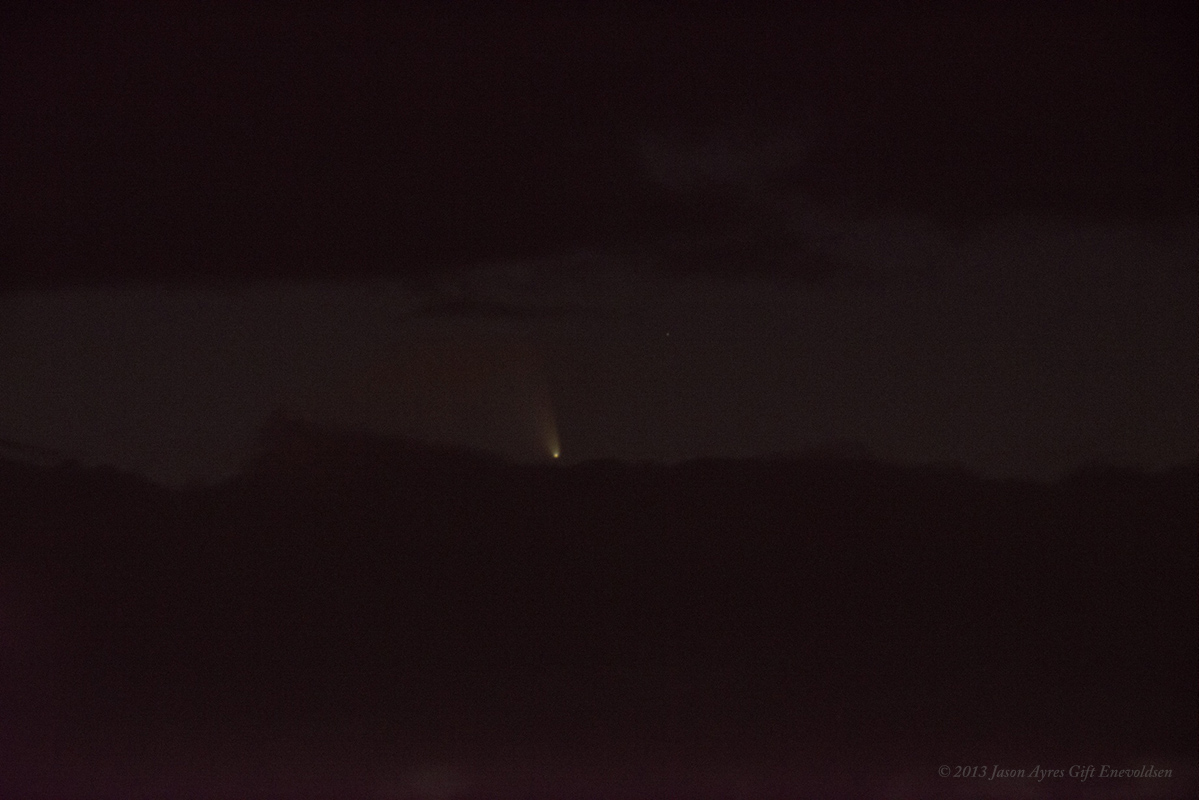
I will add more later, but here is the first photo my husband got of Comet PanSTARRS from Lincoln Park here in West Seattle. It was visible between the clouds for about three minutes.


Update, new image!

panstarrs-3-800x450-w

Comet PanSTARRS from West Seattle at 8:32pm on Friday 3/15/2013 (c) my husband Jason Ayres Gift Enevoldsen. E-mail him at jason dot enevoldsen at gmail dot com for reuse permission. Click for bigger. (This is the second, updated image. Below is the first)


This is the original image I posted this evening:

Comet PanSTARRS from West Seattle at 8:32pm on Friday 3/15/2013 (c) my husband Jason Ayres Gift Enevoldsen. E-mail him at jason dot enevoldsen at gmail dot com for reuse permission.

Comet PanSTARRS from West Seattle at 8:32pm on Friday 3/15/2013 (c) my husband Jason Ayres Gift Enevoldsen. E-mail him at jason dot enevoldsen at gmail dot com for reuse permission. Click for bigger

~ A l i c e !

Too Many Meteors? Nah.

Sure seems like we’ve had more than our fair share of bollides this weekend (Russia, Cuba, and San Francisco to name a few). Guess what? I THOUGHT SO TOO. But I was also skeptical. So I asked the scientists I trust* and scientists who specialize in this. They said that we ARE NOT experiencing an apocalypse or really even an increase.

1. Please go read my blogfather, Phil Plait’s, article about this.

The rest of my article is mostly in addition to what he’s already said.

The Frequency Illusion

In popular parlance this is also called the Baader-Meinhof Phenomenon, but the sources on that name are a bit questionable, so I’ll call it the Frequency Illusion.

You know how when you learn a new word, like “brobdingnagian,” suddenly you begin to see that word everywhere? (Perhaps brobdingnagian is a poor choice, it’s just the newest word I’ve learned.) How about The Great Gatsby? I haven’t thought about The Great Gatsby in years and suddenly there’s a new DiCaprio movie coming out and it was jut mentioned in the novel I’m reading. For my husband this week it’s the word “Trypophobia.”

Anyway, that’s the Frequency Illusion. Your mind is keyed into something, and you notice it everywhere. We’ve been hyperaware of asteroids and meteors this weekend, so more people are noticing and reporting the ones that normally occur. The media too is taking special note which is helping us notice these seemingly-extra occurrences.

Coincidence?!

Yes.

The asteroid 2012 DA14 and the spectacular and devastating bollide over Russia are a coincidence. Literally a cosmic coincidence. They are unrelated.

The bollides since then have been a normal part of our everyday lives here on Earth, you just haven’t been noticing them regularly.

Bollides are Normal?

“Alice, I don’t believe you. Are you saying the bollide over Russia was normal? I don’t think hundreds of people are normally injured in sonic booms from meteors in our atmosphere.”

You’re right about that. Fireballs/Bollides/Meteors as large and powerful as the one over Chelyabinsk tend to happen once every 100-ish years. That doesn’t mean there won’t be one tomorrow, or in 50 years. On average they happen once every 100 years.

Fireballs tend to happen for objects about the size of a basketball, and those hit the Earth about once a day. Again, you can easily have two or ten in one day, as well as several days without one, but on average they happen once a day. This is what the meteors over Cuba and San Francisco were: normal daily bollides.

P.S.

Fund the search for near earth objects.

Vocabulary

I see how you might be confused. I’ve used several words interchangeably, and those that I haven’t are minutely different than each other.

  • Comet — an ice and rock body in space.
  • Asteroid — a smallish rocky body in space. Smaller than a planet or a Moon, larger than a house usually.
  • Meteoroid — a tiny rocky object in space, usually sand-sized but up to the size of a house.
  • Meteor — when a meteoroid impacts the Earth’s atmosphere it incinerates. We see them and know them as shooting stars.
  • Meteorite — when a piece of a meteor survives the Earth’s atmosphere and impacts the Earth’s surface.
  • Bollide — an especially bright or exploding meteor. (This is the astronomy definition, the geology definition is different, but doesn’t apply here)
  • Fireball — an especially bright or exploding meteor. (Mm-hmm, pretty much the same as a bollide.)

Want More?

I got my statistics from Yeoman’s Top  Ten on NASA JPL’s Asteroid Watch.

Of course, Phil’s “The Sky is Falling… or is it?” article is also great.

Vocabulary reference from NASA’s Near Earth Object program.

~ A l i c e !

*”Hey Alice, Phil just posted something a day or two ago that he later admitted was wrong. Why do you trust him?” That’s why. Scientists admit when they’re wrong and change their views as the evidence changes. This is harder to do than you might think, so keep practicing. I keep practicing too.

Comet PanSTARRS

It’s been a while since we had a good comet. Long enough that children in North America probably haven’t seen one, and you might have forgotten just how amazing they can be.

Comets Are Awesome

Comet Huyakutake spanned 100 degrees in the sky.

Comet Huyakutake spanned 100 degrees in the sky.

I know you don’t believe me, but comets can be spectacular objects to view without any magnification at all. No binoculars, no telescope, no squinting. This one might take a little magnification though, we’ll see. Comets are also unpredictable.

In 1996 Comet Huyakutake‘s tail spanned 100 degrees across the sky. Hold your arms at right angles to each other, then lift them up over your head, still at right angles. That’s 90 degrees. Look from one hand to the other- the tail was longer than the distance between your two hands (approximately). Now, Comet PanSTARRS (C/2011 L4) will probably not be like Huyakutake. All the evidence recently points to it being a bit of a dud, but it could still surprise us.

Comet Hale-Bopp (in 1997), which you likely remember had two tails, and under the best conditions that tail was about 10 degrees long. Hold your fist at arm’s length, and from knuckle to knuckle is about 10 degrees. The Moon is half a degree.

As of February 9th, PanSTARRS had a 2 degree gas and ion tail, visible in long-exposure photography from the Southern Hemisphere.

Can I See PanSTARRS?

This is what you all want to know, right? According to Sky and Telescope it is on track to being visible here in the northern hemisphere.

  • When? March 12-24, 2013 is your best bet from the Northern Hemisphere (West Seattlites, this is you!). Look just after sunset. Lucky for us, West Seattle has a GREAT western horizon for stargazing. I’ll meet you at Lincoln Park, okay?
  • Where? In the west, low on the horizon. Since it is just after sunset you won’t see many stars, but it is in the constellation Pisces in early March, and Andromeda in later March. Astronomy has a good finder chart.
  • How? As of now, you’ll need binoculars. If it brightens up considerably you might not, but plan on bringing binoculars.
  • What? Comet PanSTARRS currently has a 2 degree tail (two pinkie-finger widths), and should max out at a little brighter than the dimmer stars visible from the city of Seattle. With good viewing, the tail will be longer than the full Moon. If you can see the tail, observe how it is directed away from where the Sun just set.
  • Is it close? We’re all about the close approaches right now. Comet PanSTARRS “will pass about 100 million miles from Earth as it briefly dips inside the orbit of Mercury.” according to NASA. That’s about the same as the distance from the Earth to the Sun. Not so close.

What Will It Look Like?

I found this image, and I like the context. This is more that you would see with your eyes. This is PanSTARRS on February 11 by Luis Argerich in Argentina (and a satellite on the right).

Comet PanSTARRS is the smear on the left. The dotted line on the right is an Iridium satellite.

Comet PanSTARRS is the double-tailed smear on the left. The dotted line on the right is an Iridium satellite in this 10-second exposure.


Want More?

Sky and Telescope–great updated viewing information.

Weekly Info on Bright Comets

NASA’s story

~ A l i c e !

Summer Solstice Sunset – 2010

  • When: Monday, June 21, 2010 at 9:11pm (so come at 8:30pm)
  • Where: Solstice Park (or, if you’re not in Seattle, wherever you have a view of the western horizon!)
  • Who: Everyone welcome, as usual.

Sunset on June 11, 2009 Credit: Jason Gift Enevoldsen

Come watch the summer solstice sunset at Solstice Park in West Seattle on Monday. We’ll see if the sunset lines up with the placed marker. I’ll be there even if it is cloudy because sometimes the Sun peeks through just as it begins to set, but if it is driving rain I’m staying home with a cup of tea.

If it is clear we’ll bring a telescope or two to take a look at the Moon after the Sun goes down – and Mars and Saturn if we stay until it is dark enough. We will not be able to see the comet – that rises a little before 3am, and I plan to get some sleep before Tuesday. You’re welcome to look for the comet on your own though!

If you’re interested – here’s the timing of various celestial events on Saturday from Seattle, courtesy of the U.S. Naval Observatory Astronomical Applications Department:

Sun and Moon Data for One Day

The following information is provided for Seattle, King County, Washington (longitude W122.3, latitude N47.6):

Monday   21 June 2010          Pacific Daylight Time

SUN
Begin civil twilight       4:31 a.m.
Sunrise                    5:11 a.m.
Sun transit                1:11 p.m.
Sunset                     9:11 p.m.
End civil twilight         9:52 p.m.

MOON
Moonrise                   3:29 p.m. on preceding day
Moonset                    1:36 a.m.
Moonrise                   4:45 p.m.
Moon transit               9:29 p.m.
Moonset                    2:05 a.m. on following day

This event is my part of the NASA’s Solar System Ambassadors program, and thanks to West Seattle Blog for publicizing the last few!

Everyone is welcome, see you there!

~ A l i c e !

Comet McNaught

I just got this in my e-mail. I can’t tell if this is a new “Comet McNaught” or a new approach by the same one we saw a couple years ago. This is a different comet than the “Comet McNaught” discovered a few years ago, but it was discovered by the same person! In any case – enjoy!

Space Weather News for June 8, 2010
http://spaceweather.com

NEW COMET McNAUGHT: A fresh comet is swinging through the inner solar system, and it is brightening rapidly as it approaches Earth for a 100 million mile close encounter in mid-June. Comet McNaught (C/2009 R1) has a vivid green head and a long wispy tail that look great through small telescopes. By the end of the month it could be visible to the naked eye perhaps as bright as the stars of the Big Dipper. Because this is the comet’s first visit to the inner solar system, predictions of future brightness are necessarily uncertain; amateur astronomers should be alert for the unexpected. Visit http://spaceweather.com for sky maps, photos and more information.

You are subscribed to the Space Weather mailing list, a free service of Spaceweather.com.

New subscribers may sign up for free space weather alerts at http://spaceweather.com/services/ .

~ A l i c e !

Comet Lulin

Short for now – more to be added later.

I saw Comet Lulin last night – FROM SEATTLE – through a break in the clouds. I observed for about 30-45 minutes, and did some hand-observations:

Comet Lulin Observations

Comet Lulin Observations - Click to see animation!

Here are some links if you want to learn more or see it yourself:

Video of it moving across the sky:
http://www.astrophotoinsight.com/node/1625

The most detailed picture I’ve seen so far:
http://bf-astro.com/cometLulin.htm

And the prettiest picture I’ve seen so far:
http://www.astropix.com/HTML/SHOW_DIG/094.HTM

A good article from this year with some background on its discovery 2
years ago:
http://www.universetoday.com/2009/01/14/comet-lulin-is-on-the-way/

A more recent article that mentions the new discovery about the
structure of the tail:
http://www.universetoday.com/2009/02/01/comet-c2007-n3-lulin-a-twist-in-the-tail/

Observation reports and charts:
http://www.skyandtelescope.com/observing/highlights/35992534.html