Dark Energy

Our universe is not only expanding – but that expansion is accelerating. It’s expanding faster and faster and faster. When you’re driving your car you don’t speed up for no reason – either you step on the gas, you’re rolling down a hill, you get slammed from behind, or your engine suddenly and unexpectedly starts feeding gas to the engine (I hope not!). The universe’s expansion can’t speed up for no reason either. That energy MUST come from somewhere – but we don’t know where, so we’re calling this extra energy “Dark Energy.”

Law of the Universe:

You cannot create energy from nothing. Just like you wouldn’t expect to see a kitten materialize out of nothingness and appear on your keyboard (it might jump there, but not materialize!), you can’t get energy out of nothing. It all comes from somewhere. This is called the law of conservation of energy. Sometimes it’s called the first law of thermodynamics.

The Universe is Accelerating:

From our measurements of Type 1a supernovae we know that the universe is expanding and that expansion is accelerating. Basically, those supernovae are farther away than our physics models predict them to be, and there’s not enough energy in the Universe to do that.

Cosmological Constant:

Einstein proposed a “cosmological constant” to solve a similar problem many years ago. Then he changed his mind and gave it up. With our new observations, it’s back in play now. Under this hypothesis, a specific volume of space (the cosmos) always (constantly) has a given amount of energy in it. Say you had one cubic meter of space. Under this theory, it would have … let’s say an amount “5” of energy. Then, over time the universe expands and now, your one cubic meter of space now takes up two cubic meters. Because of the cosmological constant, that space would have an amount “10” of energy. By definition. Just because it is space. (Usually we do this with variables in astronomy, but I wanted to be clear). Pretty weird, but you get lots of extra energy.

Quintessence:

What if Dark Energy is not constant? What if it changes over space and time? You’ve got a little more here, a little less there. There was more last year than there will be in a billion years. That’s the quintessence hypothesis. Maybe it’s particles (like photons and electrons), or maybe it’s a field (like the magnetic field of the Earth), but in any case it changes, it’s not constant.

New Physics:

And, not to be forgotten, what if our equations for Physics are just wrong? What if we need to completely rethink them? In any case, the universe is accelerating in its expansion, so until we know what is making it do that, we’re just going to call it Dark Energy.

P.S. Ghosts are not made of Dark Energy. That’s crazy talk.

Want More?

Pamela Gay “Dark Energy is Real”
Ethan Siegel
Astronomy Cast and 365 Days of Astronomy
Sky and Telescope, February 2009 “Going over the Dark Side” – More Info

Alice Enevoldsen
Why I Believe (In Dark Matter)

The Short Answer: (If you don’t read anything else, read this)

Using the force of gravity, astrophysicists predict the existence of a “dark matter” particle. It would make their math work out correctly. Particle physicists predict the existence of a particle with the EXACT same characteristics as the “dark matter particle,” but their predictions are based on the strong and weak forces – which are completely independent from gravity.

The Story and Explanation:

Up until June 2008 I didn’t believe that dark matter was really the best explanation for the inaccuracies that lead to the theory of dark matter. So at the American Astronomical Society conference I went seeking someone who could convince me that dark matter really was the best theory. I found someone.

Why Dark Matter Was Proposed:

You can calculate the mass of things in space based on how they move. You can also look at things in space, and knowing what they’re made of, you can total up what you think they should “weigh” based on how much stuff you can see.
When you weigh a galaxy based on motion you get a mass that’s double or more what you get when you total up the mass of all the the stars, dust, gas, and black holes that you think are actually there. Obviously there’s something missing, something you can’t see. This invisible stuff is called “dark matter.”

Why I Liked Modified Newtonian Dynamics (MOND):

I believe in human fallibility. We’ve gotten so much physics so wrong in the past (We used to think the Earth was the center of the solar system!), that the simplest answer is probably that we just don’t know all the laws of physics yet. Why believe that there’s invisible stuff in the universe, when you can just change the math?
That’s what MOND says: we’re doing the math wrong. If you change the math in a certain way, it matches our observations better, and you don’t need some mysterious invisible matter. MOND’s specific way of changing the math works for galaxies, but it doesn’t apply to anything else. In fact, it makes that math for other physics not work very well at all. So, I agree, MOND itself is wrong, but maybe there’s another change we could make to the math instead.

NASA/CXC/CfA

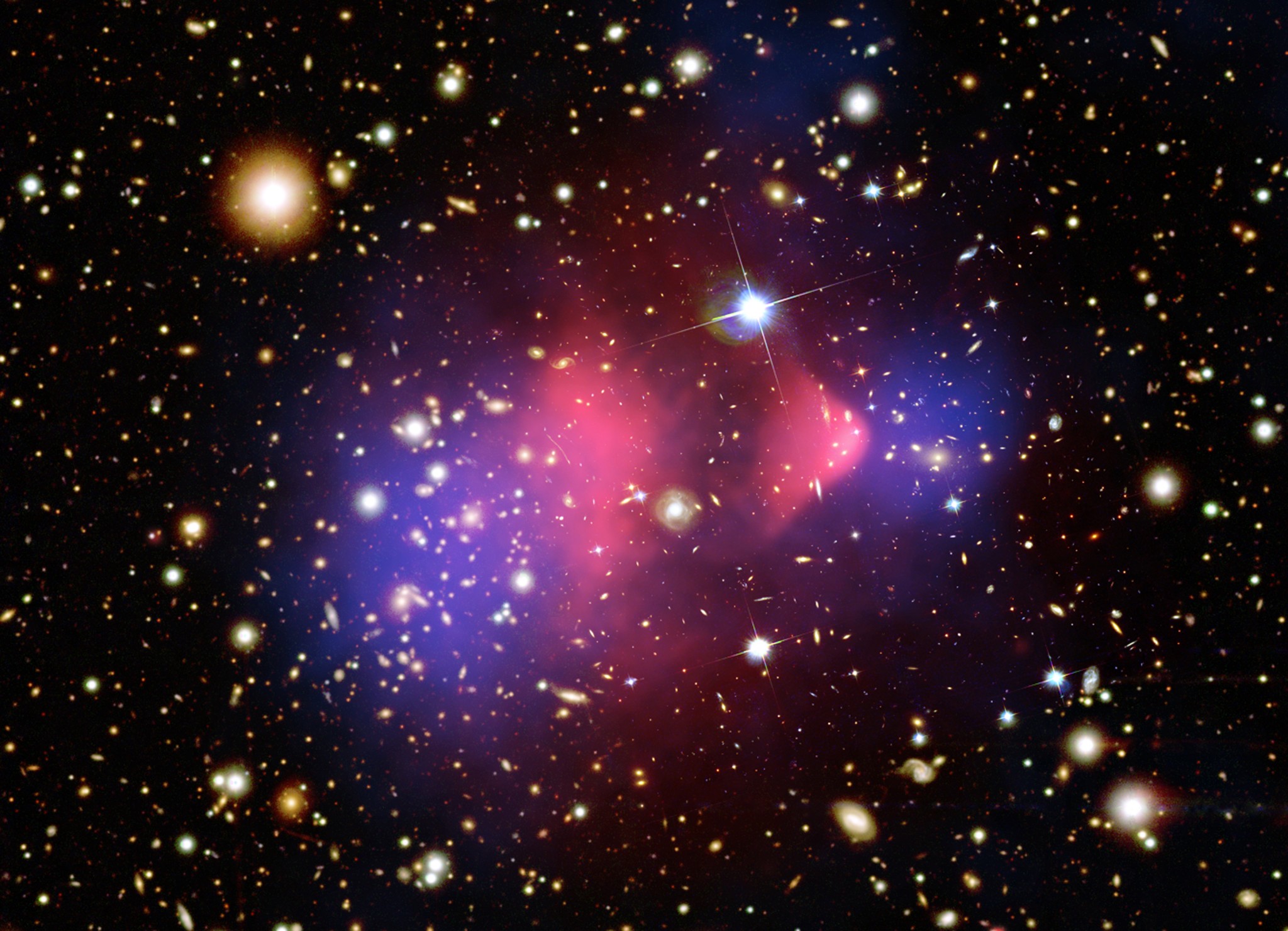
Bullet Cluster (blue is dark matter, pink is gas) Credit: NASA/CXC/CfA

What Convinced Me:

There is another, simple change you can make to the math to make it work: add a “dark matter particle.” If you account for these particles in your math, everything works. Yeah, pretty much everything.
More importantly particle physicists have also predicted the existence of a “dark matter particle.” Particle physicists are doing completely different math than astrophysicists. Astrophysicists use gravitational force and electromagnetic force (light) to do all their observations and calculations. Particle physicists are working on a different scale: they can have laboratories and manipulate particles, and the elementary forces they study are the strong force and the weak force. This means that they independently came up with the need for a “dark matter particle.” They weren’t even solving the same equations. They were truly independent.

Paul Sutter, the grad student I was speaking with says, if they fail to detect dark matter particles with the Large Hadron Collider within the next 10 years, then the theory should be reexamined. Until then, it’s pretty likely.

Want More?

Bullet Cluster
About Dark Matter
LHC and Dark Matter

Where’d I Get My Info?

I spoke with a grad student, Paul Sutter, at the University of Illinois who is studying dark matter.

ALICE looks at collisions of lead ions

I’m long overdue for a post on my new agreement with (or is that understanding of?) the theory of dark matter. I promise I’ll work on it, but till then, here’s a hilarious music video of a new rap song about Cern’s new LHC (Large Hadron Collider)

The beginning is great, then you may start to feel like it’s dragging, but if you last through the first 3 minutes or so, you’ll get an pretty cool explanation of this “Higgs” that everyone is talking about.

Found it on BoingBoing.
Did you like that? Here’s more from AlpineKat.

A Series of Questions (II)

For this week’s AstroInfo I’m going to answer a set of questions posed by youth who are currently training to offer space-related interactive activities out among the Pacific Science Center’s exhibits. In several places I express my personal opinion – which you should note is NOT the same as fact.

When can the general population go into space without paying a lot of $?
Who knows, maybe 10 years? Maybe two years, maybe 50? There is a competition called the “X Prize” that’s trying to jumpstart space travel (and other sciences). Until a couple years ago, no new spaceships for carrying people had been invented since the Shuttle. The Ansari X-Prize (http://www.xprize.org/x-prizes/ansari-x-prize) offered $10 million dollars to anyone who could “launch a spacecraft capable of carrying three people to 100 kilometers above the earth’s surface, twice within two weeks.” Burt Rutan and company completed the task on October 4, 2004 – after spending more than $100 million creating SpaceShipOne (go to the Museum of Flight to see a mock-up of it). This should push the space-travel industry along a little faster.

How plausible is human colonization of Mars/Moon in the next 50 years?
My opinion: It’s not. I say that because you used the word “colonization” which I think will take a long time. Right now there’s a plan to send humans back to the Moon and eventually to Mars, but just to visit.
The program is called the Constellation Program and it has three components:

  • Orion Crew Vehicle – like the current shuttle
  • Ares Launch Vehicles – rocket to carry the Orion
  • Altair Lunar Lander – landing people on the Moon

How do they come up with the ideas for finding stars or researching about stars?
What usually happens is that someone notices something strange about a star or something else, and they decide to find out what’s happening. A simple example is a variable star. Someone studying a variable star would notice that on different nights it appeared brighter or dimmer. Then they would want to find out why – is there something traveling in front of the star? Is the star flashing or pulsing? Is the star spinning, and is one part brighter than another? Any of these might affect brightness.

Is there intelligent life outside Earth?
Not that we’ve detected. My opinion: yes.

Does dark matter exist?
Most scientists believe so. Though the evidence is pretty overwhelming, I’m not quite ready to believe it. Redacted as of 6/4/08.

What elements are found in the gases on Uranus?

Edited as of 6/6/08: The atmosphere of Uranus has Hydrogen (mostly), Helium (a little), Methane (a trace), Water (a trace), Ammonia (a trace). The methane, water, and ammonia are all aerosol ices – suspended crystals of ice (not ice cubes or blocks of ice). A later AstroInfo will explain Uranus in more detail. I was embarrassed to realize at the Spring 2008 meeting of the American Astronomical Society that what I thought I knew was significantly wrong.

What is Hawking Radiation?

Hawking Radiation is the process by which black holes evaporate. Usually only small black holes actually evaporate, though Hawking Radiation is believed to happen to all black holes.

Background Information:

In spite of conservation of matter, we can assume that matter can be created from nothing, as long as it disappears quickly enough for the universe “not to notice.”

If you imagine that a particle is created from nothing, you can get away with it if its antiparticle (like a positive number and a negative number) is also created from nothing right next to it. The two particles immediately combine – going back into nothingness ((+1) + (–1) = 0). These imaginary particles are “virtual particles,” and their appearances and disappearances are called Vacuum Fluctuations.

An Instance of Hawking Radiation:

I’m going to write this in steps.

1. A black hole exists. Anything that ends up within the black hole’s event horizon ultimately falls into the black hole, adding its mass to that of the black hole. It can never escape.

2. A virtual particle pair springs into existence RIGHT ON the event horizon.

3. Before the two particles can annihilate (combine and disappear) one falls into the black hole’s event horizon. OH NO!

4. The second virtual particle is stuck! It can’t disappear anymore since its pair (its soulmate if you will) is gone forever!

5. The universe “notices” the existence of an extra particle by the black hole.

6. The extra particle is outside the black hole’s event horizon, and it’s a real particle now, not a virtual one because it existed for too long and the universe noticed.

7. But wait! You’re NOT ALLOWED to create something from nothing, so this particle had to come from somewhere.

8. The universe asks its bookkeepers where this extra particle came from.

9. The bookkeepers scramble. (They’re being audited.) Ummm… no one will notice if we take a little of the energy from the black hole, will they?

10. Clearly the energy for this new particle must have come from inside the black hole.

11. The black hole is now down one particle’s worth of energy. (Another way to think of this is that the virtual particle that fell in had “negative” energy – absorbing some energy from the black hole).

If you weren’t following all this anthropomorphizing of the universe, it looks like a particle is now beside the black hole, and the black hole is a little smaller.

In effect, the black hole has evaporated a little bit. Big black holes are sucking in so much mass that this tiny evaporation doesn’t have any effect. Tiny black holes, on the other hand, evaporate faster than they can suck in matter. So if there were a one-atom black hole created on Earth, one might be afraid that it would suck in the atoms next to it, and the molecules next to that, and get bigger and bigger until it sucked in the Earth. Luckily a one-atom black hole would evaporate before that happened. At least, so say the physicists in Geneva who are trying to create tiny black holes.

Want More?

http://focus.aps.org/story/v16/st12

Where’d I Get My Info?

http://focus.aps.org/story/v16/st12

Astronomy classes at Whitman College

http://en.wikipedia.org/wiki/Hawking_radiation