More Exoplanets!

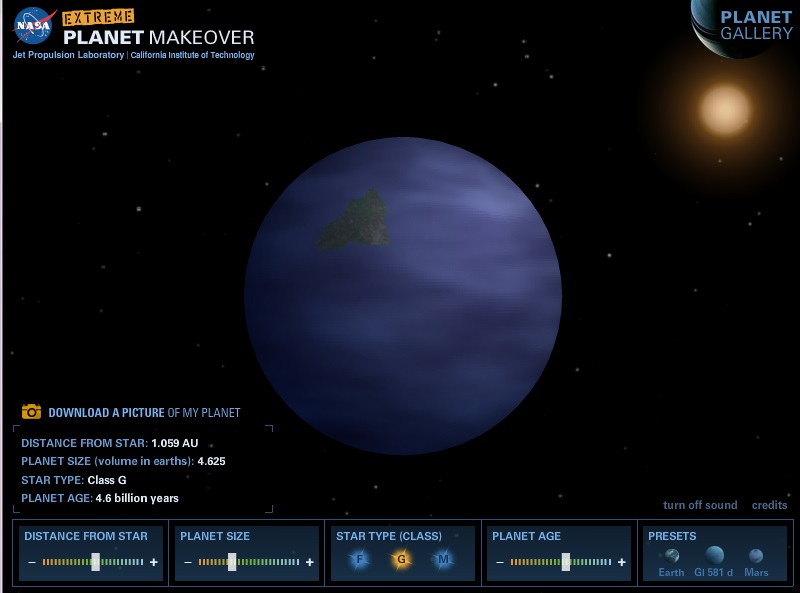
My FAKE exoplanet, which I made in NASA's Extreme Planet Makeover Game

My FAKE exoplanet, which I made in NASA’s Extreme Planet Makeover Game

I expect posts announcing confirmations of new exoplanets to become fairly regular over the next few years. We (well, Dr. Jack and his team, and Dr. Jason and his team) confirmed more exoplanets!

The Upshot

Dr. Jack (Lissauer) and Dr. Jason (Rowe) confirmed 715 new planets out of the 4 years of planetary candidate data collected by NASA’s Kepler mission between 2009 and 2013. Our confirmed total is now 1792 1690, according to the Kepler team, though not all discovered by Kepler.

Why is this Important?

Batch Processing via Probabilities

This is a meaningful discovery not simply because that’s 715 more planets that aliens might live on, but also because Jack and his team figured out a way to confirm planets in the Kepler data much faster than anyone else, so far. If you remember when Craig Vetner and Celera scooped the Human Genome Project and quickly produced what was then called the first complete human genome, this is a similar breakthrough (hopefully less controversial!).

Jack & Jason’s team uses probabilities to determine if candidates are actually planets. Read more about it in the press release.

What counts as dead, for a mission?

If you remember last May, you’ll have a vague inkling about some news that the Kepler spacecraft had finally failed. This is somewhat true, but misleading if you remember it like that. The third gyroscope (stabilizer) onboard Kepler failed, making it so it could no longer point accurately enough to continue the extension of the original mission.

Lucky for us, not only had Kepler already finished it’s original mission and a continuation, but we still haven’t finished processing all the data from the original mission. This latest press release is just the beginning of a slew of announcements confirming more and more exoplanets out of that collected data. There are over 3,000 more candidates yet to confirm.

Beyond that, there is a new mission proposed for Kepler, using only the two remaining gyroscopes. This mission is called K2 and hopes to study “planet formation processes, young stars, stellar activity, stellar structure and evolution, and extragalactic science” by examining other parts of the sky that are easier to point at steadily with two reaction wheels.

All in all: it’s not dead yet!

Some Details

Numbers, numbers, numbers!

You know I’m more a fan of comparisons in blog posts, rather than focusing on numerical values, but these ones are neither so large nor so small as to be mind-boggling, they’re just cool:

  • Total Confirmed Exoplanets, as of today: ~1792

    • Confirmed Exoplanets from Kepler: ~1656
    • Confirmed Exoplanets from other sources: ~136
    • All current Exoplanet Candidates from Kepler: 3,845
    • 7286 sources identified by Kepler, including the ones that aren’t planets

Whoops! Some of my numbers are a bit off. Here’s the fix (Thanks Toshi!)

  • Total Confirmed Exoplanets, as of today: ~1690 (depends on exactly which database you use)

    • Confirmed Exoplanets from Kepler: ~961
    • Confirmed Exoplanets from other sources: ~729
    • All current Exoplanet Candidates from Kepler: ~3,845
    • ~7286 sources identified by Kepler, including the ones that aren’t planets (no change)

The source of my error was mostly the database I chose to use and it’s lack of recent updates.

SO, I turned this into “batting averages” for Tom Hutyler since he’s always asking me for stats on my astronomy reports! Kepler currently rests at .227 .132 and can only go up from there, with a top-out possibility at .755 .528. I suspect we’ll have a good mostly-final “batting average” in about two years, based on how much data is left.  I also suspect it will be on the high end, but that’s just a guess… or a friendly wager if you care to take it.

There is a press release out there that says these 715 planets have tripled the number of confirmed exoplanets. I can’t work that out with all the numbers of planets I can find. So don’t say tripled” unless you can back it up. And please comment if you can figure out how 715 more planets triples what we knew of before. Toshi helped! Thanks!

Want More?

If you’re trying to doodle around on the internet for a while more, go play with the Extreme Planet Makeover game from NASA!

Kepler

K2

Where I got my numbers: Exoplanet Archive:1077; Kepler before today: 941; Kepler totals.

~ A l i c e !
Kepler 10b

Kepler 10B - Artists' Concept (Credit: NASA)

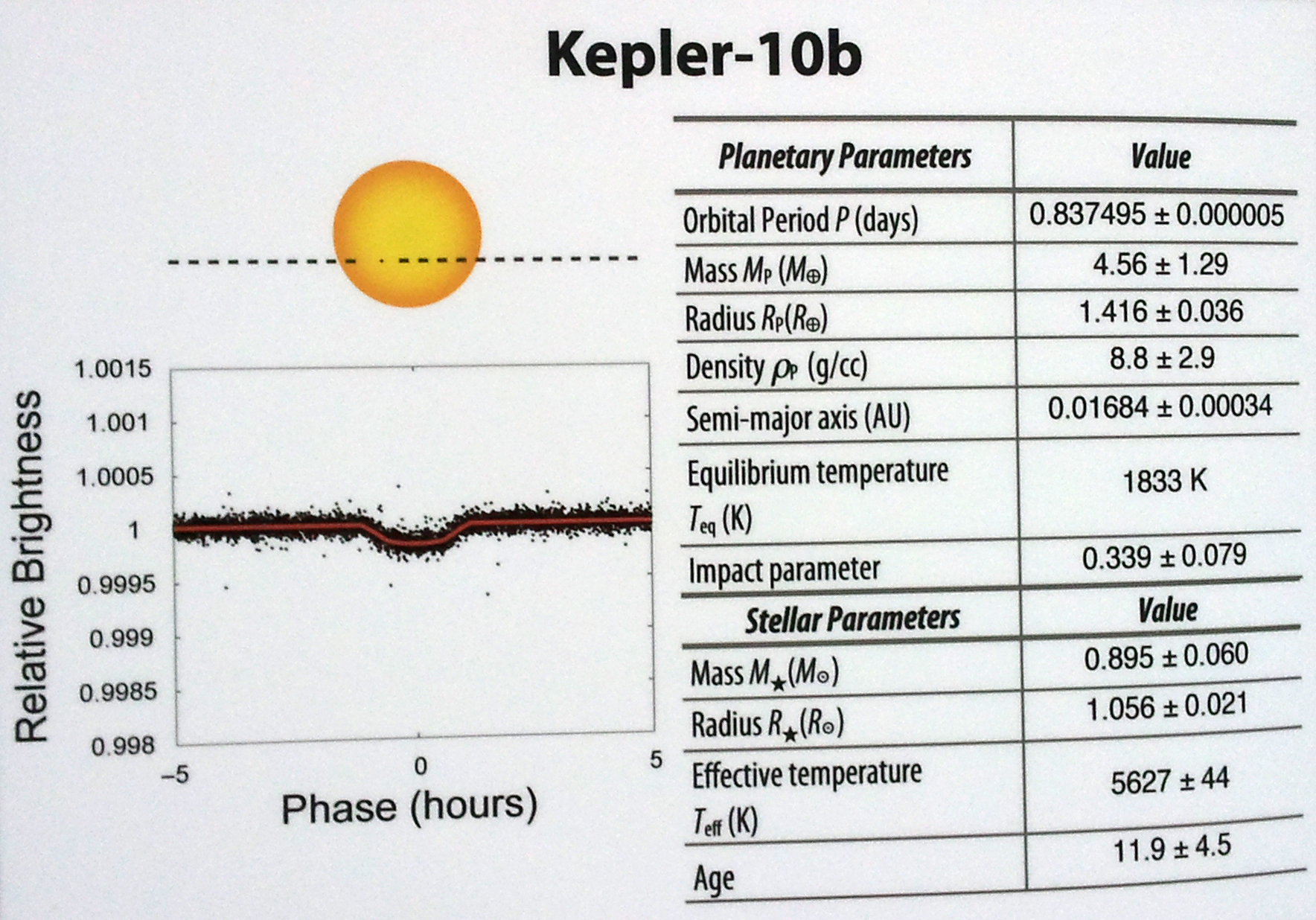
This newly-discovered planet whips round its star in less than an Earth day. Scientists used starquakes (starquakes!) to find out a little more about it, and they found that not only is it tiny, but it is also made of rock, just like our inner solar system.

It is a hot-lava planet.

A Confirmed Rocky Planet

I should mention that this planet is not Earth-like. Over the past couple years I’ve been hearing the phrase “most Earth-like planet ever discovered” bandied about by various news organizations, including some science press releases.

There’s a lot that goes into making a planet Earth-like.

  • Size: In the case of Kepler 10b, it is very small, less than half again the size of the Earth. There is nothing in our solar system nearer to this size than the Earth itself.
  • Composition: It is also definitely made of rock and metal, like the Earth, but it is denser than the Earth.
  • Distance: But, it’s incredibly close to its star, unimaginably closer than Mercury. It takes LESS THAN A DAY to circle its Sun once.
  • Temperature: This, paired with the fact that the planet is tidally locked (like our Moon is tidally locked to the Earth – same side always faces the Earth), leads to possibly the hottest planet you’ve ever tried to think about. It is hot enough to melt iron. Not lead, iron. It’s about 1833K (1560C, 2800F).
  • Habitable Zone: Kepler 10b is not in the habitable zone. Interestingly, the habitable zone does not imply that the planet is habitable, simply that it could have liquid water – if it had water at all. Kepler 10b’s water would have evaporated faster than you can say “habitable zone” if it ever did have water.
  • … and that’s just a few.

Some Stats

Kepler 10b Stats

Want More?

NASA Press Release

~ A l i c e !

Kepler Mission: Basic Background

Opening soon at the Willard Smith Planetarium will be Strange Planets, a show about how we detect planets around other stars. To whet your appetite – how about a few details about the Kepler Mission.

In short – the Kepler Mission is a telescope in orbit that is pointed at the exact same patch of sky for a period of four years (starting in 2009). It is detecting planets around other stars via the so-called transit method – watching as planets transit in front of their stars. By watching for five years it should be able to detect hundreds (if not thousands) of planets in Earth-like orbits, and therefore plenty of planets in their stars habitable zones.

Where is Kepler Looking?

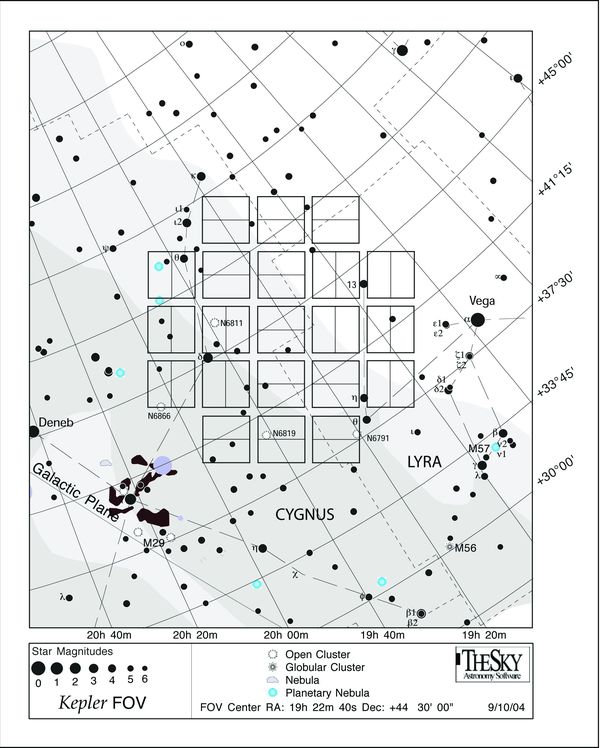
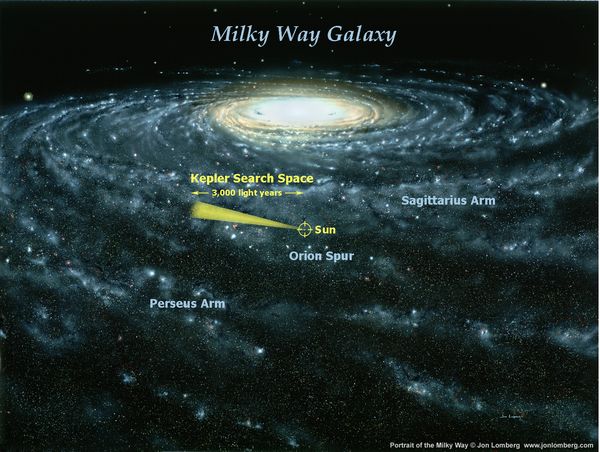
Kepler is closely watching a little patch of sky by the constellation Cygnus, pointed along our little section of the Milky Way, carefully avoiding all the brightest stars.

From NASA: Kepler's Field of View (Angle 1)

From NASA: Kepler's Field of View (Angle 2)

The Kepler Technology

Advanced gyroscopes onboard Kepler keep it pointed in exactly the same direction so the scientists at JPL can get unwavering readings on each star in Kepler’s field of view. To detect planets and calculate their orbits with certainty Kepler will have to watch each planet transit two or three times at least. For a planet like Earth, in its star’s habitable zone, the orbit takes about a year. Different sizes and temperatures of stars have habitable zones at different distances, but the Kepler mission will be able to do a good job at detecting planets with orbital periods up to about two years.

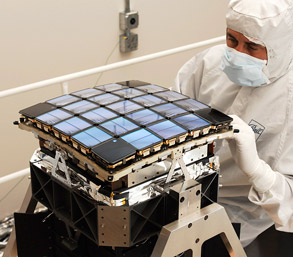
Look at this beautiful picture of the Kepler CCD array (from NASA). Ooo! Shiny!

New News: Hundreds of Planet Candidates Found

Characteristics of Kepler Planetary Candidates Based on the First Data Set: The Majority are Found to be Neptune-Size and Smaller

Authors: William J. Borucki, for the Kepler Team

(Submitted on 14 Jun 2010)

Abstract: In the spring of 2009 the Kepler Mission conducted high precision photometry on nearly 156,000 stars to detect the frequency and characteristics of small exoplanets. On 15 June 2010 the Kepler Mission released data on all but 400 of the ~156,000 planetary target stars to the public. At the time of this publication, 706 targets from this first data set have viable exoplanet candidates with sizes as small as that of the Earth to larger than that of Jupiter. Here we give the identity and characteristics of 306 of the 706 targets. The released targets include 5 candidate multi-planet systems. Data for the remaining 400 targets with planetary candidates will be released in February 2011. The Kepler results based on the candidates in the released list imply that most candidate planets have radii less than half that of Jupiter.

Comments: Paper to accompany Kepler’s June 15, 2010 data release; to be submitted to Astrophysical Journal
Subjects: Earth and Planetary Astrophysics (astro-ph.EP)
Cite as: arXiv:1006.2799v1

(added 6/15/2010 3pm)

Want More?

Kepler’s Website (Official Honoree of the Webby Awards!)

The New Worlds Atlas

The Extrasolar Planets Encyclopaedia – a good resource for the latest exoplanet totals and discoveries.

~ A l i c e !

arXiv:1006.2799v1 [astro-ph.EP]

Quick Updates: Kepler, Saturn, Perseids, Jupiter

Perseids:

The Perseids peak tonight after midnight. They’re dust- and sand-sized debris left in our path from comet Swift-Tuttle. The air compressing in front of each meteor generates enough heat that the debris burns up and we see a streak of light.

Kepler:

The Kepler mission (looking for Earth-like planets around other stars) has just proved it definitely can detect planets, with more detail and precision than other methods. Kepler observed the planet HAT-P-7, which orbits its star once every 2.2 days, and was able to detect the atmosphere of the planet, and measure the daytime temperature at 4310 degrees F. Ouch.

Saturn:

Saturn’s rings are edge-on from our point of view, which happens every 15 years when Saturn reaches its equinox. According to JPL that day was yesterday, August 11, though the rings will stay mostly edge-on for a while yet.

Jupiter:

I’m quite late off the mark on this one, but something crashed into Jupiter not too long ago. On July 19th an amateur astronomy (Anthony Wesley) found this extra dark spot on Jupiter, and later professional astronomers followed up on his observations with Hubble. With Hubble they can watch as the debris plume evolves, and make better estimates about the size of the impacting object (several hundred meters across).

There is a standing hypothesis that Jupiter, being large, helps clean up the debris in the solar system. It attracts more asteroids and comets, leaving the inner solar system clearer and thus making impacts on Earth less likely.

Want More?

Meteors
Saturn Images

Where’d I Get My Info?

Kepler
Saturn
Jupiter

~ A l i c e !

Some Links

Life comes in waves – busy waves, and waves when you have lots of time to blog. You get one guess which wave I’m in now.

Meanwhile, I will leave you with some good links.

1. There is another Alice! Not only that, there is another Alice involved in informal astronomy education. Not only THAT, there is another Alice in the Pacific Northwest who is highly involved in informal astro ed. So, if you’re looking for Alice’s Astronomy a Go Go … you’re in the wrong place, you’re at Alice’s AstroInfo. But you should definitely head over there and check out her podcasts, she’s got some neat stuff.

2. Carnival of Space #112: Out of the Cradle celebrates the Moon Landing

3. Carnival of Space #113: Dynamics of Cats hosts one all about extraterrestrial impacts

4. Carnival of Space #114: Ultra Cheap, from Cheap Astronomy

And don’t miss Kepler’s announcement of their proof of concept: http://kepler.nasa.gov/press/earlyresults.html

~ A l i c e !

Exoplanets Photographed!

Quickie:

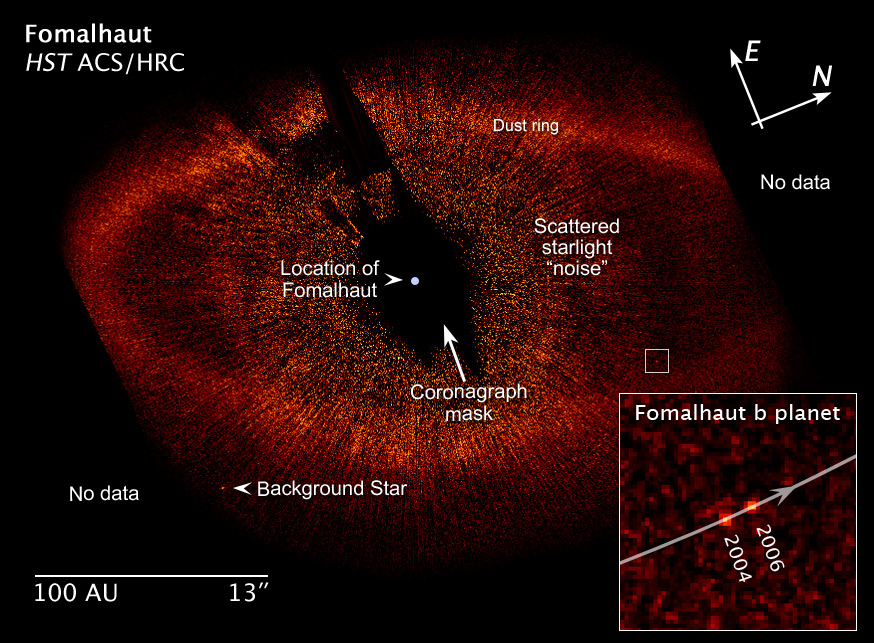
They got a photo of a planet around another star, and they’ve confirmed that it is actually a planet. (Actually, there are two discoveries, one planet around Fomalhaut, and three planets around, get this, HR8799.)

Hubble Team

Planet around Fomalhaut b Credit: Hubble Team

An Actual Photo!

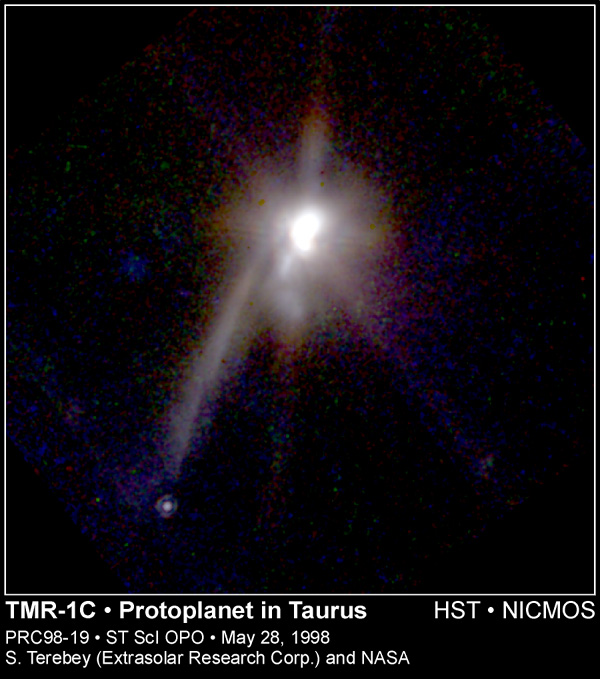
Eee gad! We finally did it. Although the current count of detected exoplanets is up to about 322, we don’t have photographs of any of those. Sadly. Over the years, there’ve been a number of false alerts, but none panned out. Most notable in my memory was May of 1998, about a month after I was hired here – they thought they found a protoplanet ejected from around a star in Taurus. Eventually they decided it was just a star in the background.

Hubble

Not a Planet in Taurus Credit: Hubble

Fomalhaut? Really?

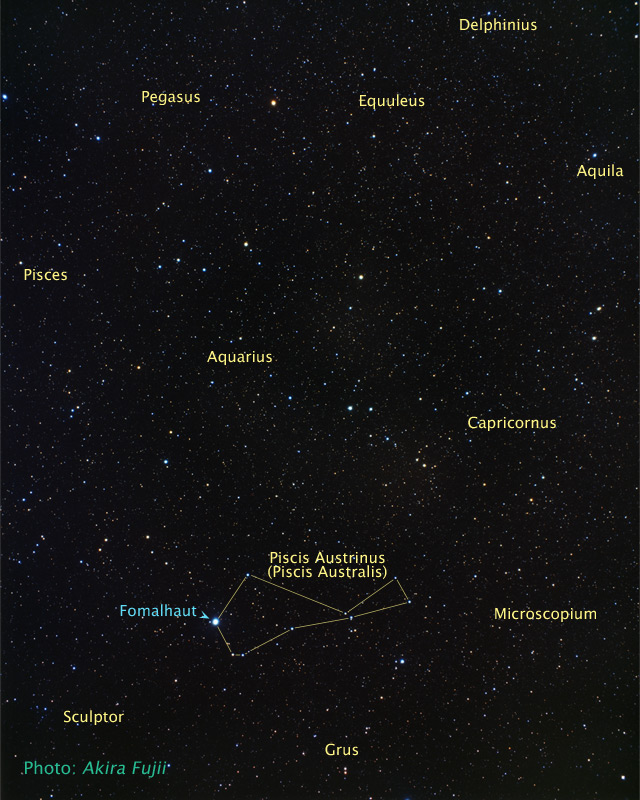
Okay, so one of the other things I find awesome about this is that the planet is around Fomalhaut (they pronounce it FOAM-al-hot). Fomalhaut is a first-magnitude star. That’s darn bright. I was expecting the first image of a planet to be around some dim little nothing star in a nothing constellation. You can see Fomalhaut tonight – look low in the South, for a bright star – and that’s where it is.

What Makes This One a Planet?

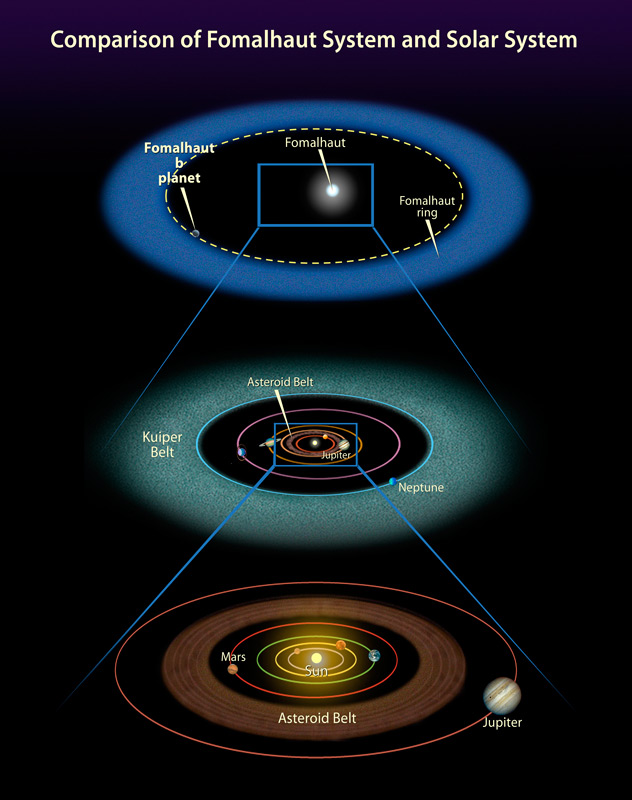
Mostly we’re finding big, high-mass planets around other stars. The problem with candidates we’re photographing is that they’re even bigger – big enough and bright enough that we can see them. Big enough and bright enough, that they generally turn out to be dim stars, not planets. This planet is in a ginormous dust ring (see the diagram). If the planet had a large mass, you’d see it mess up the dust ring – the dust would be attracted to the planet, there would be tracks and all sorts of fun physics. There isn’t. The dust ring is undisturbed. That puts an upper limit on the mass of this planet, so we can be sure it is small enough to qualify as a planet (less than 13 times the mass of Jupiter).

This planet is between the mass of Uranus and three times the mass of Jupiter.

Hubble Team

Diagram of the Fomalhaut b system, compared to our own Credit: Hubble Team

The “Marois Trio”

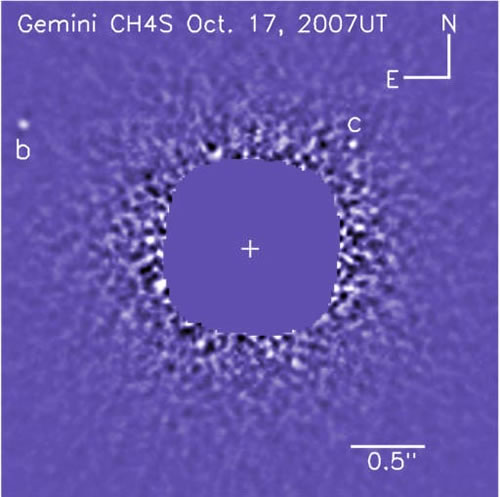
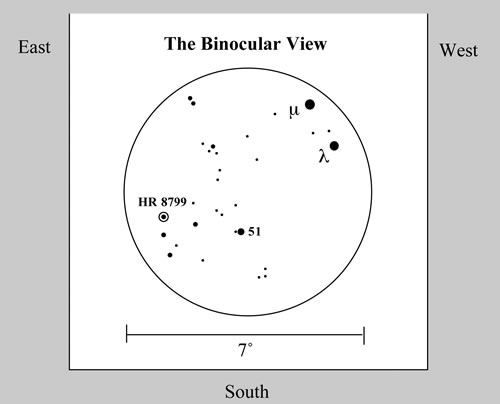
Parallel to Hubble’s discovery, Christian Marois (et al) of the Gemini Observatory also just released a paper detailing their photograph of three planets going around the star HR8799 in Pegasus. This one is a little harder to see (you need binoculars), but the fact that there are three planets all orbiting the star, points to the fact that this is also, pretty definitely, actual planets and not stars.

Two of the three planets around HR8799

Two of the three planets around HR8799 Credit: Gemini Observatory

Where do I look?

Hubble Team

Where is Fomalhaut? Credit: Hubble Team

Gemini Observatory

Where is HR8799? Credit: Gemini Observatory

Where’d I Get My Info?

Hubble Release

Gemini Observatory Release

Exo-Earth around Gliese 581?

A new planet has been discovered around a distant star, not that this in itself would be news – it seems that new planets are discovered around other stars every few days. Usually, though, these planets are several times the size of Jupiter, or are sometimes as “small” as Uranus or Neptune. Though exciting, these planets aren’t the best fodder for science fiction enthusiasts and don’t inspire dreams about terra-forming Earth 2.0.

This planet is different. Creatively named “Gliese 581 c” this planet is only five times more massive than the Earth. More importantly, this new planet is within the “habitable zone” around its star. It orbits a lot closer (0.073 AU) to Gliese 581 than Mercury orbits around our Sun.

Habitable Zones

As you know, Mercury is one of the hottest planets in our solar system due to its proximity to the Sun; it would be a nasty place to live, and humans wouldn’t last long. The star Gliese 581 is different: it’s a red dwarf star, tiny, dim, and not very warm compared to our Sun. Assuming this planet is rocky like Earth, and has a bit of an atmosphere, this close orbit would make it perfect for liquid water.

In current astronomy, liquid water is the gold of the universe: the key ingredient needed to even hope that life exists on a planet or moon. The discoverers of this planetary system estimate that the average temperature on Gliese 581 c is between 0 and 40oC (32 and 104oF).

Earth 2.0?

So, it’s time to break out the terra-forming equipment, jump on the Enterprise, zip over and see what’s there, right? Well, perhaps we’d better invent light-speed travel first – Gliese 581 is still 20 light years away. On the other hand, perhaps we should protect the habitable planet we’ve got, and turn our terra-forming eyes back on re-terra-forming the Earth, and keeping it habitable.

Statistics

Discovered by: Udry, Bonfils, Delfosse, Forveille, Mayor, Perrier, Bouchy, Lovis, Pepe, Queloz, and Bertaux from the Geneva Observatory, Switzerland.

Discovered using: the HARPS (High Accuracy Radial velocity Planet Searcher) instrument at La Silla Observatory, Chile.

Star: Gliese 581 is 20 light years away, in the constellation Libra. Though Libra is visible tonight (rising around 10:30pm), you won’t see Gliese 581 – it is too dim.

Planet: one of three planets discovered in the system so far, Gliese 581 c is 5.03 times the mass of Earth, orbits at 0.073 AU, and 1.5 times the diameter of Earth.

Alice Enevoldsen

Where’d I Get My Info?

http://www.sciam.com/article.cfm?articleID=25A261F0-E7F2-99DF 313249A4883E6A86&chanID=sa007

http://exoplanet.eu/planet.php?p1=Gl+581&p2=c

http://en.wikipedia.org/wiki/Gliese_581_c

The original press release by the ESO (European Organisation for Astronomical Research in the Southern Hemisphere):

http://www.eso.org/outreach/press-rel/pr-2007/pr-22-07.html

The real deal – Here’s the scientific paper Udry et al submitted:

http://obswww.unige.ch/~udry/udry_preprint.pdf

And their website:

http://obswww.unige.ch/exoplanets/gl581.html