My Favorite Maya Mythology and Astronomy

You’ve already been hearing about how the ancient Maya didn’t predict the end of the world today, that’s just misinformation, so I thought I’d share some of my favorite accurate topics about the ancient Maya astronomy and mythology.

Dark Constellations

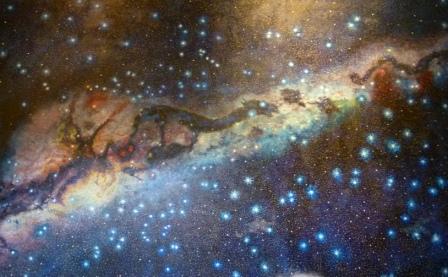
In western astronomy and western mythology we recognize constellations as dot-to-dot pictures made of stars. In other words, we make images out of “positive space” to use some art terminology. The ancient Maya are a completely different culture: several of their constellations are made of “negative space.” They recognize images in the dark spaces between the stars. Here is an enhanced image, you can easily see the llama across the middle (with a star for an eye), and the snake in the upper right-hand corner:

Andes-Milkyway-compressed


I always love to use this as an example of how “different cultures are different.” Just because we think dot-to-dot pictures are the “normal” way to do constellations doesn’t mean every other culture everywhere also thinks that.

Venus

The ancient Maya place extreme significance on the planet Venus. Their calculations of exactly when it will rise, set, first appear after sunset, last appear before sunrise rival even today’s computers. And they didn’t have computers. We should spend more time observing natural phenomena ourselves.

Calendar

Their calendar is AMAZING. It has cycles within cycles. There are several good java converters out there that show you how it works.

Also, when you see a picture of the “Maya Calendar” it should be laid out in a rectangle. If it is in a circle and looks like a compass rose it is most likely the Aztec Calendar. (If it looks like gears cycling within each other, it might be the Maya Calendar after all).

Sources

Aveni, Anthony. Skywatchers of Ancient Mexico (book)


~ A l i c e !

Mars as Big as the Moon 09 #2

Okay, I couldn’t resist. For all of you out there who have also been trying to educate folks about the Mars Hoax for years, I’ve created a brief respite.

As you know, this year’s version is going around as a PowerPoint. Once you’ve seen the hoax PowerPoint, you might enjoy my … “corrected” version. If you’re squeamish about random .pps files from the internet, I’ve attached still .jpgs here, but they’re not as cool – there aren’t any annoying animations to click through. The effect just isn’t the same. Enjoy!

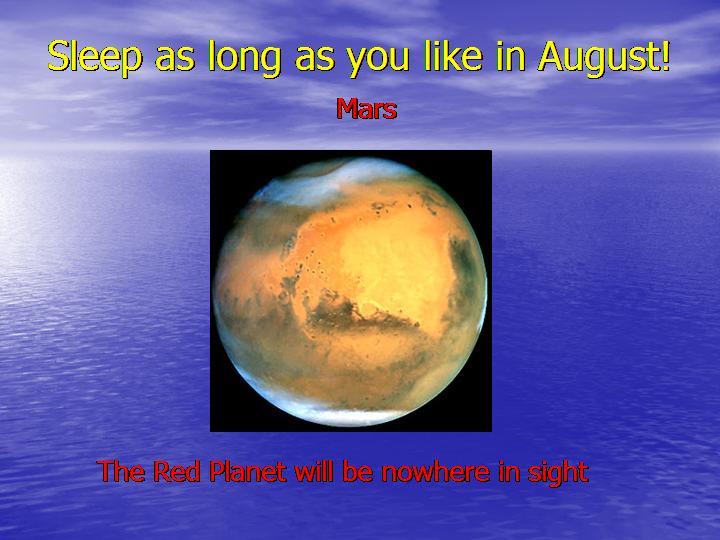
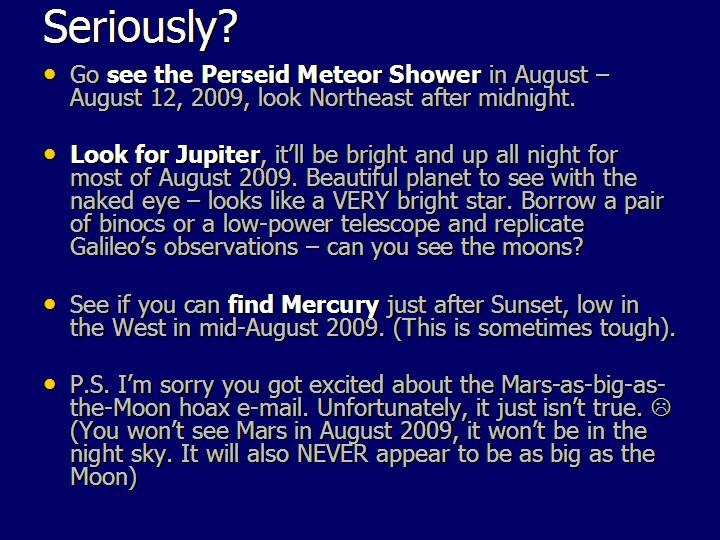
Fixed PPT Slide 1

Fixed PPT Slide 1 (well, actually, Mars rises around 2 or 3am, but it starts to get light not that long after that so it might as well be nowhere in sight!)

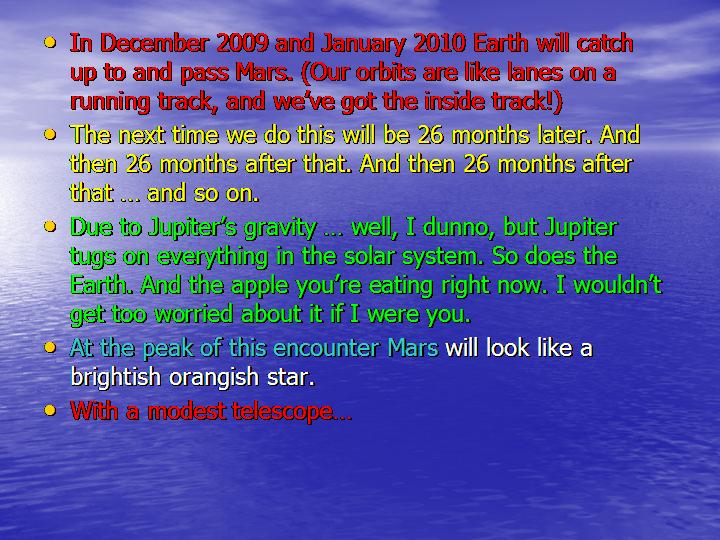
Fixed PPT Slide 2

Fixed PPT Slide 2

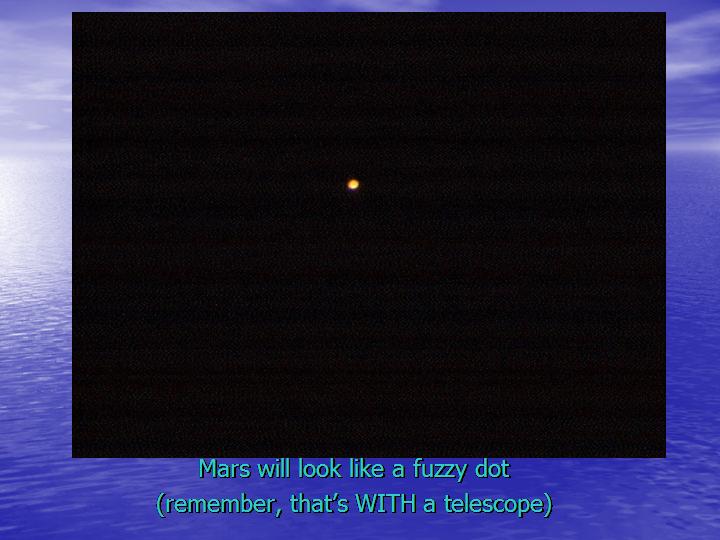
Fixed PPT Slide 3

Fixed PPT Slide 3

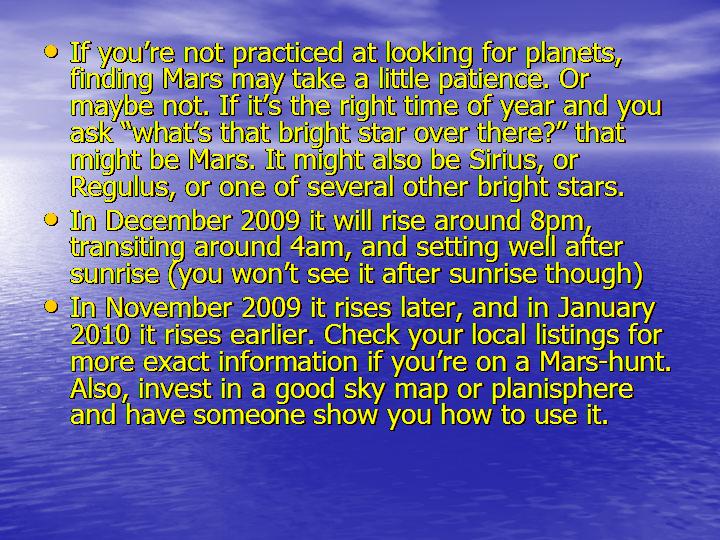
Fixed PPT Slide 4

Fixed PPT Slide 4

Fixed PPT Slide 5

Fixed PPT Slide 5

Fixed PPT Slide 6

Fixed PPT Slide 6

This really doesn’t follow my rules when it comes to talking to people about the Mars hoax. Mainly it doesn’t let you down easy, and it doesn’t validate the excitement generated by the e-mails. I just made it for fun, and mostly for those who already know.

~ A l i c e !

Mars as Big as the Moon (2009 edition) – Still Not True

It’s back, and it’s more compelling than ever this year. My best post is last year’s. I have also made a corrected version of the e-mail that’s going around in the next post.

  • First off: Mars will NOT be as big as the Moon this August (or any August).
  • Secondly: Wouldn’t it be cool if it was? Well – it would look cool, but I’d be concerned about the gravitational effects on the Earth.
  • Thirdly: Would you like something cool to look for this August instead? Something real? How about the Perseid Meteor Shower? It peaks on August 12th, after midnight. Look Northeast. You can make as many wishes as you like on all those “shooting stars” – you could even wish for the Mars Hoax to come true, if you like.
  • Lastly: If you’re bent on seeing Mars, wait until December 2009, and you’ll see it rising in the East mid-evening. It will look like a bright-ish slightly-orange star.

Here are some quickie details:

  • Mars is at opposition with Earth (as close as we get) every 26 months.
  • This hoax has been going around every August since 2003.

Curious about how that opposition slips against Earth years? Here’s a short overview courtesy of the Students of Exploration and Development of Space.

  • In 2003 Mars was at opposition in August, and it WAS close, from an astronomical point of view. It wasn’t actually all that exciting for the average viewer.
  • In 2004 Mars was not at opposition.
  • In 2005 Mars was at opposition in early November.
  • In 2006 Mars was not at opposition.
  • In 2007 Mars was at opposition in late December.
  • In 2008 Mars was not at opposition.
  • In 2009 Mars will not be at opposition (this one slips to January 2010).
  • In 2010 Mars will be at opposition in January.

Mars Hoax ’09

This year the e-mail is going around as a PowerPoint attachment, complete with all the PowerPoint bells and whistles you could ever wish to avoid.

This is the PowerPoint file if you really want to see it. I’m not sure I’d trust it to be virus-free if I were you, but I did scan it for viruses, and didn’t find anything: MARS.pps. If you’d rather not risk it – screen-shots of the slides without their animated glory follow.

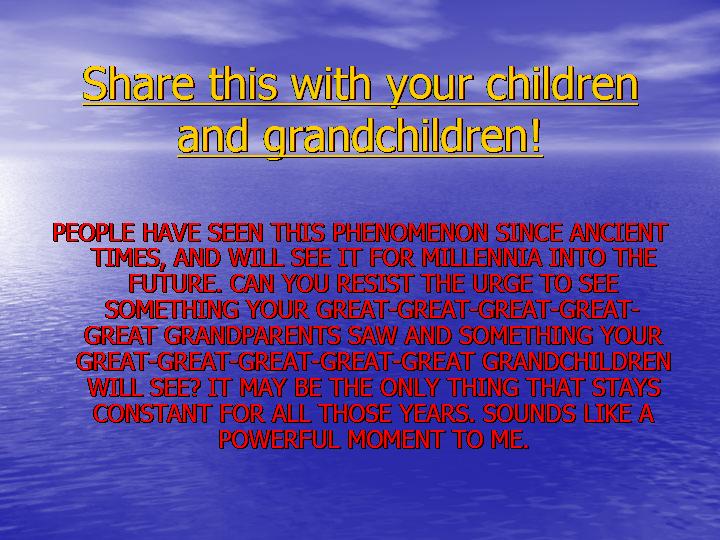
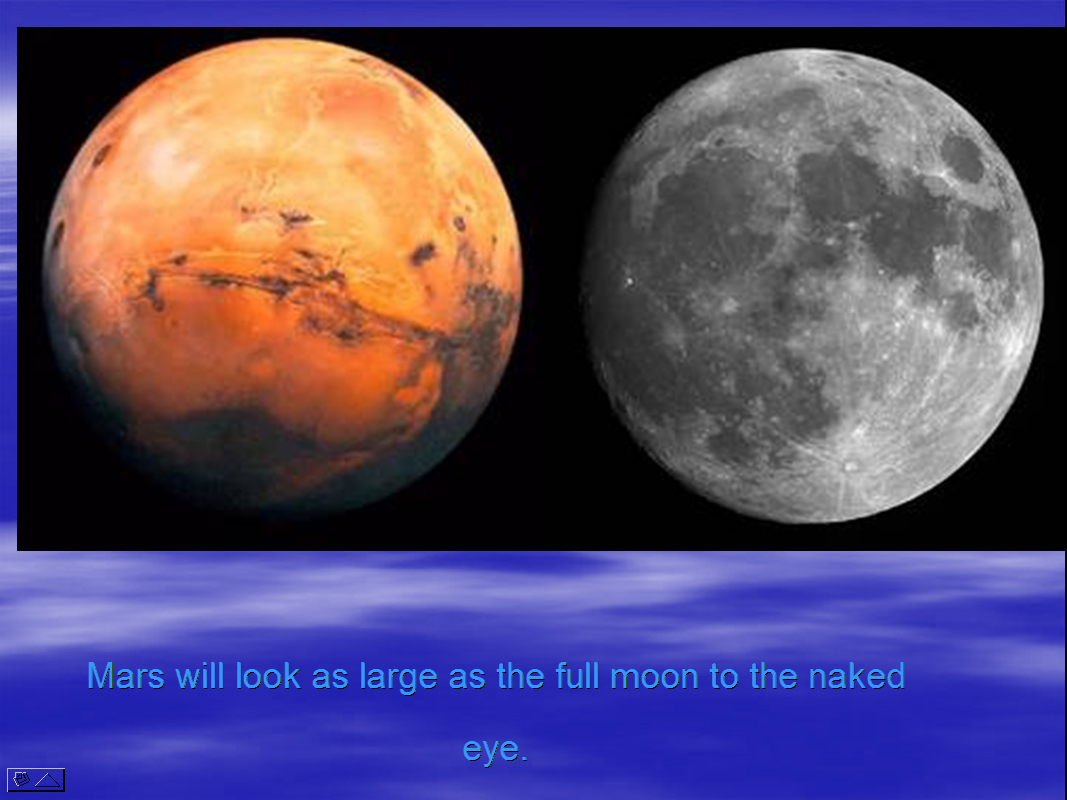
Mars Hoax PowerPoint 2009 Page 1

Mars Hoax PowerPoint 2009 Page 1

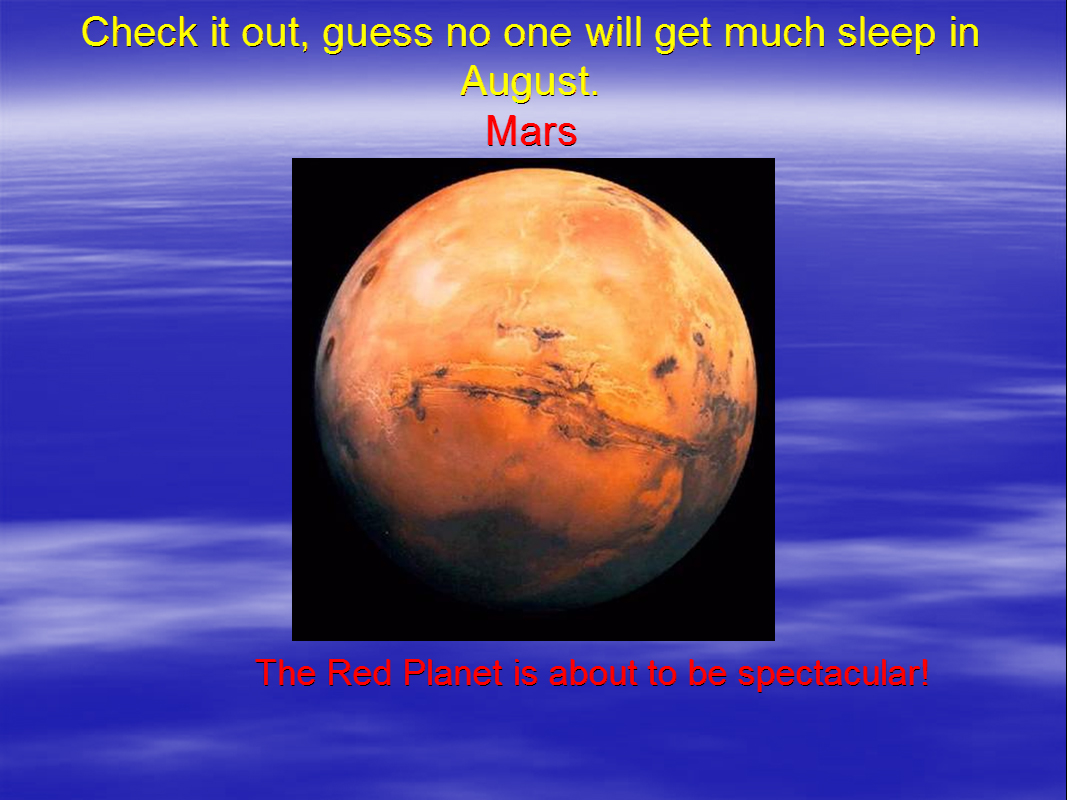
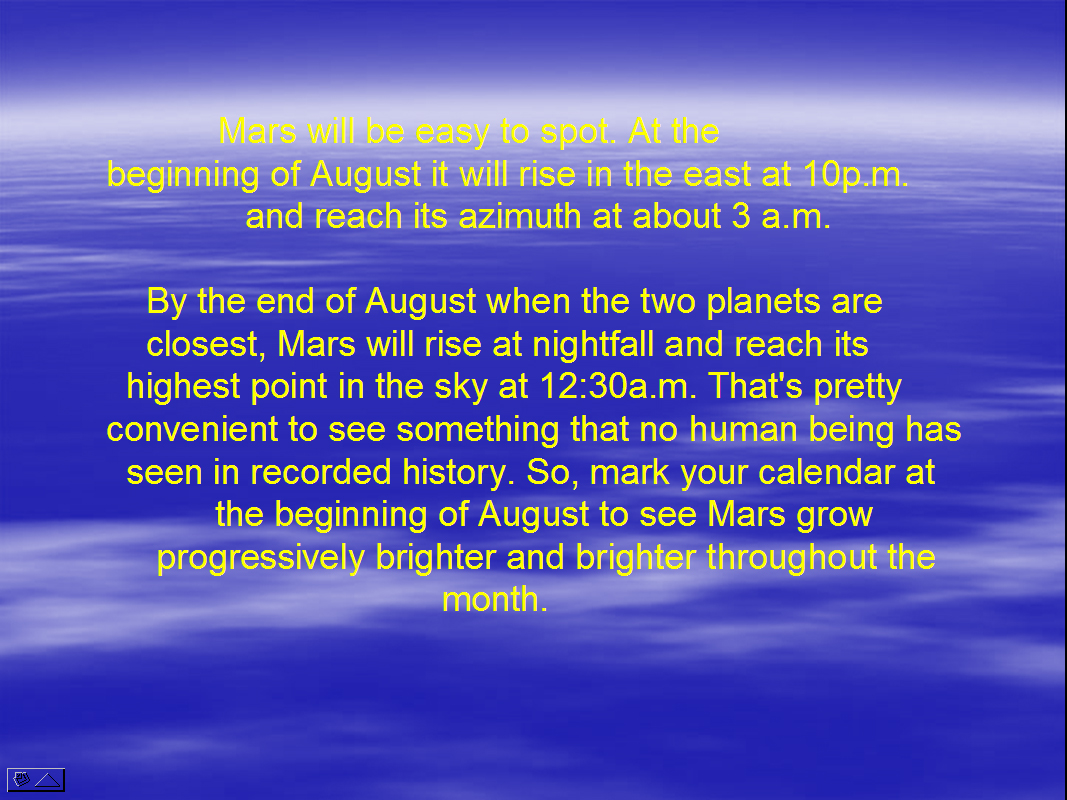
Mars Hoax PowerPoint 2009 Page 2

Mars Hoax PowerPoint 2009 Page 2

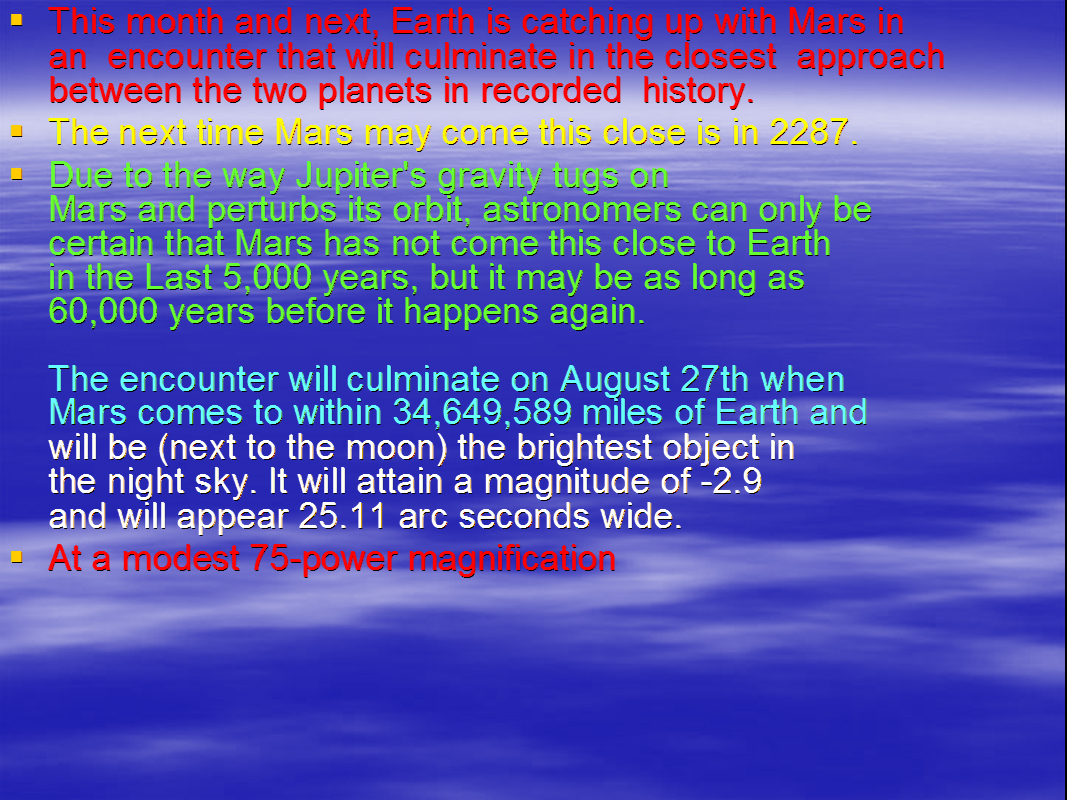
Mars Hoax PowerPoint 2009 Page 3

Mars Hoax PowerPoint 2009 Page 3

Mars Hoax PowerPoint 2009 Page 4

Mars Hoax PowerPoint 2009 Page 4

Mars Hoax PowerPoint 2009 Page 5

Mars Hoax PowerPoint 2009 Page 5

Anyway, more info on the history of this hoax is here.

And some further links from other people:

~ A l i c e !

Aliens? Yes. UFOs? No.

On the topic of aliens and UFOs, I agree with the giants of astronomy education (Carl Sagan, Neil DeGrasse Tyson, and Phil Plait to name a few). Somewhere out there is life. It may or may not be intelligent, but it probably exists. Have “they” visited us? The possibility is vanishingly small. In short: Space is huge, it would be amazing if the right combination of our 120+ known elements only came together to form life here on Earth and nowhere else.

I’m going out on a limb. I’m not trained in rhetoric, so I expect my discussion to have major loopholes. I invite readers knowledgeable about this topic and knowledgeable about rhetoric to comment, and help me close up those loopholes. I would also like to point out that I started writing this article on November 18th, 2008 (I’ve been struggling with it for a long time). Phil wrote his post of the same title on November 25th, 2008. Whether you believe me or not, I’m not copying him.

Finding a Place to Live:

When we talk about alien life, we talk about “life as we know it.” Life as we know it needs liquid water, which is between the temperatures of 0C and 100C. Our experience suggests that this occurs on planets and moons.

Have we found planets? Yup. We’ve got 322 (last I checked) planets orbiting other stars, and those were the ones that were EASY to detect. Those don’t tend to be in the right temperature zone, but if we’ve found 322 in just the last 5-10 years, imagine how many more there must be!

Creating Life:

You need some complex molecules to create even a single-celled organism. Carbon is great for this, because it can easily make form four bonds to other elements. Imagine Legos(TM). You can build anything you want out of Legos(TM), even if all you have is the quintessesntial 8-stud brick, because you can attach pieces together in other ways than just a straight line. When I was in school we also had Unifix Cubes. They were so frustrating, because all you could do was make a long chain. You couldn’t build robots or houses or anything. Carbon is the Lego of the Universe, Helium is the Unifix Cubes. There aren’t many other elements that can be the Lego of the Universe. Silicon is one, but Silicon is significantly less common in the Universe than Carbon. One of my astronomy professors argues strongly against the possibility of Silicon-based life, but I’d like to leave the door open on that one: the Universe is a strange place.

Something More:

We don’t know what it is, but there’s something else that you need to move from a gigantic mass of complex molecules to something “alive.” Is it protection from contamination? Is it the ability to take in and use energy? Scientists are working on this. (Here’s a much better article that reinforces the “moving energy around” idea as what got life going: Why Life Originated.The original link that caused me to say “protection from contamination” is here, though I don’t really like it much.)

So, the first two are easy. The third one we’re not sure about, but People Who Know think it’s a problem for us as humans to figure out, but not too difficult for Nature to stumble across. After all, Nature has a lot of space and a lot of materials, all combining in different ways all the time.

UFOs:

Once you’ve got life, you need to evolve into something intelligent. Then into something that can communicate – that took us millions of years. Then (if you want SETI to succeed) you’ve got to communicate across thousands, hundreds of thousands of lightyears, and stay alive long enough to get a response (this is hard). If you want our UFOs to be of real alien origin then you ALSO need to become spacefaring, travel across thousands, hundreds of thousands of lightyears, (stay alive for that entire journey – which is SUPER-HARD), and arrive at Earth. Hmm.

Earth has only been broadcasting signals into space for 50-100 years. If they’re further than 100 lightyears away, how would they decide to come here? Before we started broadcasting we were nobody. If they’re closer than that, and they can detect radio transmissions, why haven’t we heard their radios? Or, if you want to believe in UFOs, how did they get here so fast? It violates our understanding of Physics, and it doesn’t add up. They do this in Star Trek with fictitious (and awesome) inventions like subspace and warp drive. In Star Wars and Babylon 5 they use hyperspace. In Stargate they use a portal. Fiction. All of them.

When we invent warp drive (real and for true) I’ll eat my words and grant you the possibility that the UFOs really are aliens. Till then, I’m going to say it’s probably the Goodyear Blimp, a bollide, or even a pretty planet.

Who Do You Trust?

Why are you listening to me? I’m not an expert in aliens (who is?). I’ve only seen one UFO in my life (it later became an IFO: the Goodyear Blimp). So then, if I’m not the expert, what did I base this article on?

With the breadth and depth of knowledge now available to the human race, one person can no longer “know everything,” nor can one person understand everything. We are not Erastothsenes, Aristotle, or Plato. We have to trust other people to tell us things. Because of this, we have to choose where we get our information carefully, and everyone will choose different sources as trustworthy.

Me? I trust Carl Sagan and Phil Plait. I also tend to trust Neil DeGrasse Tyson, though I disagree with him on some points of quality education. I like to trust NPR, and I listen to everything Garrison Keillor has to say. I don’t trust Wikipedia to do anything other than jog my memory, point me towards a list of sources, or give me unimportant information (how old is Zac Efron?). I get my tech news from Boing Boing, and my local news and weather from specific blogs (I choose blogs for local information because they know they’re fast, up-to-the-minute, they know they’re biased and admit their bias, and the writers can change their minds and edit things anytime). For current astronomy questions I ask my college profs, re-read my texts, look at the data, and wade through the peer-reviewed papers (if I have time).

Where Did I Get My Info?

Check out what Phil has said about SETI and about UFOs:

Neil DeGrasse Tyson gave a great speech about this to Congress.

How many aliens are there? Figure out your best guess with the Drake Equation.
Mars Hoax, Again Again and Again

Edited to add: The 2009 Edition of this post is up!

Phil reminded me, the Mars Hoax is coming around again.

Previously published here.

For those of you who are connected to the astronomy education world, it’s that time of year: the “Mars will be as big as the Moon” e-mail is going around again. The short answer is “Nope.”

The Beginning:
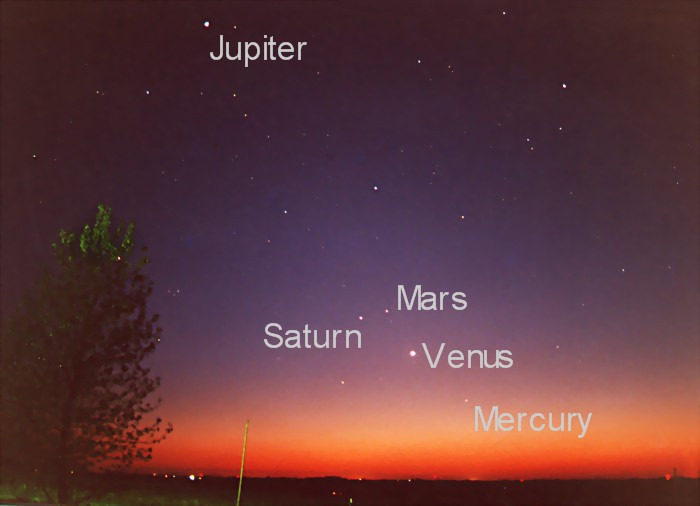
Mars and Earth regularly pass “close” to each other, but not that close. Astronomers get excited because we’re at “closest approach” or “opposition,” so our ground-based telescopes have a better view of Mars. Will you see a difference without a telescope? Not really, Mars may be a little brighter or a little redder, but it will still look, to your eyes, just like a star.

2007_08_06 5 Planets
Credit: Dan Bush
Caption: This is what planets look like to the naked eye.

This e-mail hoax started in August 2003, when Mars was actually very close, astronomically speaking. It was a mere 35 MILLION MILES AWAY. Since then, the e-mail has been going around every August, with the date slightly changed.

The Truth:
In 2007 Mars was at opposition in December, not August, and it will still be 55 million miles away. The next one after that is in January of 2009 2010. So, you’ve got a while to wait.

Here is what some scientists are saying:

Dec 18, 2007- Closest approach of Mars and Earth (0.589 AU = 88.42 million km). Apparent diameter of Mars is 15.88″ (seconds of arc). The apparent diameter of the Moon is about 1/2 degree which is 1,800″ (seconds of arc). So, will Mars look as big as the Moon? Not even close. [1 degree = 60 arcminutes – 3,600 arcsec]
-Alan Gould, UC Berkeley

The Moon and Mars could not look alike in the sky, BUT an astronomer might say that that through a telescope at 100X, Mars _through a telescope_ might look almost as big (1,588″) as the Moon to the unaided eye (1,800″). Perhaps the part of the comparison about looking through a telescope was lost, and media types looking for a hype to hang a story on ran with it. That’s the only explanation I can give about the recurring story about Mars being as big in the sky as the Moon. This story reappears at almost every opposition of Mars, especially the really close ones.
– Steve Berr

Let Them Down Easy:
So what do you say to someone who is excited? Cover each of these topics:

  • Validate the excitement
  • Point out something related that will be cool
  • Correct the misconception
  • Invite them to view/look up something real

For example:
“So did you hear about Mars being as big as the Moon?”
“Yes! I agree, that would be awesome. You know, October 2009 through April of 2010 is really going to be the best time to view Mars though, maybe we could take out a telescope together? Unfortunately, it’s still really far away, so it won’t ever look as big as the Moon. Also, if you want to see something cool sooner, let’s go out and see the Andromeda Galaxy or Jupiter this month!”

Want More?
http://www.badastronomy.com/bad/news/marsattacks2005.html
http://en.wikipedia.org/wiki/Apollo_moon_landing_hoax_accusations
http://www.snopes.com/science/mars.asp

Planetary Alignment

Question:

“I’m interested in the stars and planets. One thing I always wondered about is if the planets in the solar system ever totally align with each other, so I mean not just a few planets but ALL of them. If this happens, how often does it occur? And is there a name for it? Thank you.”

Note:

This question comes up every once in a while. Partially it’s due to random doomsayers, and partially it’s due to Lara Croft: Tomb Raider, in which there is a planetary alignment causing widespread … actually, I don’t know what it causes, I haven’t seen the movie.

Answer to “Does this happen? How often?”:

This is a difficult question to answer. First off, as an astronomer I have to point out that the planets aren’t all in exactly the same plane. If one of these alignments occured, when you looked down on the solar system from above you would see the planets in a line, if you looked from the side at the same time, some would be a little higher, and some would be a little lower.

Everything I’m reading is pointing to the fact that even that sort-of alignment probably won’t happen. On May 5, 2000, the Earth, Sun, Mercury, Venus, Mars, Jupiter, and Saturn were close to a line, but it wasn’t perfect. Check out this simulator, you’ll have to type in 2000-05-05 in the date field.

Planetary Confluence from wonderquest.com

Planetary Confluence from wonderquest.com

Phil Plait over at Bad Astronomy says this: “As it turns out, planetary alignments are fairly rare. Getting more than three lined up is difficult; getting them all lined up is rare indeed. But 5 billion years [the length of time the solar system has been around] is a long time! Alignments may be rare, but given enough time they do occur, and the Earth is still here. Even more, what most doomsayers say is an alignment is really more of a confluence, or loose gathering, of planets.”

You’d think that with the planets going around the Sun for 5-10 billion years we’d get a perfect alignment at least once, but it looks like the math just doesn’t work out.

Answer to “What is it called?”:

The article from almanac.com calls this a “great conjunction,” which is a pretty good word. Conjunction just means that from our point of view the planets end up close to each other in the sky.

Phil Plait would call these things “confluences,” since they’re not a perfect line.

The other word I can think of to describe this is “syzygy” which refers to the alignment of at least 3 celestial bodies. It doesn’t really apply though to the 5/5/2000 conjunction, because the planets aren’t in a straight line. So, save up the word and use it next time you play Scrabble.

Update 2/22/2009:

Amazingly, this is one of my most popular posts of all time. I’ve also gotten several questions recently about the “upcoming” planetary alignment. Hmm. I don’t know exactly which one y’all are interested in, but a quick web search turned up March 26th, 2009 as something the astroLOGERS seem to be interested in. Here’s what that alignment looks like according to the simulator I linked to above:

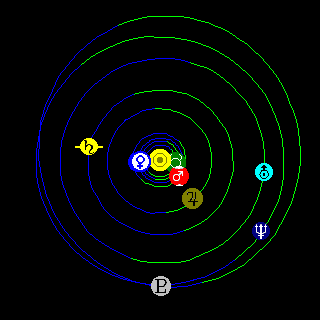
Planetary Alignment March 26th, 2009

Planetary Alignment March 26th, 2009

In case you can’t tell – Earth is an icon underlying Venus in this picture. Doesn’t mean the Earth is under Venus – it means the icons in this picture are too big. Looks like the big deal is the Earth, Venus, Sun, Mercury “line.” Good luck all – you’re not going to be able to see a thing for this one – the blasted Sun is in the way! :)

Where’d I Get My Info?

Planetary Orbit Simulator
Tomb Raider’s Science is Wrong
Phil Plait’s Article
Nothing Special Will Happen on 5/5/2000
Syzygy

Update: 6/26/2009

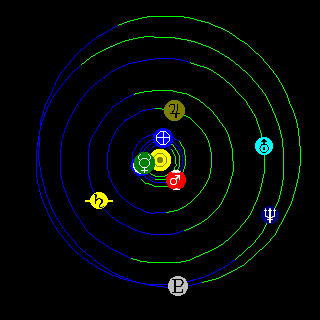
P.S. Here is the “alignment” of the planets on 12/12/2012:

On 12/12/2012 the planets will be in this position.

On 12/12/2012 the planets will be in this position.

Hmm.

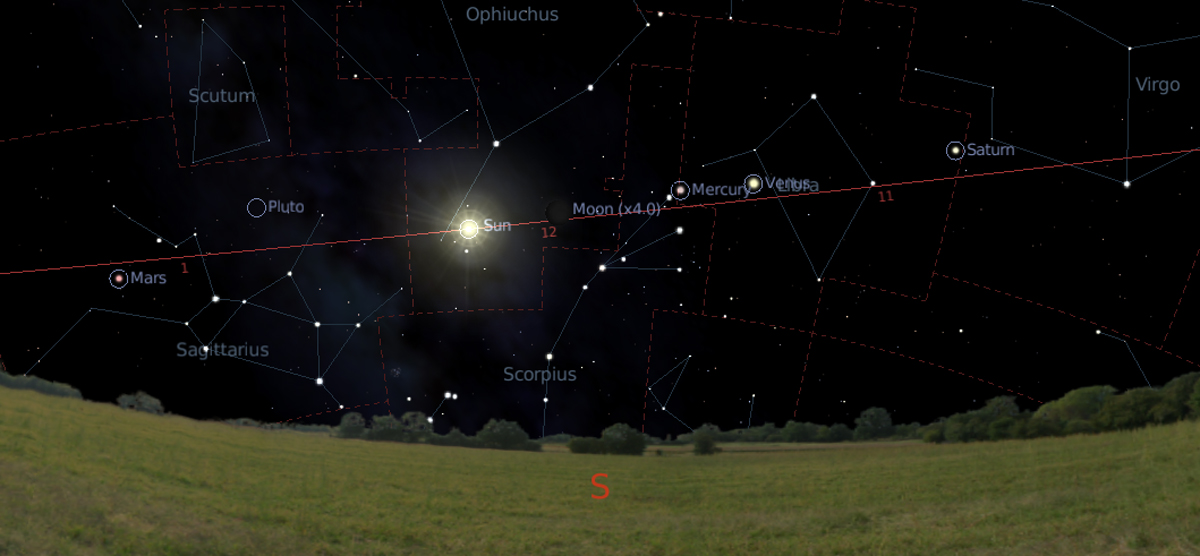
Here’s what that looks like in Stellarium – at noon on 12/12/2012

Don't forget - that line is the ecliptic

Don’t forget – that line is the ecliptic

That looks pretty lined up – but don’t forget – the line those planets (and the Sun and Moon) are all aligned on? It’s the ecliptic. The Sun, Moon, and planets are all ALWAYS lined up along that line somewhere. Always. Even right now. Go turn on your Stellarium, turn on the ecliptic, and set it for today, right now. You’ll find every planet on that line. And the world isn’t ending. Hmm. And you won’t see it – this is during the day.

Update: 7/7/2009

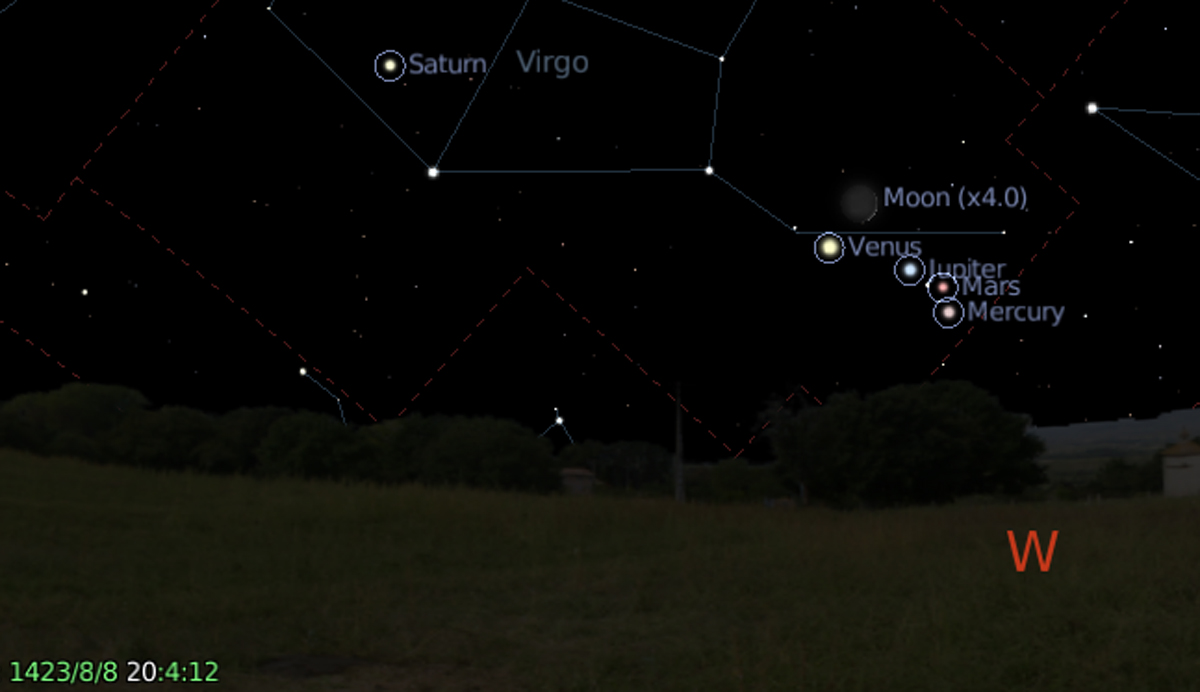
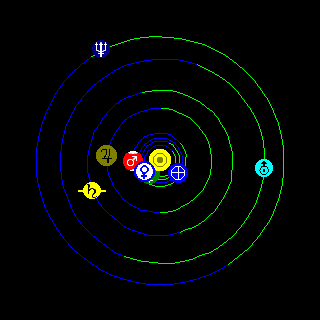
Charity asked about the conjunction on 8/8/1423. Here’s what it looks like:

August 8, 1423 8pm - from Stellarium

August 8, 1423 8pm – from Stellarium

August 8, 1423 - Planetary Orbit Simulator

August 8, 1423 – Planetary Orbit Simulator

Mars Hoax Again

For those of you who are connected to the astronomy education world, it’s that time of year: the “Mars will be as big as the Moon” e-mail is going around again. The short answer is “Nope.”

The Beginning:
Mars and Earth regularly pass “close” to each other, but not that close. Astronomers get excited because we’re at “closest approach” or “opposition,” so our ground-based telescopes have a better view of Mars. Will you see a difference without a telescope? Not really, Mars may be a little brighter or a little redder, but it will still look, to your eyes, just like a star.

2007_08_06 5 Planets
Credit: Dan Bush
Caption: This is what planets look like to the naked eye.

This e-mail hoax started in August 2003, when Mars was actually very close, astronomically speaking. It was a mere 35 MILLION MILES AWAY. Since then, the e-mail has been going around every August, with the date slightly changed.

The Truth:
In 2007 Mars will be at opposition in December, not August, and it will still be 55 million miles away.

Here is what some scientists are saying:

Dec 18, 2007- Closest approach of Mars and Earth (0.589 AU = 88.42 million km). Apparent diameter of Mars is 15.88″ (seconds of arc). The apparent diameter of the Moon is about 1/2 degree which is 1,800″ (seconds of arc). So, will Mars look as big as the Moon? Not even close. [1 degree = 60 arcminutes – 3,600 arcsec]
-Alan Gould, UC Berkeley

The Moon and Mars could not look alike in the sky, BUT an astronomer might say that that through a telescope at 100X, Mars _through a telescope_ might look almost as big (1,588″) as the Moon to the unaided eye (1,800″). Perhaps the part of the comparison about looking through a telescope was lost, and media types looking for a hype to hang a story on ran with it. That’s the only explanation I can give about the recurring story about Mars being as big in the sky as the Moon. This story reappears at almost every opposition of Mars, especially the really close ones.
– Steve Berr

Let Them Down Easy:
So what do you say to someone who is excited? Cover each of these topics:

  • Validate the excitement
  • Point out something related that will be cool
  • Correct the misconception
  • Invite them to view/look up something real

For example:
“So did you hear about Mars being as big as the Moon?”
“Yes! I agree, that would be awesome. You know, December is really going to be the best month to view Mars though, maybe we could take out a telescope together? Unfortunately, it’s still really far away, so it won’t ever look as big as the Moon. Also, if you want to see something cool sooner, on August 27 there will be a lunar eclipse, and the Moon itself will look red!”

Want More?
http://www.badastronomy.com/bad/news/marsattacks2005.html
http://en.wikipedia.org/wiki/Apollo_moon_landing_hoax_accusations
http://www.snopes.com/science/mars.asp