Autumn Equinox Sunset Viewing – 2010

It’s time again! Add it to your calendar – the quarterly sunset viewing at Solstice Park is coming up in just a couple weeks!

  • When: Wednesday, September 22, 2010 at 7:07pm (so come at 6:30pm)
  • Where: Solstice Park (or, if you’re not in Seattle, wherever you have a view of the western horizon!)
  • Who: Everyone welcome, as usual.

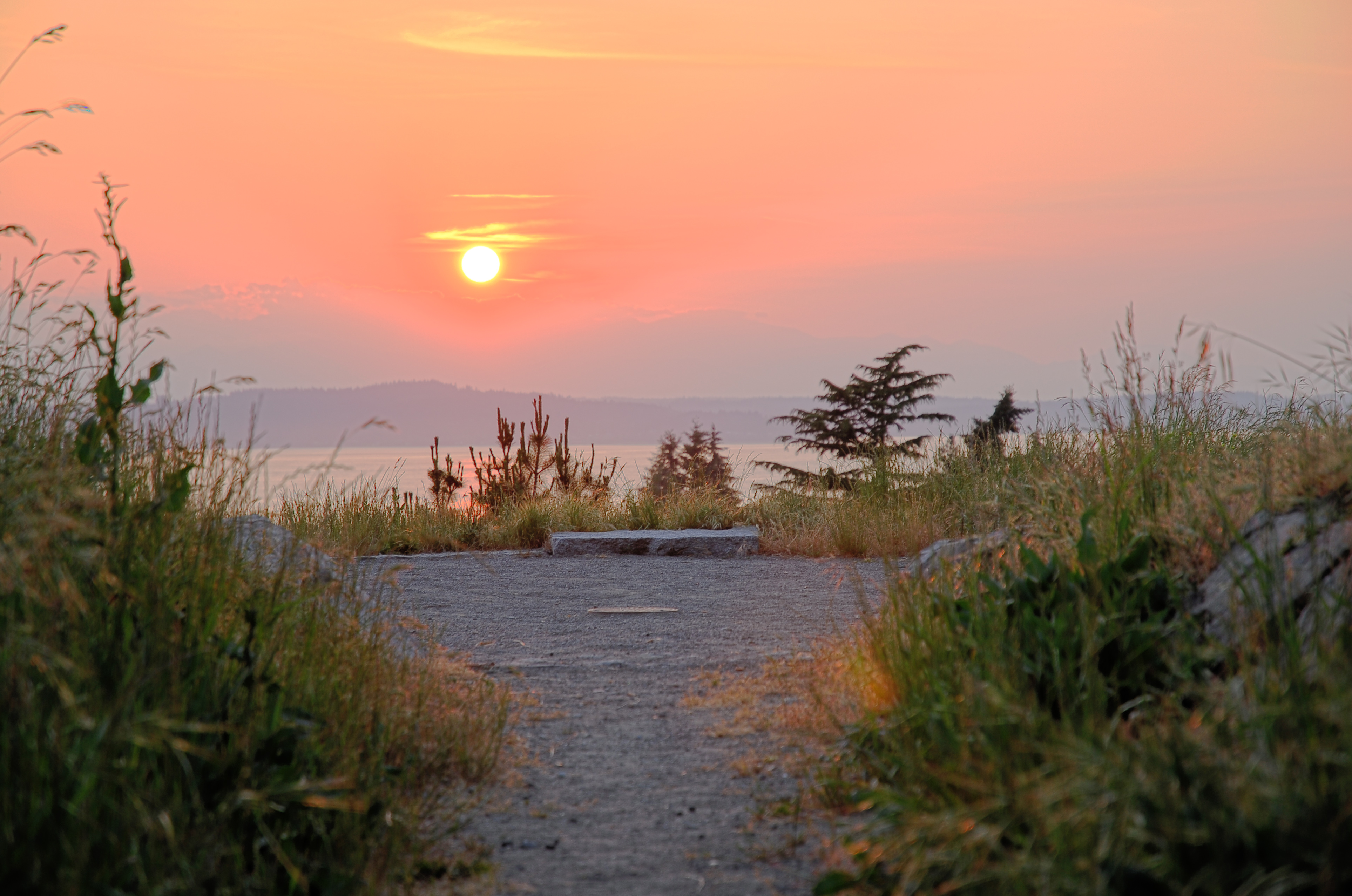
Sunset on June 11, 2009 Credit: Jason Gift Enevoldsen

Come watch the autumn equinox sunset at Solstice Park in West Seattle on Monday. We’ll see if the sunset lines up with the placed marker. I’ll be there even if it is cloudy, but not if the weather is miserable.

If it is clear we’ll bring a telescope or two to take a look at the Moon after the Sun goes down – and maybe Jupiter if we stay until it is dark enough.

If you’re interested – here’s the timing of various celestial events on Saturday from Seattle, courtesy of the U.S. Naval Observatory Astronomical Applications Department:

Sun and Moon Data for One Day

The following information is provided for Seattle, King County, Washington (longitude W122.3, latitude N47.6):

Wednesday 22 September 2010 Pacific Daylight Time

SUN
Begin civil twilight 6:25 a.m.
Sunrise 6:56 a.m.
Sun transit 1:02 p.m.
Sunset 7:07 p.m.
End civil twilight 7:38 p.m.

MOON
Moonrise 6:10 p.m. on preceding day
Moon transit 12:11 a.m.
Moonset 6:23 a.m.
Moonrise 6:28 p.m.
Moonset 7:27 a.m. on following day

This event is my part of the NASA’s Solar System Ambassadors program, and thanks to West Seattle Blog for publicizing the last few!

Everyone is welcome, see you there!

~ A l i c e !

Quick Updates: Kepler, Saturn, Perseids, Jupiter

Perseids:

The Perseids peak tonight after midnight. They’re dust- and sand-sized debris left in our path from comet Swift-Tuttle. The air compressing in front of each meteor generates enough heat that the debris burns up and we see a streak of light.

Kepler:

The Kepler mission (looking for Earth-like planets around other stars) has just proved it definitely can detect planets, with more detail and precision than other methods. Kepler observed the planet HAT-P-7, which orbits its star once every 2.2 days, and was able to detect the atmosphere of the planet, and measure the daytime temperature at 4310 degrees F. Ouch.

Saturn:

Saturn’s rings are edge-on from our point of view, which happens every 15 years when Saturn reaches its equinox. According to JPL that day was yesterday, August 11, though the rings will stay mostly edge-on for a while yet.

Jupiter:

I’m quite late off the mark on this one, but something crashed into Jupiter not too long ago. On July 19th an amateur astronomy (Anthony Wesley) found this extra dark spot on Jupiter, and later professional astronomers followed up on his observations with Hubble. With Hubble they can watch as the debris plume evolves, and make better estimates about the size of the impacting object (several hundred meters across).

There is a standing hypothesis that Jupiter, being large, helps clean up the debris in the solar system. It attracts more asteroids and comets, leaving the inner solar system clearer and thus making impacts on Earth less likely.

Want More?

Meteors
Saturn Images

Where’d I Get My Info?

Kepler
Saturn
Jupiter

~ A l i c e !