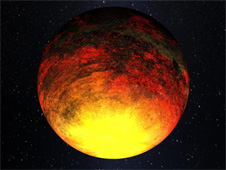
Kepler 10b

Kepler 10B - Artists' Concept (Credit: NASA)

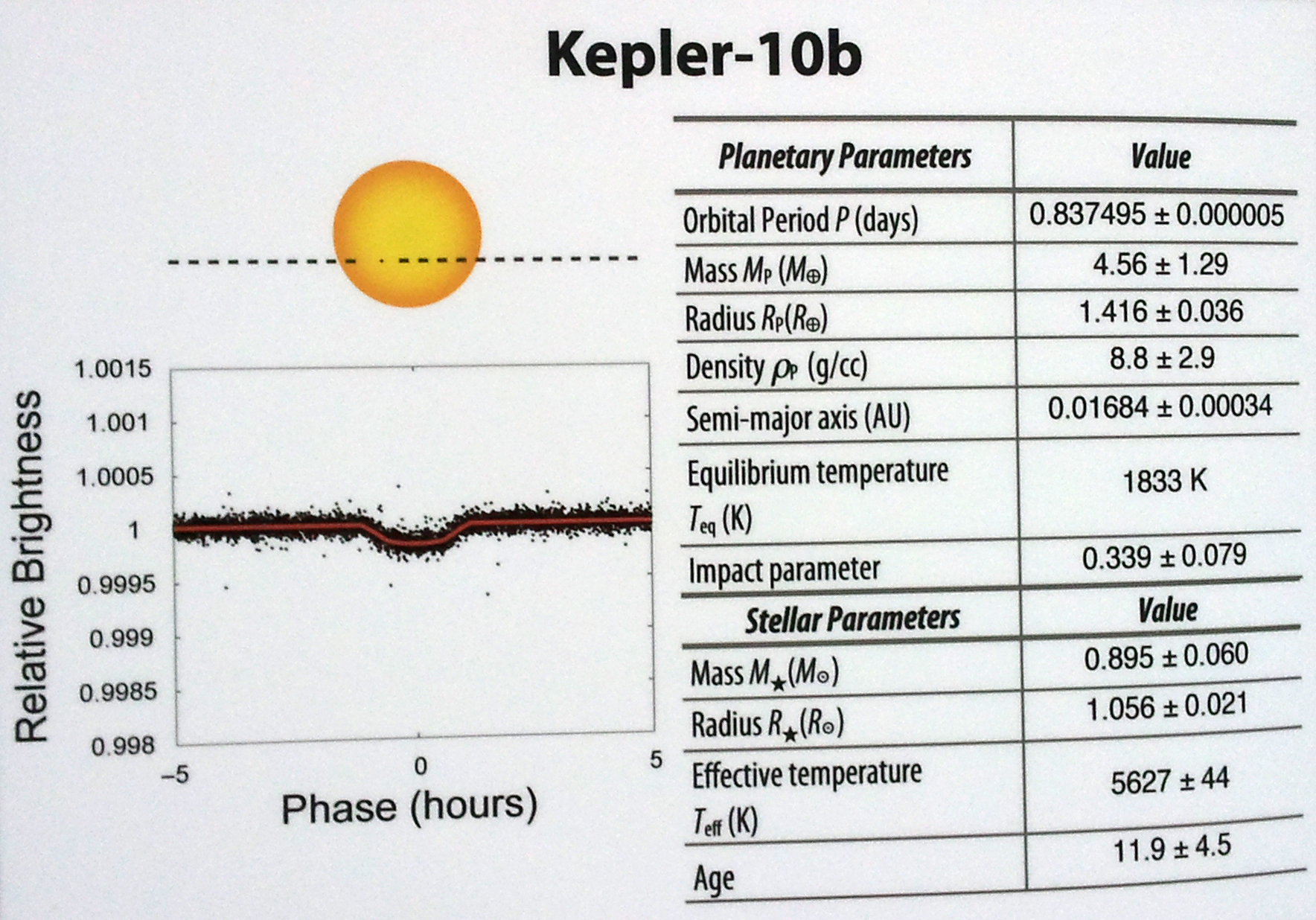
This newly-discovered planet whips round its star in less than an Earth day. Scientists used starquakes (starquakes!) to find out a little more about it, and they found that not only is it tiny, but it is also made of rock, just like our inner solar system.

It is a hot-lava planet.

A Confirmed Rocky Planet

I should mention that this planet is not Earth-like. Over the past couple years I’ve been hearing the phrase “most Earth-like planet ever discovered” bandied about by various news organizations, including some science press releases.

There’s a lot that goes into making a planet Earth-like.

  • Size: In the case of Kepler 10b, it is very small, less than half again the size of the Earth. There is nothing in our solar system nearer to this size than the Earth itself.
  • Composition: It is also definitely made of rock and metal, like the Earth, but it is denser than the Earth.
  • Distance: But, it’s incredibly close to its star, unimaginably closer than Mercury. It takes LESS THAN A DAY to circle its Sun once.
  • Temperature: This, paired with the fact that the planet is tidally locked (like our Moon is tidally locked to the Earth – same side always faces the Earth), leads to possibly the hottest planet you’ve ever tried to think about. It is hot enough to melt iron. Not lead, iron. It’s about 1833K (1560C, 2800F).
  • Habitable Zone: Kepler 10b is not in the habitable zone. Interestingly, the habitable zone does not imply that the planet is habitable, simply that it could have liquid water – if it had water at all. Kepler 10b’s water would have evaporated faster than you can say “habitable zone” if it ever did have water.
  • … and that’s just a few.

Some Stats

Kepler 10b Stats

Want More?

NASA Press Release

~ A l i c e !

Kepler Mission: Basic Background

Opening soon at the Willard Smith Planetarium will be Strange Planets, a show about how we detect planets around other stars. To whet your appetite – how about a few details about the Kepler Mission.

In short – the Kepler Mission is a telescope in orbit that is pointed at the exact same patch of sky for a period of four years (starting in 2009). It is detecting planets around other stars via the so-called transit method – watching as planets transit in front of their stars. By watching for five years it should be able to detect hundreds (if not thousands) of planets in Earth-like orbits, and therefore plenty of planets in their stars habitable zones.

Where is Kepler Looking?

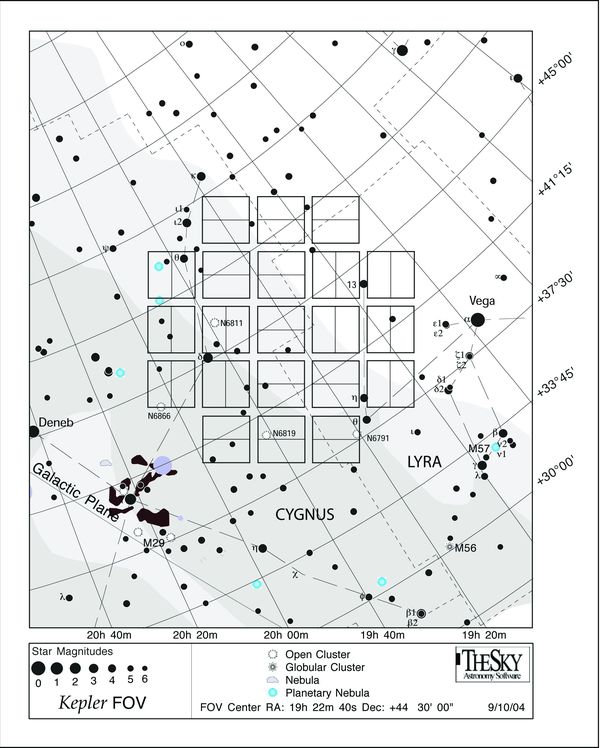
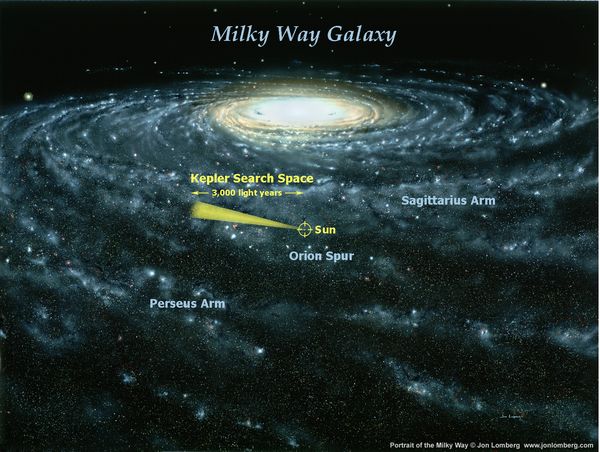
Kepler is closely watching a little patch of sky by the constellation Cygnus, pointed along our little section of the Milky Way, carefully avoiding all the brightest stars.

From NASA: Kepler's Field of View (Angle 1)

From NASA: Kepler's Field of View (Angle 2)

The Kepler Technology

Advanced gyroscopes onboard Kepler keep it pointed in exactly the same direction so the scientists at JPL can get unwavering readings on each star in Kepler’s field of view. To detect planets and calculate their orbits with certainty Kepler will have to watch each planet transit two or three times at least. For a planet like Earth, in its star’s habitable zone, the orbit takes about a year. Different sizes and temperatures of stars have habitable zones at different distances, but the Kepler mission will be able to do a good job at detecting planets with orbital periods up to about two years.

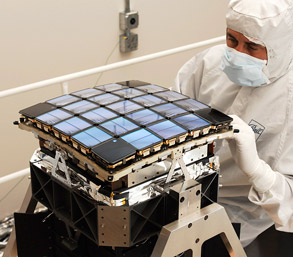
Look at this beautiful picture of the Kepler CCD array (from NASA). Ooo! Shiny!

New News: Hundreds of Planet Candidates Found

Characteristics of Kepler Planetary Candidates Based on the First Data Set: The Majority are Found to be Neptune-Size and Smaller

Authors: William J. Borucki, for the Kepler Team

(Submitted on 14 Jun 2010)

Abstract: In the spring of 2009 the Kepler Mission conducted high precision photometry on nearly 156,000 stars to detect the frequency and characteristics of small exoplanets. On 15 June 2010 the Kepler Mission released data on all but 400 of the ~156,000 planetary target stars to the public. At the time of this publication, 706 targets from this first data set have viable exoplanet candidates with sizes as small as that of the Earth to larger than that of Jupiter. Here we give the identity and characteristics of 306 of the 706 targets. The released targets include 5 candidate multi-planet systems. Data for the remaining 400 targets with planetary candidates will be released in February 2011. The Kepler results based on the candidates in the released list imply that most candidate planets have radii less than half that of Jupiter.

Comments: Paper to accompany Kepler’s June 15, 2010 data release; to be submitted to Astrophysical Journal
Subjects: Earth and Planetary Astrophysics (astro-ph.EP)
Cite as: arXiv:1006.2799v1

(added 6/15/2010 3pm)

Want More?

Kepler’s Website (Official Honoree of the Webby Awards!)

The New Worlds Atlas

The Extrasolar Planets Encyclopaedia – a good resource for the latest exoplanet totals and discoveries.

~ A l i c e !

arXiv:1006.2799v1 [astro-ph.EP]