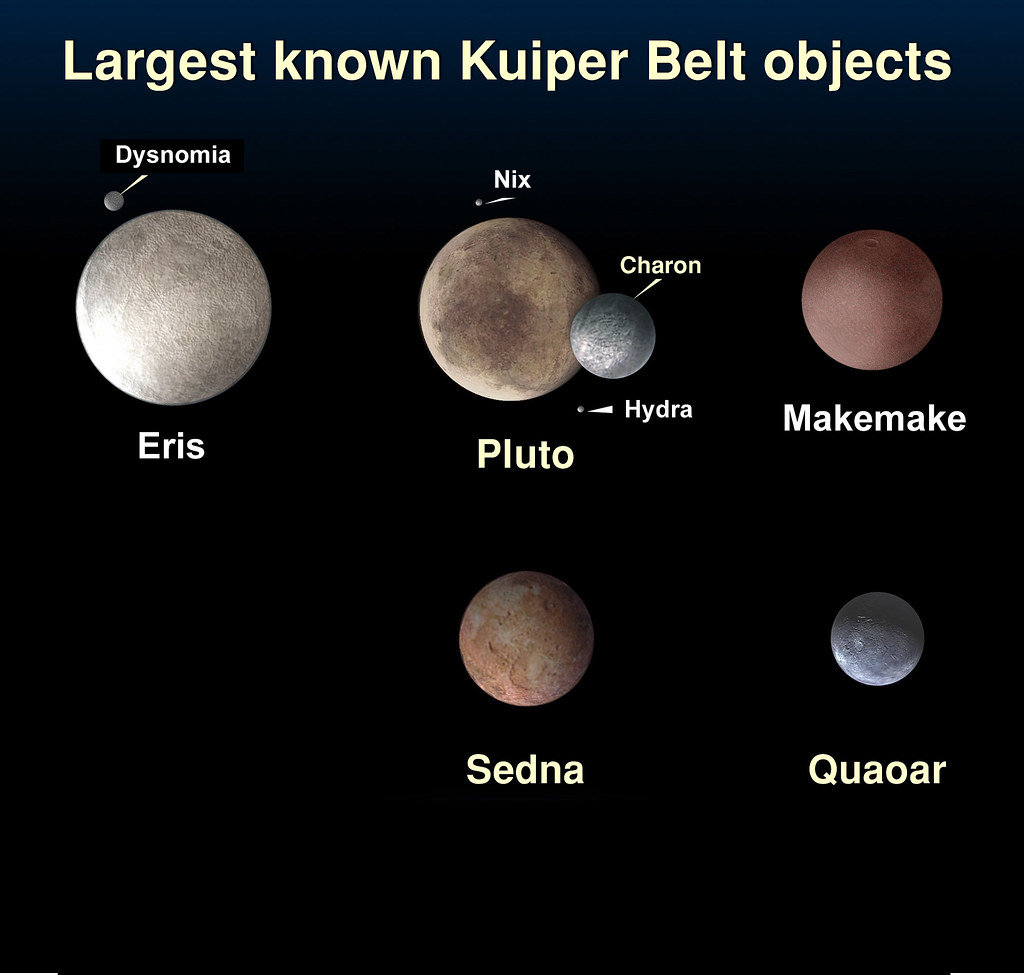
A List of Dwarf Planets
Updated September 18, 2008
Haumea:
Diameter: 1,320-1,550 km
Orbit Radius: 35.161-51.525 AU
Moons: Hi’iaka and Namaka
Composition: almost all rock
Discovered: 2003 Mike Brown, Chad Trujillo, and David Rabinowitz or Francisco José Aceituno Castro, Pablo Santos-Sanz, and Jose-Luis Ortiz
Resource: http://www.planetary.org/blog/article/00001649/, http://web.gps.caltech.edu/~mbrown/2003EL61/
Other Classifications: Plutoids, Trans-Neptunian Object, Kuiper Belt Object
Make-make:
Diameter: 1,600 km
Orbit Radius: 38.666-52.809 AU
Moons: ?
Composition: ?
Discovered: 2005 Mike Brown, Chad Trujillo, and David Rabinowitz
Resource: http://www.planetary.org/blog/article/00001553,
http://www.mikebrownsplanets.com/2008/06/whats-in-name.html
Other Classifications: Plutoids, Trans-Neptunian Object, Kuiper Belt Object
Eris:
Diameter: 2400 km
Orbit Radius: 38.17- 97.61 AU
Moon: Dysnomia
Composition: roughly half rock, half ice
Discovered: 2003-2005 Mike Brown, Chad Trujillo, and David Rabinowitz
Resource: http://www.planetary.org/explore/topics/trans_neptunian_objects/eris.html
http://web.gps.caltech.edu/~mbrown/planetlila/
Other Classifications: Plutoids, Trans-Neptunian Object, Kuiper Belt Object
Ceres:
Diameter: 950 km
Orbit Radius: 2.98 AU
Moons: none
Composition: rock with 17-27% water ice
Discovered: 1801 by Guiseppe Piazzi
Resource: http://www.planetary.org/explore/topics/asteroids_and_comets/ceres.html
Other Classifications: Asteroid
Pluto:
Diameter: 2,306 km
Orbit Radius: 30.164- 48.494 AU
Moons: Charon, Nix, Hydra
Composition: probably a mixture of 70% rock and 30% water ice
Discovered: 1930 by Clyde Tombaugh
Resource: http://www.nineplanets.org/pluto.html
Other Classifications: Plutoids, Trans-Neptunian Object, Kuiper Belt Object
Want More?
Planetary Names List of Dwarf Planets
Planetary Society List of Notable Trans-Neptunian Objects
Where’d I Get My Info?
Thanks to Mike Brown, Emily Lakdawalla, and Bill Arnett