Livestream Commentary: Mars Perseverance Entry, Descent, and Landing

I will be hosting live commentary over Zoom during the Entry, Descent, and Landing of Mars Perseverance.

When: Thursday, February 18, 2021 12:20pm-1:15pm

Where: Register in advance for this meeting (because it is public)

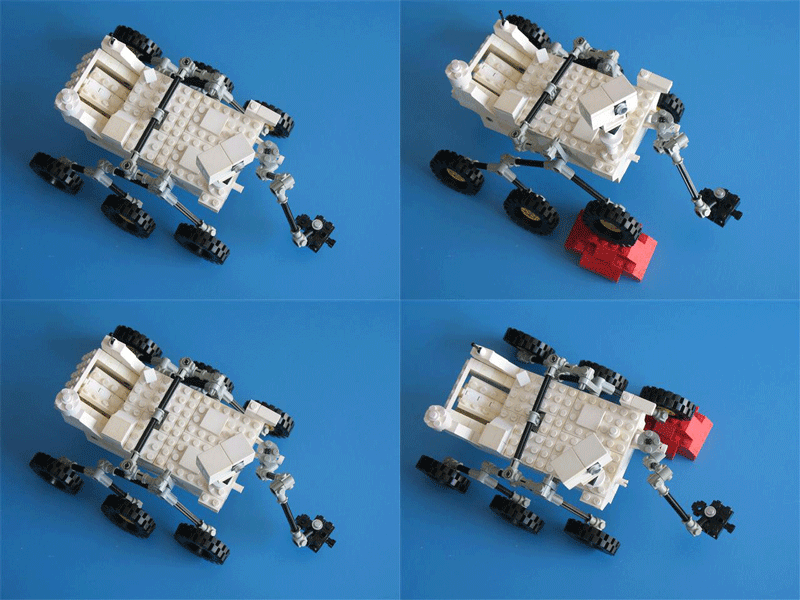
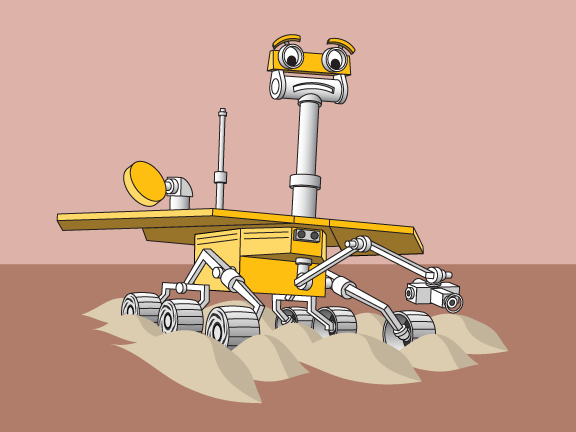
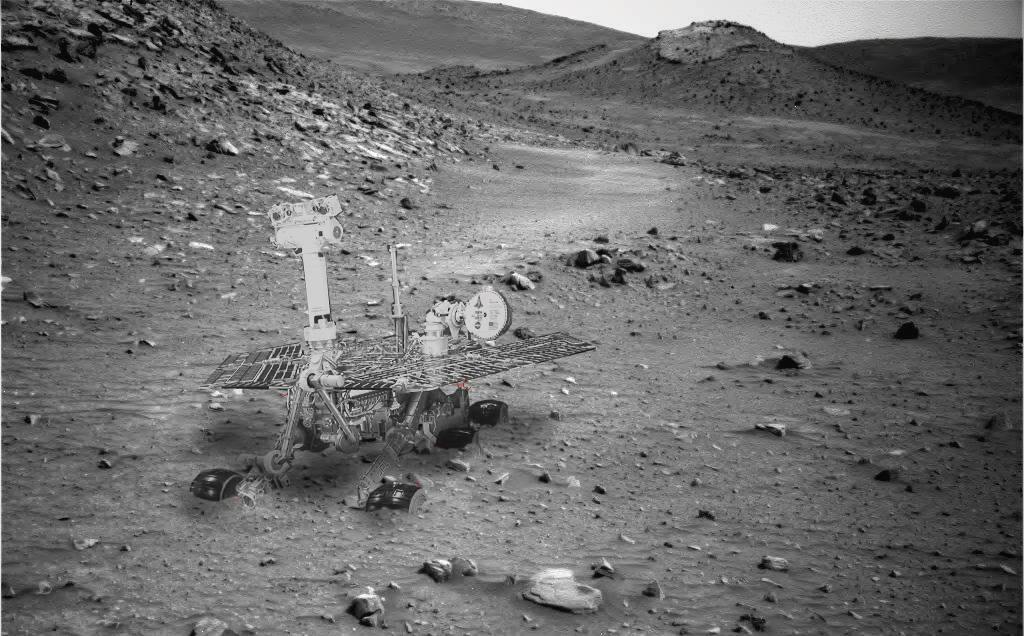
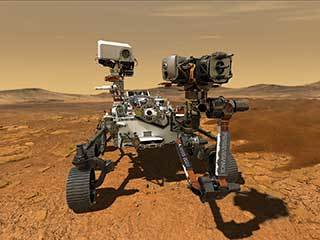
A rover on Mars with six wheels, a camera on a mast, and an arm with equipment on it.

I will be livestreaming the splashdown via https://mars.nasa.gov/mars2020/timeline/landing/watch-online/ within the commentary. I will be chatting directly with you, and will attempt not to be talking over the NASA official commentators, but explaining some terms they use and answering your direct questions.

To watch the livestream of the launch on your own go to NASA’s Mars Landing site to get the best links from NASA.

Also, here are some great activities and information to get you started.

<iframe src="https://mars.nasa.gov/gltf_embed/25042" width="100%" height="450px" frameborder="0"></iframe> <iframe src="https://mars.nasa.gov/gltf_embed/25043" width="100%" height="450px" frameborder="0"></iframe>

See you later this month!

-Alice

Watch the MAVEN Launch With Me: Monday at 10am Pacific

Hey everyone, I’ll be live-Google-Hangouting from the MAVEN launch (next mission to Mars) in Florida on Monday morning (November 18th. The launch is at about 10:20 Pacific Time, so tune in around 10am.). That’s right, you get me as an on-location reporter for this launch for the first time ever … I’ve never been to a real in-person launch before. I’ll be watching from the Causeway.

I’ll be co-hosting with Shannon Hall and Sarah Culp, who will be Hangouting from Pacific Science Center. Turn on NASA TV in one browser, and join our Hangout in another. Can’t wait to see you! I’ll be posting links here as I get them, and if all else fails check in on my Twitter and Pacific Science Center’s Twitter to get the full scoop that morning!

You can also join Shannon and Sarah in person at Pacific Science Center, details to follow later this afternoon.


Edit to add: You can listen to my interview on KOMO about the MAVEN launch if you missed this hangout or the interview on the actual day of launch.

~ A l i c e !

Mars Rover Rocker-Bogie Differential

Today’s is a guest post, brought to you by my father, engineer, physicist, computer programmer, and Lego, Mars, and animation enthusiast: Keith Enevoldsen. If you’re not caught by the title of the post, scroll down and look at the pictures… then scroll back up and read the rest of the article because it is fascinating stuff! (P.S. He has a website full of awesome science stuff too!)
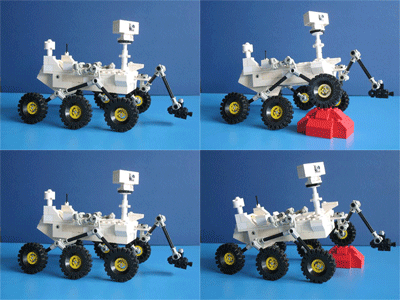
A teaser for what you have to look forward to…

~ A l i c e !

The Rocker-Bogie

All the Mars rovers have six wheels and use a rocker-bogie suspension system to drive smoothly over bumpy ground. The rocker-bogies are easy to see in pictures of the rovers (see pictures below). There is one rocker-bogie assembly on each side of the rover. The rocker is the larger link that connects to the rover body (the chassis) in the middle (at the rocker pivot), has a wheel on the front, and connects to the bogie in the back. The bogie is the smaller link that connects to the rocker in the middle (at the bogie pivot), and has wheels at both ends. Each of the six wheels has its own motor.

The Differential

It is not so easy to see and understand how the rocker-bogie mechanism keeps the body level. What prevents the rover body from tipping all the way forward or backward around the rocker pivots? If you build a model rover and you attach the rockers to the body with an axle or two pivot pins, the body will tip forward or backward until it hits the ground! In the real rovers the two rockers connect to each other and to the body through a mechanism called a differential. The differential is what keeps the body level. Relative to the body, when one rocker goes up, the other rocker goes down. Relative to the ground, the body angle is halfway between the angles of the two rockers. That’s cool, but how does it work? The different rovers use different mechanisms: a differential gearbox or a differential bar.

Differential Gearbox

The Mars Pathfinder (Sojourner) and Mars Exploration Rovers (Spirit and Opportunity) use differential gearboxes.
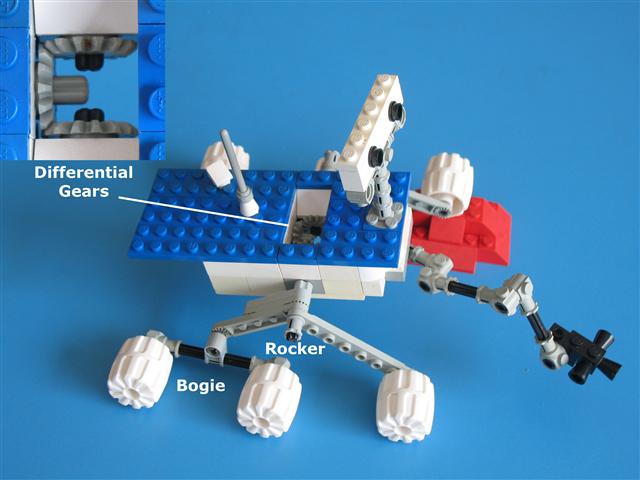
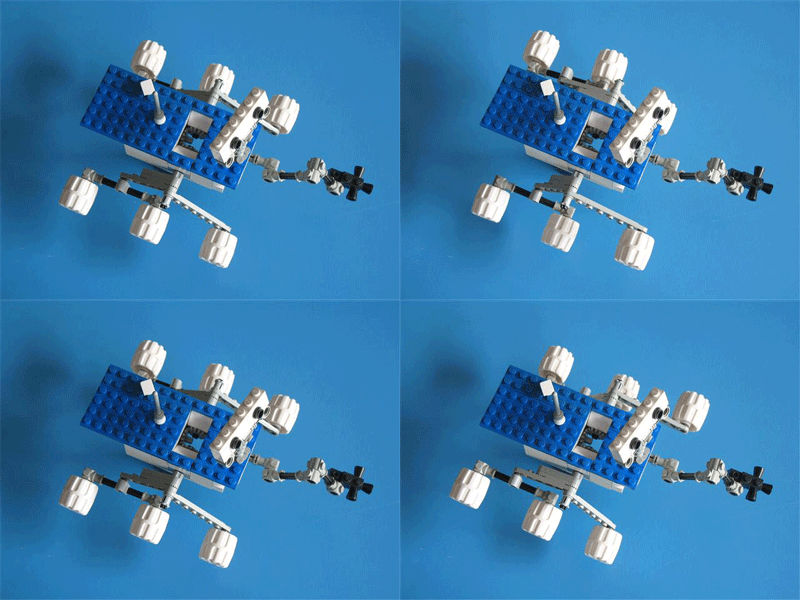
MER’s Differential
Image and Model © 2012 Keith Enevoldsen

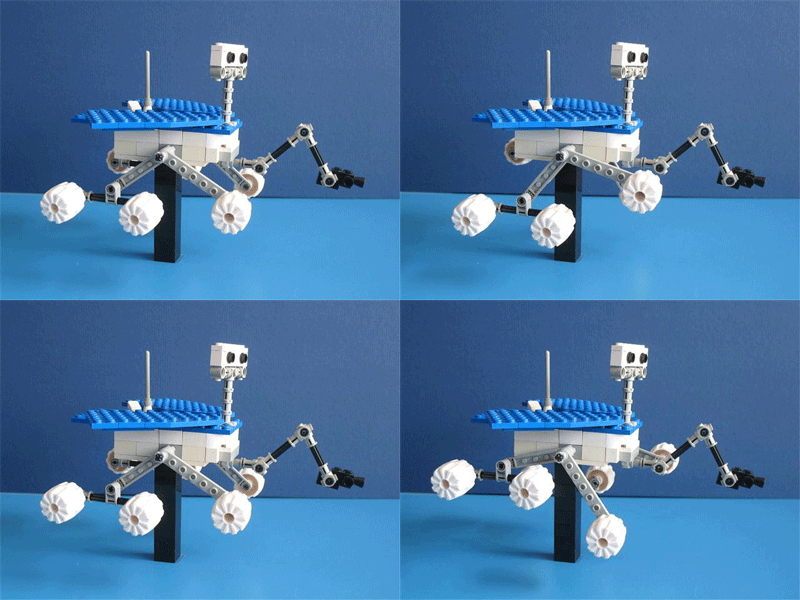
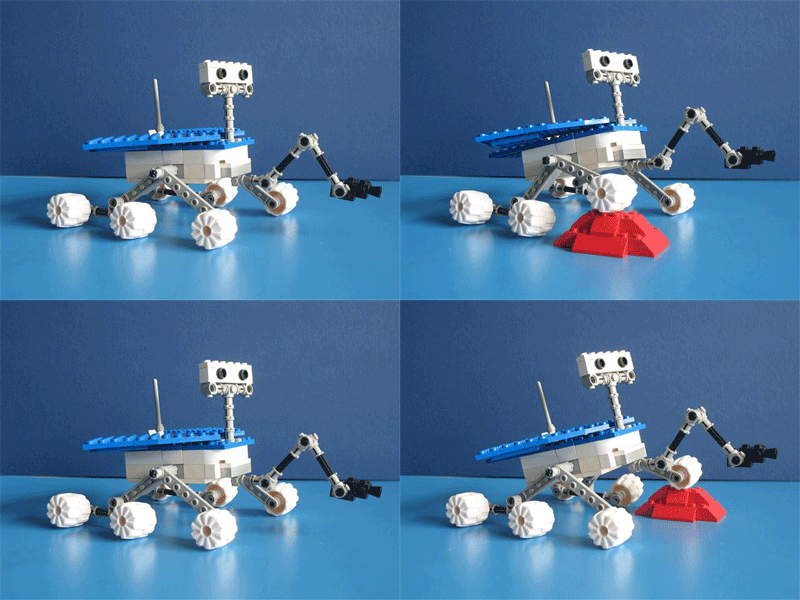
The gearbox is inside the rover body, so you never see it. No wonder it is hard to figure out how it works! In my Lego model rover shown here, I use a simple three-gear differential. Two gears connect to the two rockers and the third (middle) gear connects to the body. If you hold the model rover body steady in midair and tilt one rocker up, the gears will turn and the other rocker will tilt down (see the animations below).

The real Mars Exploration Rovers use more complicated gearboxes with more gears but they are functionally equivalent to this simple three-gear differential.

Differential Bar

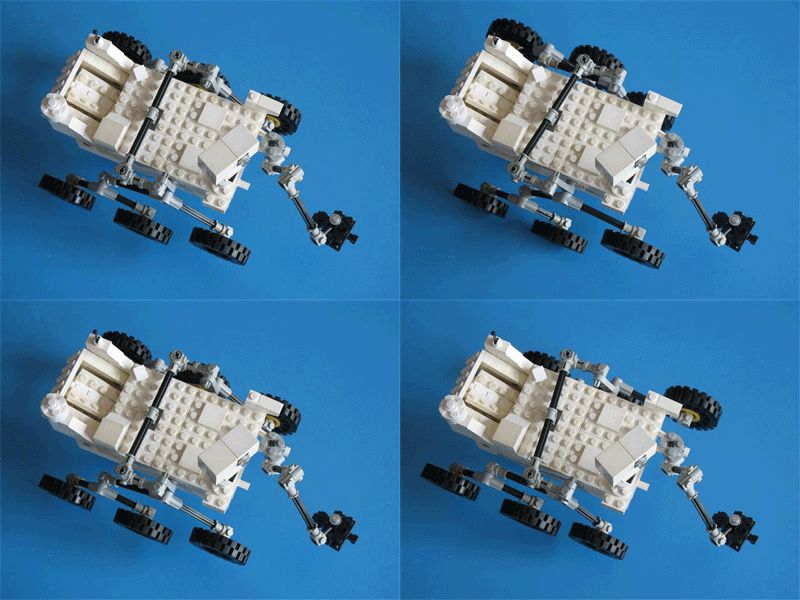
The Mars Science Laboratory (Curiosity) uses a differential bar. This is the big black bar that you see across the deck of the rover.
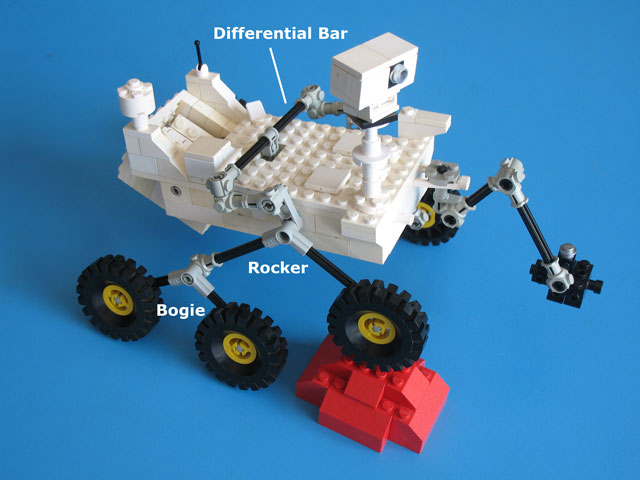
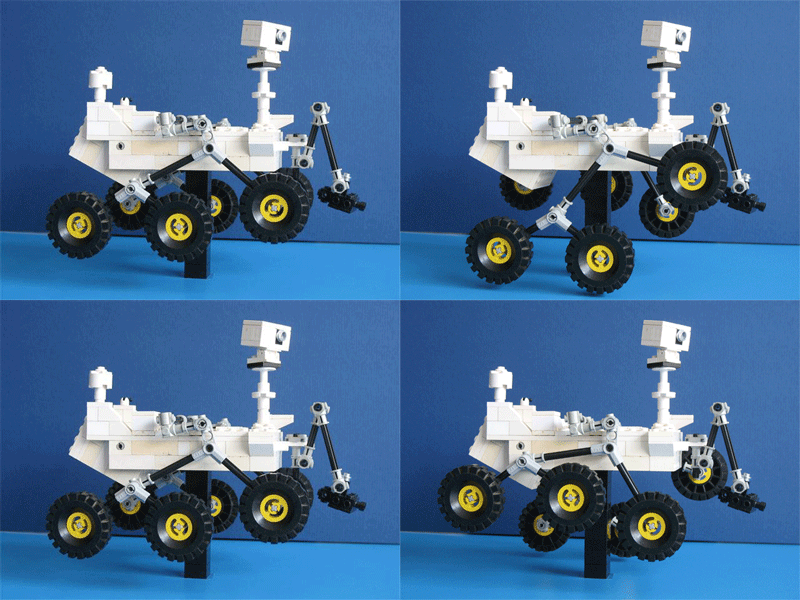
Curiosity’s Differential
Image and Model © 2012 Keith Enevoldsen

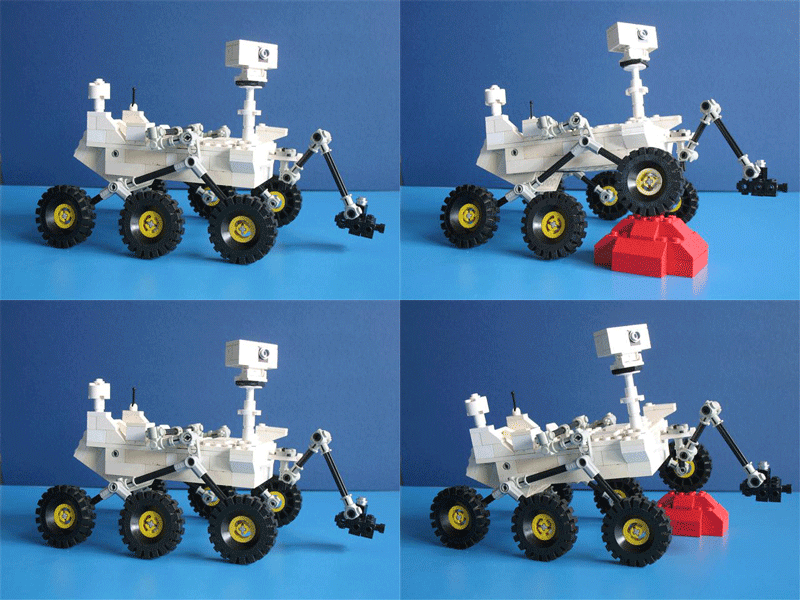
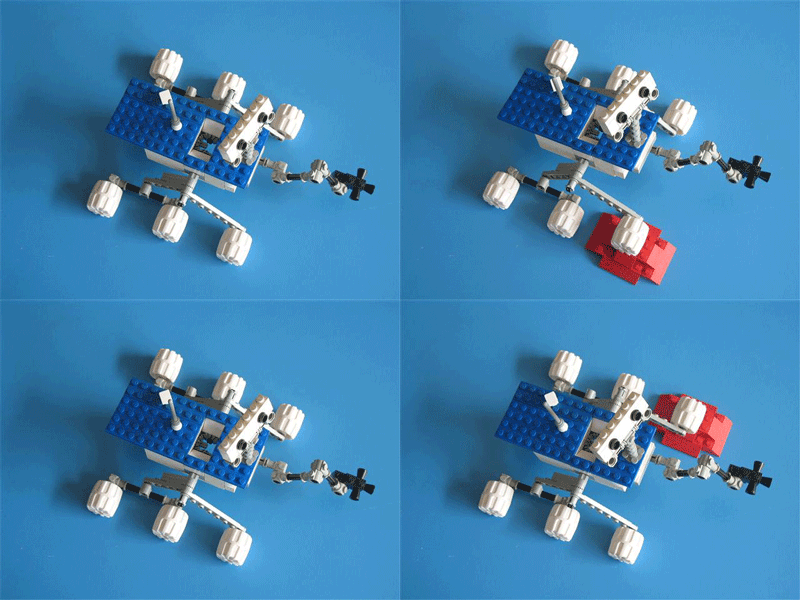
The middle of the bar is connected to the body with a pivot and the two ends are connected to the two rockers through some short links. If you hold the model rover body steady in midair and tilt one rocker up, one end of the bar will go back, the other end will go forward, and the other rocker will tilt down (see the animations below).

The Mars Exploration Rovers did not use a differential bar because it would interfere with the solar panels. But the Mars Science Laboratory does not have that problem because it is nuclear powered and has no solar panels.

Animations

Animations of a Rocker-Bogie with a Differential Gearbox

Mars Exploration Rover (Spirit and Opportunity)

Body held steady in midair:
 

Wheels on the ground:
 

Animations of a Rocker-Bogie with a Differential Bar

Mars Science Laboratory (Curiosity)
Body held steady in midair:

Wheels on the ground:
 

No Springs

The rocker-bogie mechanism has no springs. The absence of springs helps it keep all six wheels on the ground with approximately equal pressure on each wheel. This is a good thing when you are driving on sand!

Want More? (and References)

“Mars Exploration Rover Mobility Assembly Design, Test and Performance”, JPL

“A Capable and Temporary Test Facility on a Shoestring Budget: The MSL Touchdown Test Facility”, JPL


I hope you enjoyed my dad’s post. He sure had fun figuring out those mechanisms and creating them out of Lego!

I’ll be posting a Curiosity-landing-“watching” event here very soon.

~ A l i c e !
Soil on Mars Honors Around the Americas

Happy Homecoming Ocean Watch, you now have a soil on Mars named after you. That’s right. A little patch of dirt* on Mars is now named “Ocean Watch.”

Wait, what’s Ocean Watch?

Pacific Science Center and Sailors for the Sea have just completed Around the Americas: a science outreach project to sail all the way around both North and South America (including through the Nortwest Passage). The boat they sailed was called Ocean Watch, and they did all kinds of fun science and activities with people at every port of call.

Mission:

Around the Americas is a 25,000 mile sailing circumnavigation of the American continents with the mission of inspiring, educating, and engaging citizens of the Americas to protect our fragile oceans.

Back when I was a kid the Northwest Passage didn’t exist, so this would have been impossible, and now not only is it possible, but my friend Zeta sailed through it. This wasn’t that long ago either … the ice really is melting.

Ocean Watch arrived back in Seattle today (June 17, 2010).

What does that have to do with Mars?

Nothing. But Dr. Amy Knudson from the Planetary Science Institute was volunteering with Pacific Science Center during the exhibit Facing Mars, and she works with the Mars Exploration Rovers doing soil analysis among other things. She was asking if we had recommendations for naming little things on Mars. The names had to be nautical, so I told her about Around the Americas and Ocean Watch. A few weeks later she returned, telling us that she’d proposed the name for one of the patches of soil she was analyzing and it had been accepted!

She’s just sent me some photos of Ocean Watch on Mars as taken by Opportunity (also known as Mars Exploration Rover B). She is continuing to name other soils and rocks after Around the Americas’ ports of call.

Show Me the Dirt*!

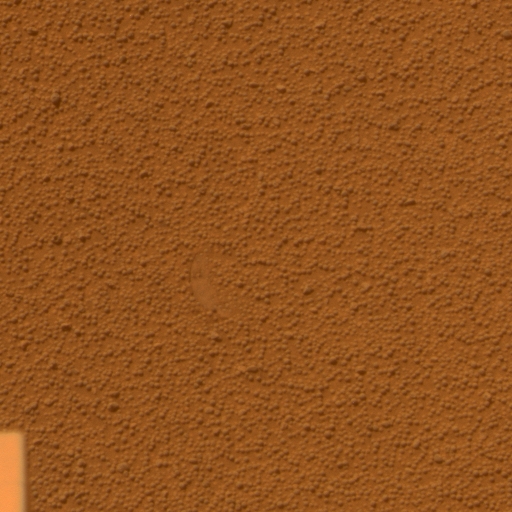
Ocean Watch (a soil on Mars) - field of view approximately 1/2 meter by 1/2 meter.
Photo credit: D. Savransky and J. Bell (Cornell) / JPL / NASA

Opportunity took this picture on Sol 2225 (martian day 2225) with its panoramic camera. This image is approximately true color, and shows a small impression where Opportunity’s instrument rested during the soil analysis.

Nothing has been released about the analysis of this soil yet – so your best guess about that texture is just great. Be the scientist – what do you think those “bubbles” are? Are they depressions or spheres? Are they hard? Soft? Are they just shapes in the sand that are easily disrupted or are they harder? Look at how they are different when they’ve been pressed by the instrument. Does that help you determine what they’re like? What might have caused them?

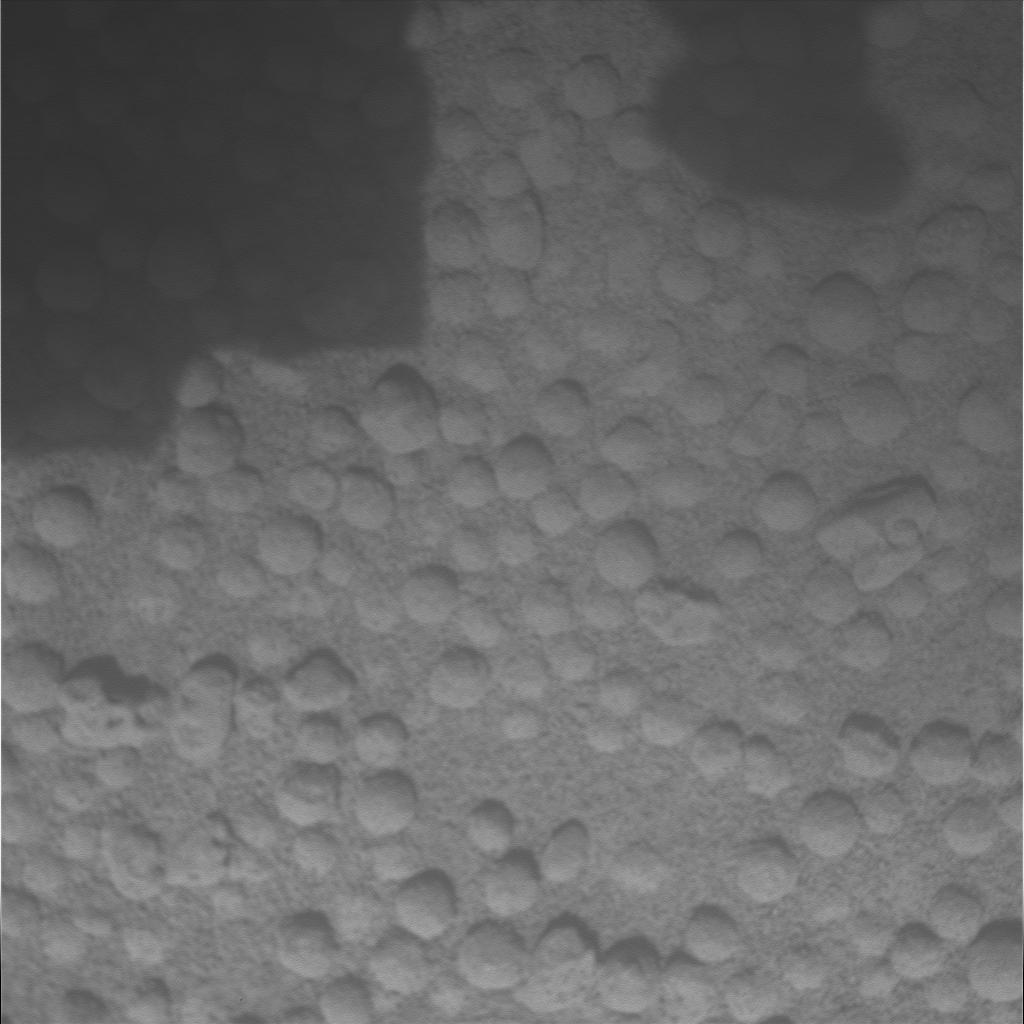
Ocean Watch soil through Microscopic Imager (3cm by 3cm)

Using the microscopic imager Opportunity took a close up picture of the soil before deploying the “IDD” – the “Instrument Deployment Device” – also known as the arm.

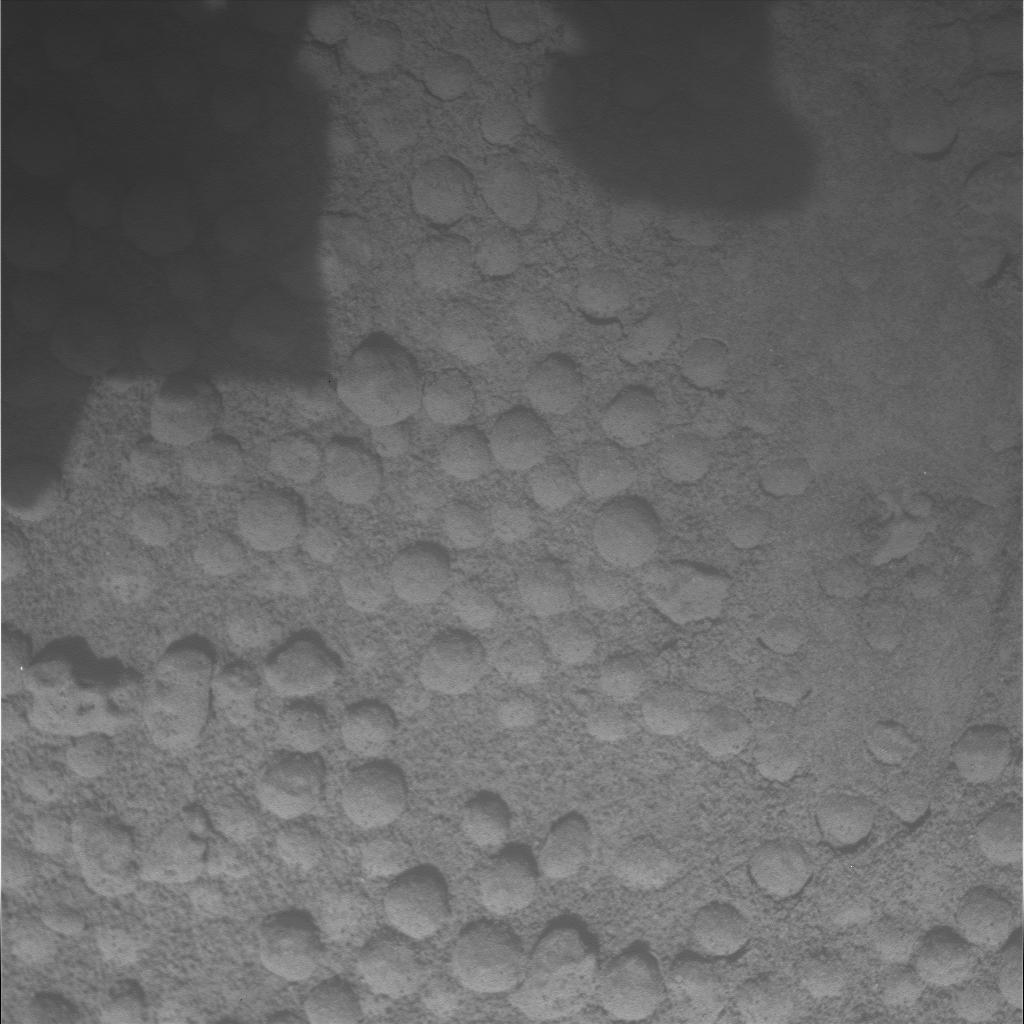
Ocean Watch with impression (3cm by 3cm)

Using the microscopic imager Opportunity took another close up picture of the soil AFTER deploying the arm. You can see where the instrument rested in the upper right of the picture. Some of the little bubbles or depressions are flattened, and others have been entirely squished.

Naming on Mars

If you follow the rover missions you’ll have heard of rocks and landforms on Mars named things like “Chocolate Hills,” “Concepcíon,” “Columbia Hills,” “Endurance,” or “Jenny.” Naming of objects in the solar system has to go through the International Astronomical Union (IAU), which can take years. In order to stay sane and not constantly have to say to each other “let’s take a look at that rock” or “shall we drive to crater 001-5BX?” the technicians and scientists working with the Mars rovers assign their own names to these items. Ocean Watch is such a name. I find it likely that many of these names will stick – having been used for years by the time the IAU has time to choose official names – but some will be changed, and some are of locations too small for anyone to care about once the rover has driven on. Ocean Watch is a very small patch of soil (about 1/4 of a square meter), so who knows what will happen.

For now though, a little patch of a distant planet holds a name that reminds us of the fragility of our own planet, and honors the excitement of doing science and science outreach.

Want More?

More information about this soil will eventually be posted in the MER Analyst’s Notebook.

[*Technically I wouldn’t use the word “dirt” because that tends to imply organic content … but, forgive me this time.]()

Thank you, Amy.

~ A l i c e !

. Savransky and J. Bell (Cornell) / JPL / NAS

Which Way to Mars?

How long does it take to get to Mars? Well, that depends. As per usual I’ll give you the short answer first: 5-7-ish months.

Depending On …

  • Energy

    • The faster you go, the more energy you must expend to get there. Energy is expensive.
  • When You Leave

    • You could leave any time you wanted to, but if you don’t leave at the right time you’ll just end up chasing after Mars, or doodling around the orbit waiting for Mars to catch back up to you. It’s like catching a bus – you don’t want to wait around at the bus stop too long, but you also don’t want to miss the bus.
  • Length of Stay

    • If you’re going to all the trouble of going to Mars, I would think you’d want to spend a little time there. Then, your return journey has to be timed just right

Some Choices

A Hohmann transfer orbit is one of the most common ways to move between orbits. It is energy-efficient without being incredibly slow.

The Classic Choice:

Hohmann Transfer - Image Credit: Gary Kezele

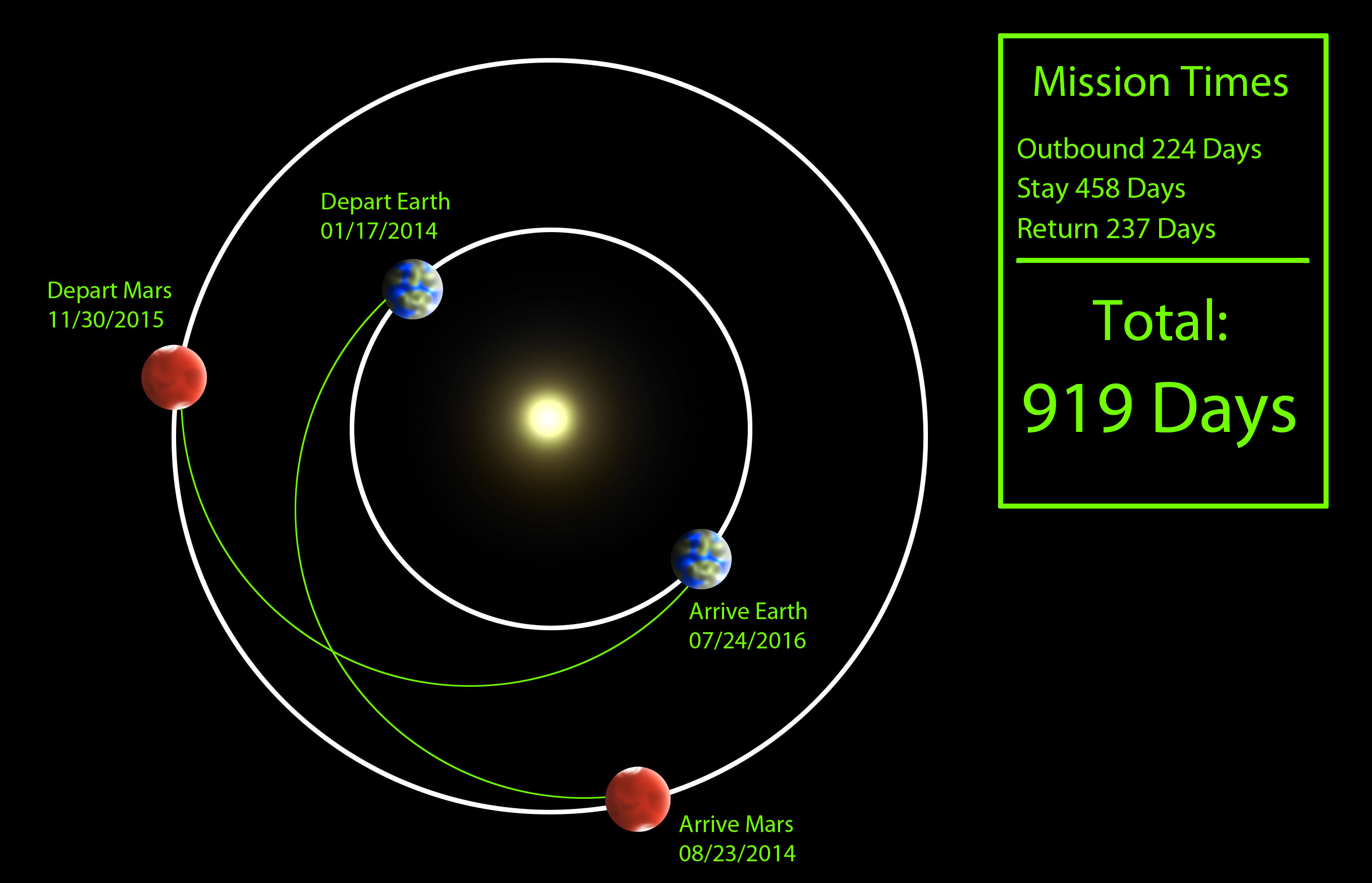
So, if you do a couple of plain Hohmann transfer orbits – one on your way to Mars, one on your way back, you end up with about 7.5 months each direction with a nice long stay of over a year on Mars.

Speed It Up:

Get There Quick - Image Credit: Gary Kezele

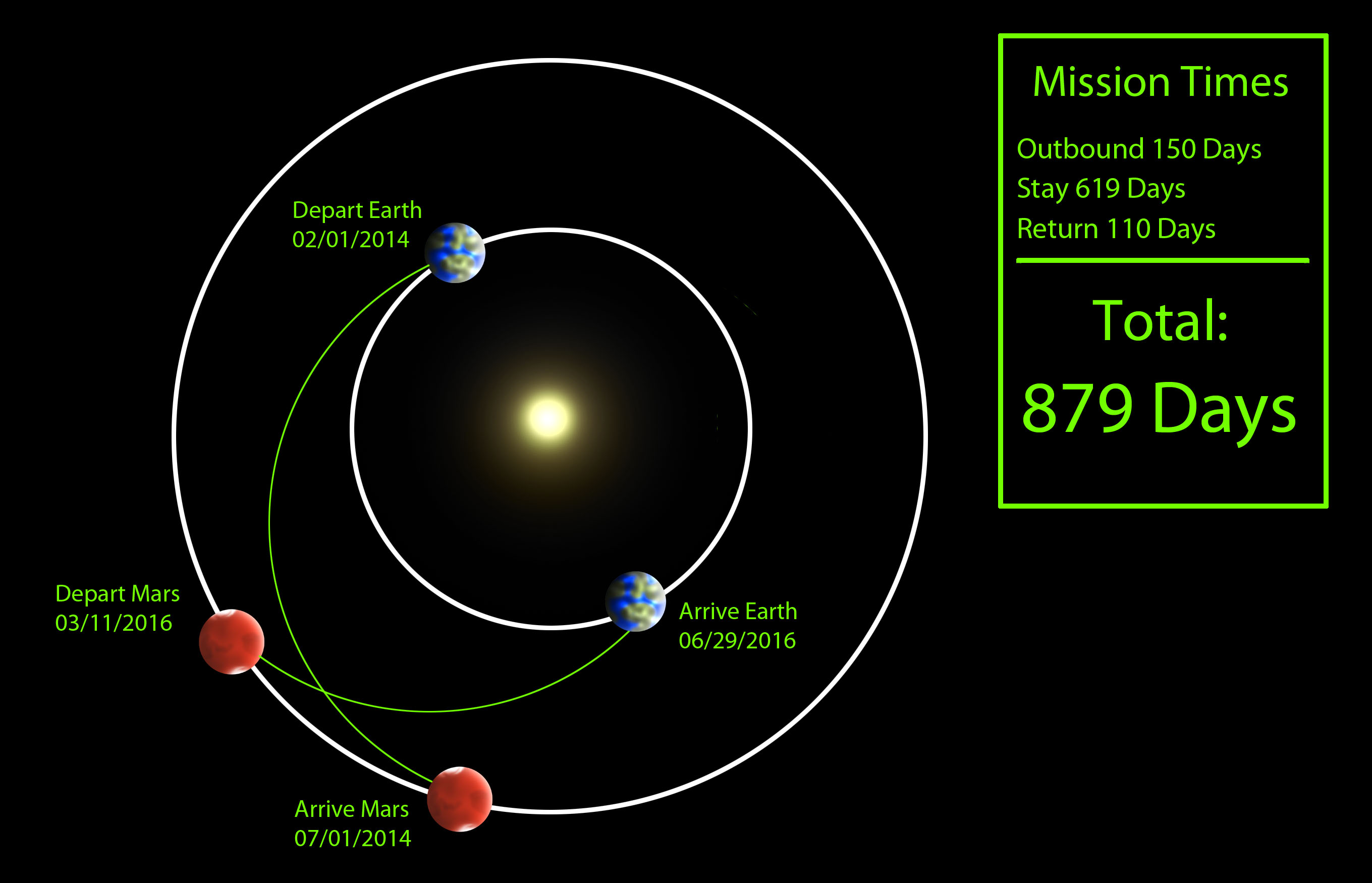
Well, why waste all that time en route? If you up your energy consumption you can move between orbits a little faster. This is very similar to a Hohmann transfer orbit, but significantly quicker. Travel time is more like 5 months each direction, and you still get to spend almost two years on Mars.

Early-Return

Early-Return Mission - Image Credit: Gary Kezele

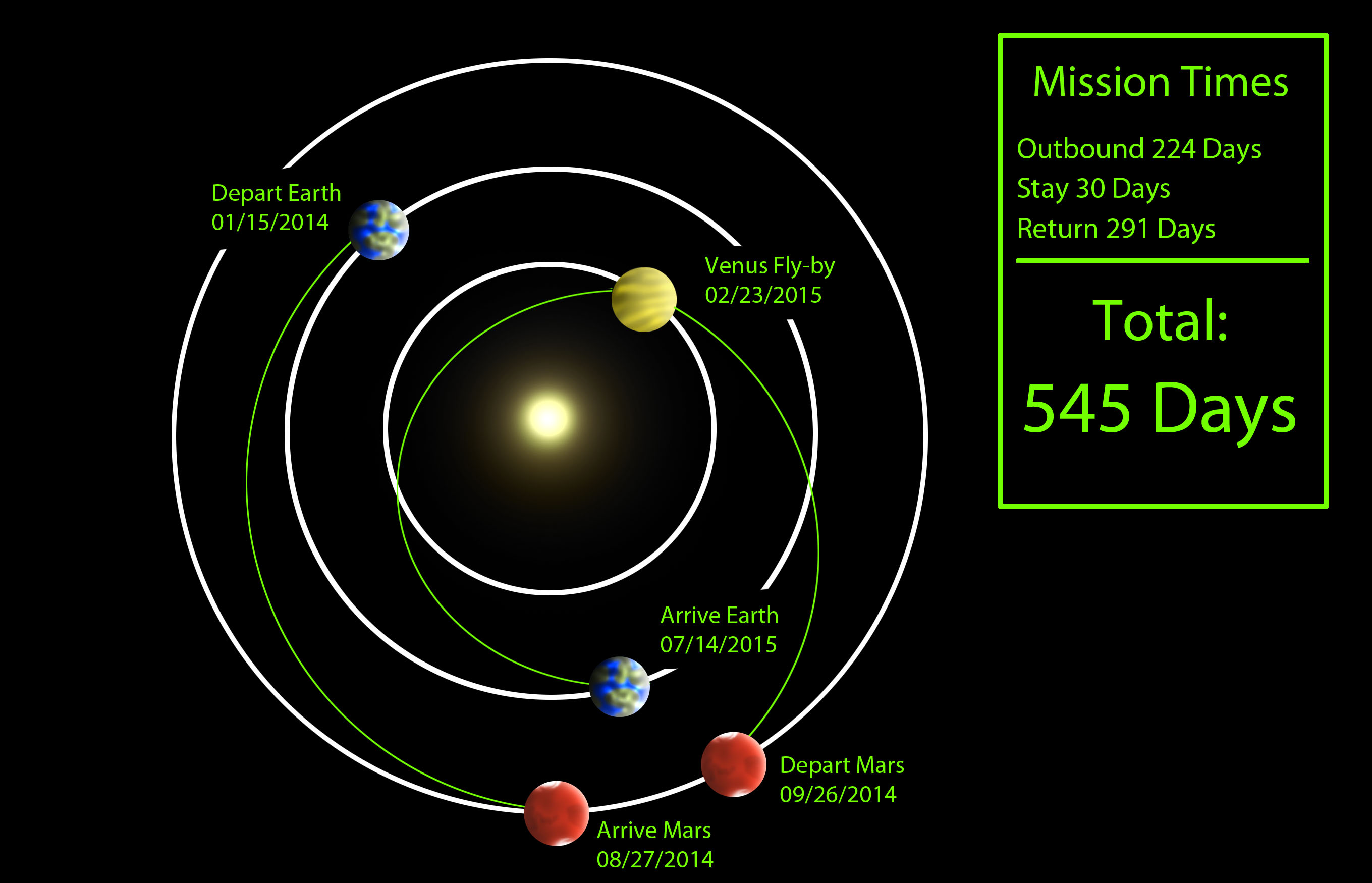
What if you get there and need to come back? What if you’re just not sure what might happen and don’t want to invest a lot in spending time there? If your goal is more to prove that it is possible to go there than to spend time there, you might prefer an early-return mission. You sacrifice a lot on the return mission: it takes almost 10 months to get home. For a “footprints on Mars” mission (similar to our first Moon missions) this gets you just under a month of study-time on Mars. Also, if things start to go wrong early on in a longer mission, you could abandon the remaining mission and return early using this path. Plus you might get to swing by Venus!

Ultra-Slow

There are two more quick options I’d like to mention. The ultra-slow route – spiraling out from Earth’s orbit, eventually reaching the orbit of Mars. The Dawn spacecraft is using an orbit like this and a low-energy ion engine to reach the asteroid belt over the course of six years.

Don’t Come Back

It sure takes months off your travel time if you just go and don’t return. Like the settlers of the American West and all over the world – the people who make a new world their own are the people who set out with that in mind. This is a much cheaper mission – and there are some fascinating arguments for it.

Want More?

http://nssdc.gsfc.nasa.gov/planetary/mars/marsprof.html
http://image.gsfc.nasa.gov/poetry/venus/q2811.html
http://dawn.jpl.nasa.gov/mission/trajectory.asp

~ A l i c e !

Communicating With Mars

One of the most basic questions when it comes to Martian expeditions is communication, namely “how long does it take to communicate with Mars?” The simple short answer is 4-20 minutes, depending on where the Earth and Mars are in their orbits. It also gets more difficult when Mars is near or behind the Sun from our point of view.

Interplanetary Internet

You’re probably quite used to looking up the answers to your questions on the internet anytime you want, but with the delay in communication in space, the internet can’t work quite the same way – besides the fact that you’ll be using a connection that feels like a very, very slow modem. The way webpages are designed now that would take forever.

Data Rates

Of the missions currently at the red planet, the Mars Reconnaissance Orbiter (MRO) has the ability to transmit the most data. Its data speed to and from Mars is about 6 megabits per second (about twice as fast as the connection I’m currently on), but that’s not continuous – it is only when MRO can “see” Earth. Since Mars is rotating, the rovers are periodically out of contact, and the satellites lose their connection when they orbit to the far side of the planet.

Eeep! We’re using speed in two different ways. Don’t confuse the speed at which the data is transmitted (the amount of data per second) with how long it takes the data to get to Earth. MRO may transmit at 6 megabits per second, whereas Spirit can only transmit directly to Earth at a maximum of 12,000 bits per second (that’s 0.01 megabits per second – like using a very old dial-up modem!), but still both messages will take the exact same amount of time to get to Earth: between 4 and 20 minutes, depending on the time of year.

Relays

Most messages from space missions go through relay satellites, for example the Mars Rovers often send data through MRO. This in itself might make interplanetary internet a reality, if we can overcome some of the blocks – like the delay causing excessive timeouts among many others. There are some folks studying this problem, and there are even proposed solutions.

Incidentally, the International Space Station just got live internet for the first time – really it’s a connection to a computer in Mission Control – and that computer is connected to the internet. That limits the information that really needs to be transmitted to the Space Station.

Would You Like to Receive a Message from Mars?

Would you like to get some tourist snapshots of Mars? The surface of Mars? Well, your chance to point the HiRISE camera at your favorite part of Mars is here.

More Info:

http://deepspace.jpl.nasa.gov/dsn/

http://marsrovers.nasa.gov/mission/comm_data.html

~ A l i c e !

Spirit at Troy

Happy Valentine’s Day and Happy Lunar New Year, Spirit! Here are some of our imaginings about how you look as a station!

Advanced Entries

Silence at Troy - Spirit's Next Million Years from Emmanuel Gaffard

There are six secrets hidden in this image. Emmanuel says: “Some are Mars exploration related. Kind of. Can you find them?” (I’ve found one so far … he sent me the answers, but I haven’t opened that file yet.) If you want the answers, comment below and I’ll e-mail them to you.

Also of note – as this is pixel-art, the display, zoom, and rendering are important. See below* for extensive detail, or visit PixelJoint.com to increase your exposure to the medium. The original size of Silence at Troy is available here.

Spirit on Mars - Gary Kezele

This entry is from Gary Kezele, accomplished artist and astronomy-visualizer. Bear with us while we get a better scan of this image, but for now you can see a decent version of Gary’s submission! Please click to see it in more detail.

Both these entries show amazing attention to detail – and you can tell they looked closely at the photos of Spirit’s location.

Hobby Entries

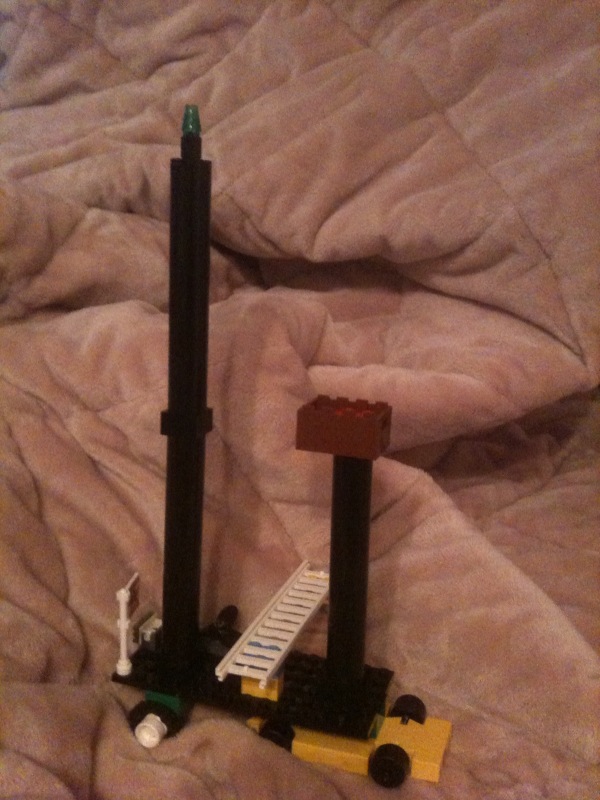
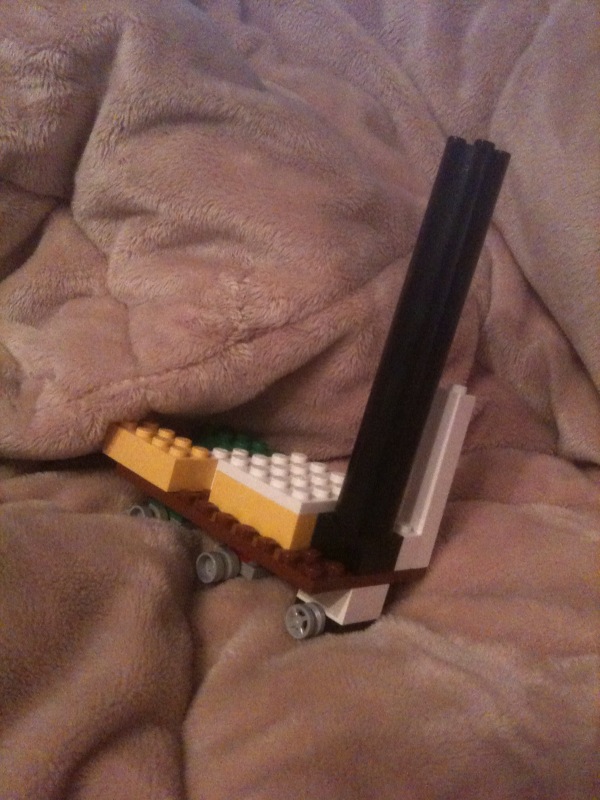
From @MamaJoules come two model entries – one from each son. I love them both, and bet that it was a lot of fun to build rovers out of Legos and then try to position them just right in the “sand.” :)

Spirit - by Kerm, 8

The camera mast is great, there are lots of fun details, and the flag is a nice touch too!

Spirit - by Little Brother, 4

Once again, the camera mast is in evidence, and the rover is just like Spirit: it has six wheels (I wonder if all of them work on this model).

Thanks to everyone who submitted – I’ll be sending you all some fun NASA postcards. :) I’ll also pass these along to as much of the Spirit team as I can.

More

These were not submissions, and you’ve seen them before, but I had to include them in this post because I thought you’d enjoy them.

Spirit Embedded at Troy Credit: Keith Enevoldsen

Image from Stuart Atkinson

Go see more of Stuart’s Mars Art.

[*Pixel Art]()

Emmanuel has sent these details about viewing pixel art, which I found fascinating.

Pixel-art makes for small images and files. They should ideally be viewed at 200%, 300% max. You should be able to just see the pixels without them being overwhelming.
Displaying pieces at 100% makes them look very small, and the pixels are lost on good monitors.

Using the browser zoom is not an option! All current browsers use ‘bilinear filtering’ for zooming images (and most image viewing software too), the result is horribly blurry on pixel-art (you might have noticed this if you browsed the Pixeljoint gallery and used the zoom function. However, from Firefox 3.6, websites can opt for an old-fashioned unfiltered zoom function. This is not something the user can do, it’s only a website-side option. So if you visited Pixeljoint using Fx 3.6, you didn’t notice any problem.

You should note, I did not do anything website-side to enable this function in Firefox. All his images are displayed exactly at the resolution I got from him though. Clicking the main image takes you to his 300% zoom version.

Want More?

The Mars Exploration Program at JPL

Thanks all! Let’s do it again sometime. Thanks to the NASA Solar System Ambassadors Program for the support.

~ A l i c e !

Why Is Rust Red?

This post is at a deeper level of understanding than a lot of what I write. If you’re lost by step one or two – review spectra and come back!

The Premise

When I think of a good question, I just can’t let it rest. Here’s what I tweeted today:

Why does iron make things red? Mars – blood – iron tablets – hematite scratch tests? (I don’t know)

I’ll clarify/deepen my question: Assume your audience groks spectra and color (in depth). Now answer “Why does iron oxide make things red?”

People started sending me parts of the answer, and I just had to figure it out.

The Puzzle Pieces

Together these pieces make up an answer.

  1. All the colors that are not absorbed are the colors you see.
  2. Spectra for single atoms tend to be simple – electron energy levels are fairly well defined so one detects discrete absorption lines.
  3. Spectra for molecules (such as the various iron oxides) are much more complex, because the electron energy levels are less well defined. In fact there are significantly more energy states and vibration possibilities for molecules, so those discrete lines end up as whole bands of absorption.
  4. Iron oxide happens to be a molecule that absorbs energy in pretty much every state corresponding to the purple, blue, green, and into the yellows – leaving the reds reflected.

    • Blood is a little different, but related. Hemoglobin has hemes – those hemes carry the Iron in the middle. When that heme interacts with O2 (note I did NOT say bonds to) the whole shape of the molecule changes causing the orbitals to move, which changes the energies that can be absorbed by the electrons. These shift towards those blues again, leaving (once again) the reds reflected.
    • Oh, and hematite is grey/silver, but the scratch is reddish because in the hematite crystal structure the orbitals are stuck in one state, but once you disrupt that structure – by grinding it up – the orbital positions can change allowing different amounts of energy to be absorbed – like the blues, leaving the reds. Again.

Whew.

Thanks @superacid & Doug

Sources:

http://chemed.chem.wisc.edu/chempaths/GenChem-Textbook/The-Visible-and-Ultraviolet-Spectra-of-Molecules-Molecular-Orbitals-1040.html

http://www.newton.dep.anl.gov/askasci/bio99/bio99423.htm

http://twitter.com/superacid

Doug McGregor

And I used Wikipedia to get some definitions – like “heme” and “ligand.” That doesn’t mean you should cite Wikipedia as a trustworthy source though!

I am accepting corrections and clarifications to this post – though I’m not going to go into the basics of spectra here. Maybe another time?

~ A l i c e !

Mineral Indications of Water

What you need to know:

Carbonates (like antacids that you dissolve in water) dissolve easily in water, and are deposited easily out of water. Sulfates (which are why Yellowstone’s fantastic mud-pots smell awful) are similar. Silica-rich deposits are more commonplace – so you need more detail to tell if they’re from water or not.

Up until now you’ve taken it for granted when you read in an article that a mineral discovered on Mars indicates the prehistoric existence of water. But how can a certain mineral in a rock tell you that there was once water? How can it tell you if that water was more recent or more ancient?

Carbonates

There are many carbonates, but calcium carbonate is probably the most familiar to you – and one of the most common carbonates. As you know from taking Tums or Alka-Seltzer – these dissolve easily in water. Many seashells are made of carbonates as well, and when those animals die, the shells are dissolved into the ocean and eventually that calcium carbonate is redeposited as limestone. Like that, all carbonates are usually formed in “hydro” and hydrothermal situations, and are also later dissolved by even a slightly acidic situation. Although this example only represents redeposition of carbonates – they are also deposited primarily (in the first place) by water as well. Finally, in order for carbonates to last a geologically long time they must be protected from water and other acids. Carbonates are either a good indication of water activity in the geologically recent past, or there hasn’t been any water near them in a long, long time.

Carbonates in ALH84001 (one of the meteorites from Mars)

Sulfates

Sulfate minerals are similar to carbonates in terms of their indication of water – they are also water-soluble, and occur in similar places to carbonates: embedded with limestones, etc. Sulfates tend to need more “thermal” in the term “hydrothermal” than carbonates – which is why you find a lot in volcanic regions like Yellowstone. That rotten-egg smell associated with hydrothermal areas on earth is due to the sulfur in sulfates. Sulfates are a great indicator for water activity paired with heat.

Spirit Unearths Sulfates on Mars

Silica

Almost every rock on Earth is silica-based. The presence of silicates in and of themselves is not an indication of water, current or prehistoric. More analysis or specificity is needed. After oxygen (yes, oxygen!) silica is the most common element in the Earth’s crust, as well as the crust of the Moon, and what we know of the surface of every other terrestrial planet.

Where’d I Get My Info?

Klein, Cornelius. The 22nd Edition of the Manual of Mineral Science.

~ A l i c e !

A Challenge for Artists! Spirit at Troy

Update: This is the first event I’m officially hosting as one of NASA’s volunteer Solar System Ambassadors!

Well, Spirit is now a station at Troy rather than a rover somewhere south of Mars’ equator. Time to have some fun, while the drivers try to back her into the perfect parked position to get Sun on those solar panels!

Spirit Embedded at Troy

I know there’s lots of you artists out there itching to do some science illustration. We don’t have cameras that can show us what it looks like for Spirit to be stuck. Odd, isn’t it? There are what 6? 7? cameras onboard Spirit, and yet, that’s just the problem, they are all ON BOARD Spirit. We can see bits of her, but not the her whole body.

So, draw, photoshop, paint, contstruct a picture of Sprit at her new home and send it on over here.

Skill Level

This competition is for kids and adults. Entries will be divided by me into “professionalish artists” and “doodling around and having fun artists.” There will be winners in both categories. For instance, if you’re really good at photoshop, but you just do it on your own time you’ll probably get put in the “professionalish” category. If you’re 3 and just learning to hold a pencil (hopefully your parents will help you label your drawing so everyone knows what’s what) you’ll be in the “doodling around” category.

Rules

Submit digitally in a web-ready format to my e-mail address alices astro info at gmail dot com (all one word, make that at an @ etc). File should be high enough quality to print. If you’d like to submit on paper e-mail me and I’ll give you an address.

I’m making the choices. I’ll be fair.

Deadline: February 13 – Let’s put them up on Valentine’s day and show Spirit’s rover team that we love them!

Prizes?

Everyone

  1. A copy of your picture will be displayed somewhere interesting, where lots of people can see it!
  2. (Until i run out) – Lenticular postcards from NASA (oooh! pretty)
  3. A digital copy will be shared with NASA to show the Spirit drivers how much we appreciate their hard work.

Featured “Winners”

(You are all winners, just for participating) but there will be one chosen from each category

  1. A very awesome  lenticular postcard from NASA.
  2. A copy of your picture will be displayed on this blog.
  3. Got a suggestion that would be meaningful to you and wouldn’t cost me much? I’m listening!

Liability

If you are under 18, please sign your piece with your first name only, and have your parents send me a message saying it is okay for me to post your picture and your first name.

~ A l i c e !