Density Waves: What’s Up with Galactic Spiral Arms?

What’s up with the spiral arms of our galaxy?

The short answer:

This is awesomely weird. Imagine a bike wheel – each spoke is an “arm.” When the wheel rotates, the arms rotate, right? This is NOTHING like our galaxy. Imagine a beanie hat with a propeller on top. Hold the propeller still, and spin the hat underneath. That’s a little more like it. The hat is the stars, dust, gas, and everything our galaxy is made of. It spins around, passing THROUGH the arms (the propeller) of our galaxy. The arms aren’t made of anything. Whoa, what?

Okay, interested? Confused? Ready for more? Good, because that wasn’t a very accurate description, it was just enough to make you think.

Arms are Denser Areas

When I said “the arms aren’t made of anything” that’s because they’re just denser areas of the same stuff the whole galaxy is made out of, but as the galaxy spins, the arm is made up of different stars, different dust from one eon to the next. The stars and stuff glide right through the arms, though they may slow down while they’re there.

Try this at home:

  1. Take a face-on mug shot of your favorite spiral galaxy (how’z about the Milky Way?)
  2. Mark your 1000 favorite stars in one arm.
  3. Wait 100 million years.
  4. Take another photo.
  5. Find those 1000 favorite stars, and where the arms are now, compared to before.
  6. The arms may have moved a bit, but the stars will have moved a LOT. Some of them will be halfway around the galaxy again, some will only have moved a touch, and still others may have gone around a couple times. The arms will now be made up of different stars, but they’ll still be there.

Okay, obviously you can’t really do this at home for about 10 very good reasons, but you get the idea.

Stars Travel through the Arms (Traffic Jam)

Think about it another way. Spiral arms are like traffic jams of stars. You know how there’s always a traffic jam at the Renton S-Curves, or by the U District on I-5? If you take either of these routes, you’ll be in the traffic jam for a while, and then once you’re out of the bad area, you can get back up to speed. The traffic jam is still there though? (usually true … we’re talking about I-5 here), but you’re out, it’s someone else’s turn to bite their lip and grumble at traffic.

Same way with stars. The traffic jam is always there, but different people are in it at different times.

There’s a PERFECT animation over at: Traffic Waves.

Density Wave Motion

Now that we’ve established that spiral arms are density waves (technically a “spiral density wave”), and it’s the stars that move through it, not the arm spinning around like a bike wheel, I’ve got a shocker for you. The arms move too, just at a different speed. That’s called the “pattern speed.”

Watch this video – see how the traffic jam moves around the circle, but the cars move differently?

Now this one – it’s a little easier to see both motions with this spinning galaxy.

Density Wave Formation

How do the spiral arms get started? Umm… that’s an open question, but I can tell you a couple of useful things.

First – the galaxy rotates differentially. Oops, jargon. The middle rotates at a different speed than the outer edge. Ta-da! Differential rotation. The Sun and Jupiter do this too. A bicycle wheel does not.

This differential rotation is due to Kepler’s laws. objects closer in revolve around the center a lot faster than objects further out.

Second, the likelihood that the galaxy started as one big perfectly even ball of gas is pretty low. There were pockets of lots of gas, and pockets of less stuff. These pockets will spread out and spin into denser areas.
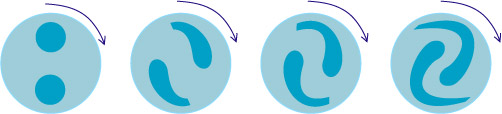
Galaxy Rotation

Galaxy Rotation

So that’s a pretty easy explanation. There are still some problems we need to solve, but that should give you an idea.

Lastly, a way in which the arms keep themselves dense is due to the gravity of more material in the arm itself: stars speed up as they enter and arm, and then slow down as they leave it – the opposite of a traffic jam.

The Wind-Up Problem

But how come the arms don’t twist themselves up? Well, that’s one of the problems with the formation hypothesis I just showed you. This is the question that led to the idea of density wave arms in the first place.

It doesn’t twist itself up because the arms are not made of material, they’re just a denser area, there’s no reason for the arm to change.

Want More?

Astronomy Cafe has some really useful, deep answers.

Check out Voyages to the Stars and Galaxies by Fraknoi, Morrison, and Wolff
Retrograde Motion

So. You’ve heard of retrograde motion, and you’ve seen it in a planetarium or a video, and heard from your favorite astrologer that it means that now is not the time to start a new relationship, especially since the Moon is in Venus’s house (huh?). But now you want to explain it scientifically to someone, and you’re kinda stumped as to how to begin. What is retrograde motion really? Something about planets going backwards? Remember this: Retrograde happens when an inner planet laps an outer planet.

Different Kinds of Retrograde:

Retrograde is a common word. “Retro” means “backwards,” and “gradus” means “step,” put together you get “going backwards.” Let me mention the three top kinds of retrograde in astronomy:
Retrograde Rotation: any planet that spins opposite from the other planets is said to have retrograde spin. Venus is one such planet. This is caused by the tidal lock between Venus, the Sun, and the Earth.
Retrograde Orbits: any planet or moon that orbits in the opposite direction from others is said to be in a retrograde orbit. This is uncommon among larger ojects: the largest retrograde moon Triton (around Neptune), which is one of the reasons that scientists think it is a captured moon.
Apparent Retrograde: when a planet appears to go backwards in the sky. This is the more complicated one, so now we’ll launch into more detail. Remember this: Retrograde happens when an inner planet laps an outer planet (because inner planets are moving faster than outer ones).

Apparent Retrograde Motion:

As you go through a day, the stars, the Moon, the Sun, and the planets all appear to rise in the East, and set in the West, because the Earth is spinning.
As you go through a month or a year, the Sun appears to move from WEST to EAST across the background stars. Go into a planetarium (or download Stellarium) and try it. This is normal. This is called prograde or direct motion. Now watch the planets, start with Saturn or Jupiter, they also mostly move from WEST to EAST across the background stars. This is both because the Earth is revolving around the Sun, and because the planets themselves are revolving around the Sun.
Now watch Mercury for about two months. Yikes! Did you see that? It just went backwards. (No? Then go download Stellarium like I told you, and look at it! Here’s a video if you’re lazy: Mars in Retrograde) It traveled from EAST to WEST across the background stars? This is because it’s on the inside of the solar racetrack, and it just passed us. We’re eating Mercury’s dust. Remember this: Retrograde happens when an inner planet laps an outer planet.

WHAT?

Okay, let’s add some pictures, some Java applets, and some videos.
First, go play with this: applet from UIUC You’ll need to have Java installed and functional, and to start it going click the middle blank button.
Now, I have a worksheet for you. Hah! Thought you’d never get homework from AstroInfo, didn’t you? Seriously folks, this will help you understand it if you don’t get it yet. And I’m not grading it.

Drawing Fun!

Retrograde Diagram
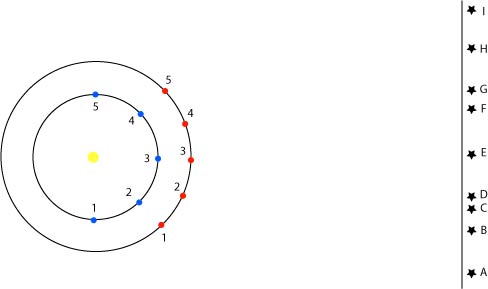
Earth and Mars from Above (NOT TO SCALE)

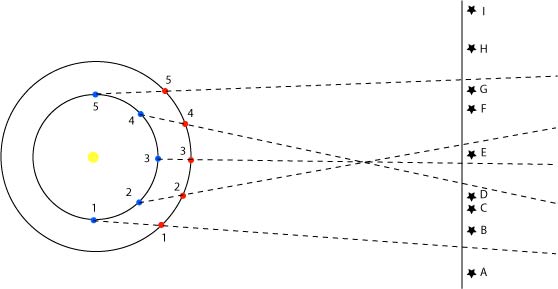
The inner (blue) dots are the Earth. The outer (red) dots are Mars. The lettered stars over on the right are background stars. As the Earth orbits the Sun, so does Mars. The numbers are to show time passing. When Earth is at position 1, Mars is at position 1. When Earth is at position 2, Mars is at position 2. Etc.
Draw a straight line connecting Earth 1 with Mars 1. Extend the line out to the background stars. These are the stars that Mars appears to be between, if you were looking up from Earth. If you look up from Earth at night, away from the Sun, you’ll see Mars, and some of the background stars.
Now do the same thing for Earth 2 and Mars 2. Do all 5 positions.

Retrograde Diagram

The Sky from Earth’s Point of View

If you were standing on Earth, looking up at those numbered stars, it would look something like this. Now draw in where Mars would be when Earth is at position 1 and Mars is at position 1. Repeat for positions 2-5. Be sure to number each Mars.
Connect the Mars dots from 1-5. You should get a loop. That’s Mars retrograding. Remember this: Retrograde happens when an inner planet laps an outer planet.

Here’s what I get:

Retrograde Diagram
Earth and Mars from Above
Retrograde Diagram
The Sky from Earth’s Point of View

Now go play with that Java applet again.

These drawings are not to scale, but they serve to get the point across. You’re welcome to try doing one for Mercury and Venus.

When you do, answer me this: which side of the Sun is Mercury on when it goes into retrograde? On the side closer to the Earth, or the side farther from the Earth?

Remember this: Retrograde happens when an inner planet laps an outer planet.

Want More?

Stellarium
YouTube Mars Retrograde Video
Retrograde applet.

Where’d I Get My Info?

The best dictionary ever, the Oxford English Dictionary. (if you have a library card with Seattle Public Libraries you get free access to their online dictionary).