Science with a Twist, Astronomy Day, and Carnival of Space

First off Astronaut Greg Johnson will be at this week’s Science with a Twist on Thursday April 15th at Pacific Science Center. The event is also on Facebook. I’ll be there too, holding a brief discussion about false color, and Toni Meyers, director of Hubble 3D will be speaking about the film.

“Science with a Twist will celebrate Hubble 3D. Toni and Greg will circulate during the event and introduce the film and answer questions after the film. Pacific Science Center’s resident NASA Solar System Ambassador, Alice Enevoldsen, will  also lead you through an explanation of astronomical images: What do you see vs. What’s really there? Tickets for staff are only $17 (21 +, ID required)”

Toni Myers is the director and producer of Hubble 3D and one of the few women directors in the history of IMAX filmmaking. Toni has worked on IMAX documentaries since 1971. She has worked on every IMAX space film and has worked directly with over 120 astronauts and cosmonauts in the making of the IMAX space films. She has an extensive background in a variety of films in addition to  IMAX filmmaking .  In addition to documentary projects she has a background in the music world having worked on music projects for the Beatles’ company, Apple; and individual features and videos for John Lennon and Yoko Ono. The IMAX documentaries that Toni has worked on have been among the most successful here at the Science Center including Under the Sea 3D.   For her work on Hubble 3D  the astronauts of the STS-125 crew presented her with the Silver Snoopy Award in recognition of her excellence and

achievements in bringing the space experience to IMAX audiences around the world.

Greg Johnson graduated from West Seattle High School and from the UW  with a degree in aerospace engineering.  He received his Naval Aviator wings in December 1978.  He served as a senior research officer in Office of Naval Research. He has logged over 9500 flying hours in 50 aircraft and has over 500 carrier landings. In 1990, he was accepted as an aerospace engineer and research pilot at NASA . He joined the astronaut program in 1998. He was the pilot the final Space Shuttle mission to the Hubble Space Telescope. On this mission he logged almost 13-days in space—–traveling 5,276,000 miles in 197 Earth orbits at 17,500 miles per hour. And he was an IMAX cinematographer on the mission.

Next, April 24th will be Astronomy Day at Pacific Science Center. Here’s a copy of that e-mail:

Calling all astronomy enthusiasts!

Celebrate the 20th anniversary of the launch of the Hubble Space Telescope at Pacific Science Center on April 24th.

What: Pacific Science Center presents Astronomy Day

When: Saturday, April 24th 10am-6pm

Where: Pacific Science Center

Astronomy Day this year will be in style at Pacific Science Center! With planetarium shows, hands-on exhibits in Facing Mars, facilitated space-themed activities with our onsite Science Interpretation staff, crafts, and the eagerly-anticipated IMAX film Hubble 3D this day of science just won’t end.

IMAX FILMS

Hubble 3D

Showing April 24th at 10:30am & 11:45am

The perfect way to celebrate the 20th Anniversary of the launch of the Hubble Space Telescope is to take in a screening of this new IMAX film which is gaining rave reviews! Today’s Seattle Times review calls Hubble 3D an “extraordinary spectacle” and an “out of this world documentary.” http://seattletimes.nwsource.com/html/movies/2011381515_mr19hubble.html

Roving Mars

Showing April 24th at 11:30am, 1:30pm, 3:30pm and 5:30pm

Go behind the scenes with NASA scientists and engineers as they worked to design Mars Rovers, Spirit and Opportunity, to travel millions of miles to Mars and report back!

FEATURED EXHIBIT

Facing Mars

Open 10am-6pm

Here’s your chance to experience the sensations, emotions and conditions of a real trip to Mars without ever leaving Earth! Build your own simple rocket, take a “Mars Walk,” see firsthand what microgravity does to the human body and so much more!

Last, you should go look at Carnival of Space #149!

Okay, enough advertising. I’ll tell you more science-y stuff next week.

~ A l i c e !
Hubble 3D vs Life

I went to see the press preview of  Hubble 3D at Pacific Science Center’s Boeing IMAX Theater. It’s opening on March 19th (2010) – tickets here. Full disclosure, in case you were unaware, I am employed by Pacific Science Center but my comments here are my own.

I have been looking forward to this film for months, and I was struck by the similarity to some of what I do. So, if you will excuse the conceit, I would like to share a double story with you.

Hubble

Hubble 3D is partially just plain fun: fly-throughs of actual beautiful Hubble images, three-dimensionalized by some very talented folks who worked with some very intelligent astronomers to be as accurate as possible. As much as I love Hubble images, the other part of the movie is what I enjoyed most. The story of how to fix an ailing telescope, 350 miles above the Earth’s surface. I’ll give you some hints – but go see the movie for yourself to get the full story of the repairs to Hubble.

A Day in the Life

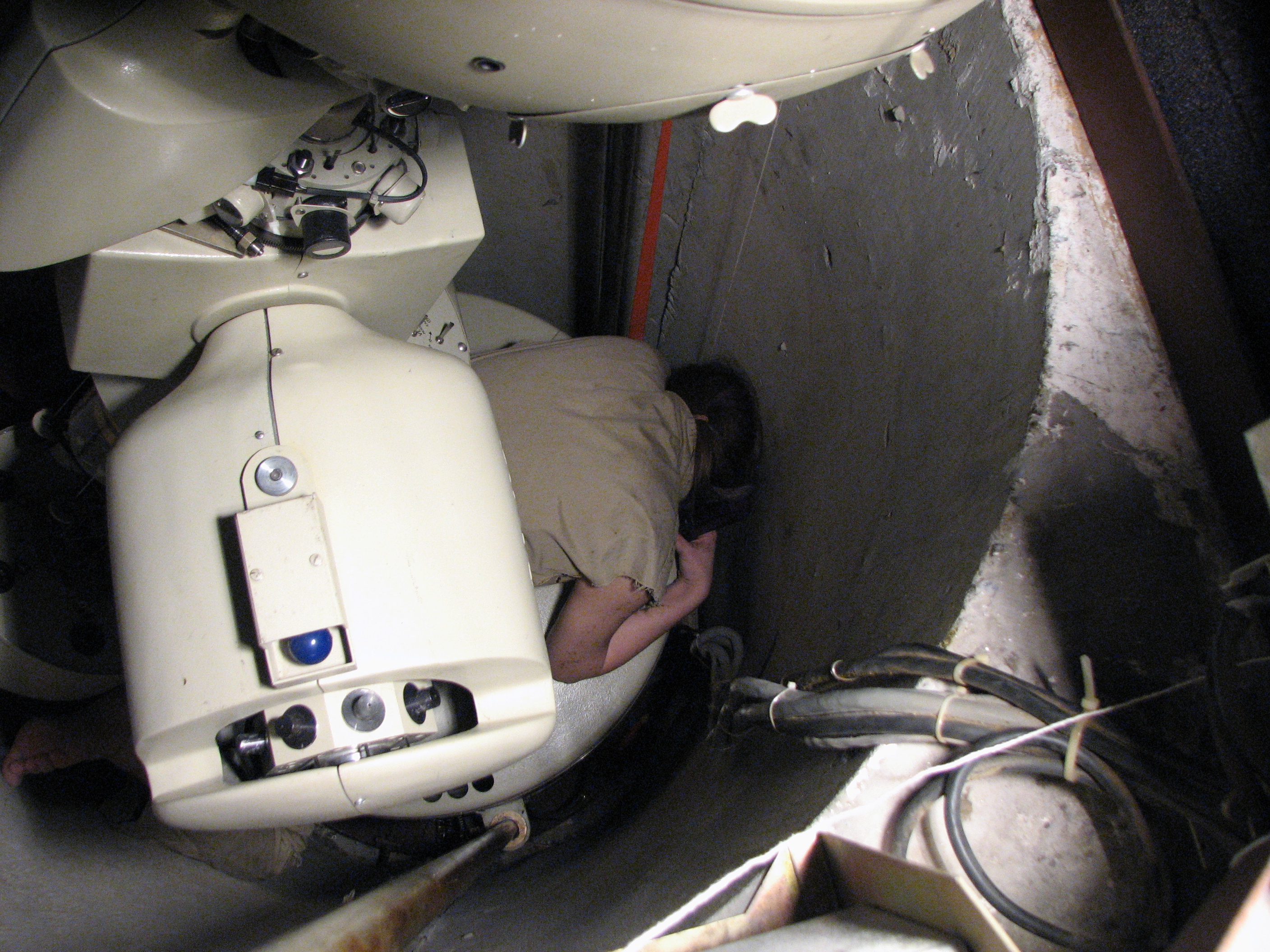
Then there’s what I do. In November, the planetarium projector also chose to show its age. On its way down the elevator shaft it slipped the last six inches and refused to budge. This was extremely scary for all of us, and after several calls to the techs in Pennsylvania we decided we needed to winch it up.

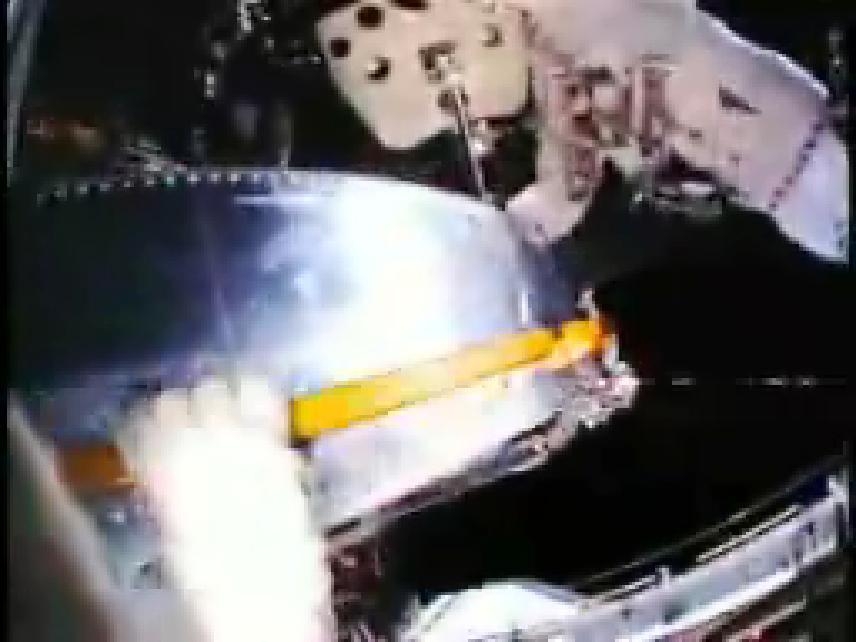
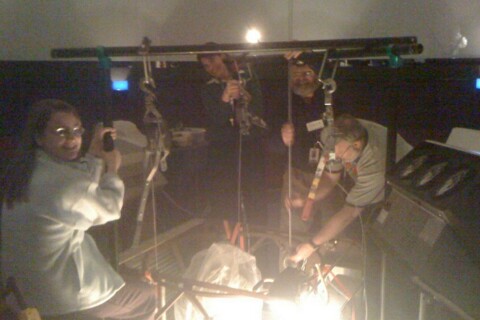
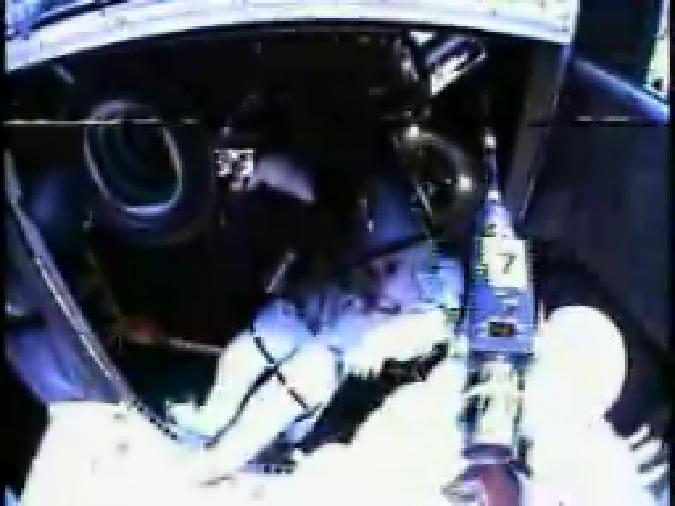
Here’s where it gets similar to the Hubble mission. Compare these two pictures:


That’s Astronaut Mike Massimino in the center, with his head stuck up in the bowels of Hubble. Astronaut Mike Good’s  hands are in the lower right, holding a tool that looks like a drill with a long bit.
And this is me. Five feet down an elevator shaft that’s about  three-and-a-half or four feet in diameter, trying to reach down another two and a half feet to unhook a chain.

The astronauts on STS-125 had quite a lot more to contend with, they were wearing space suits, the stakes were higher, their equipment larger and more expensive, but we both succeeded through teamwork, specialized tools, perseverance, and time.

Nemeses

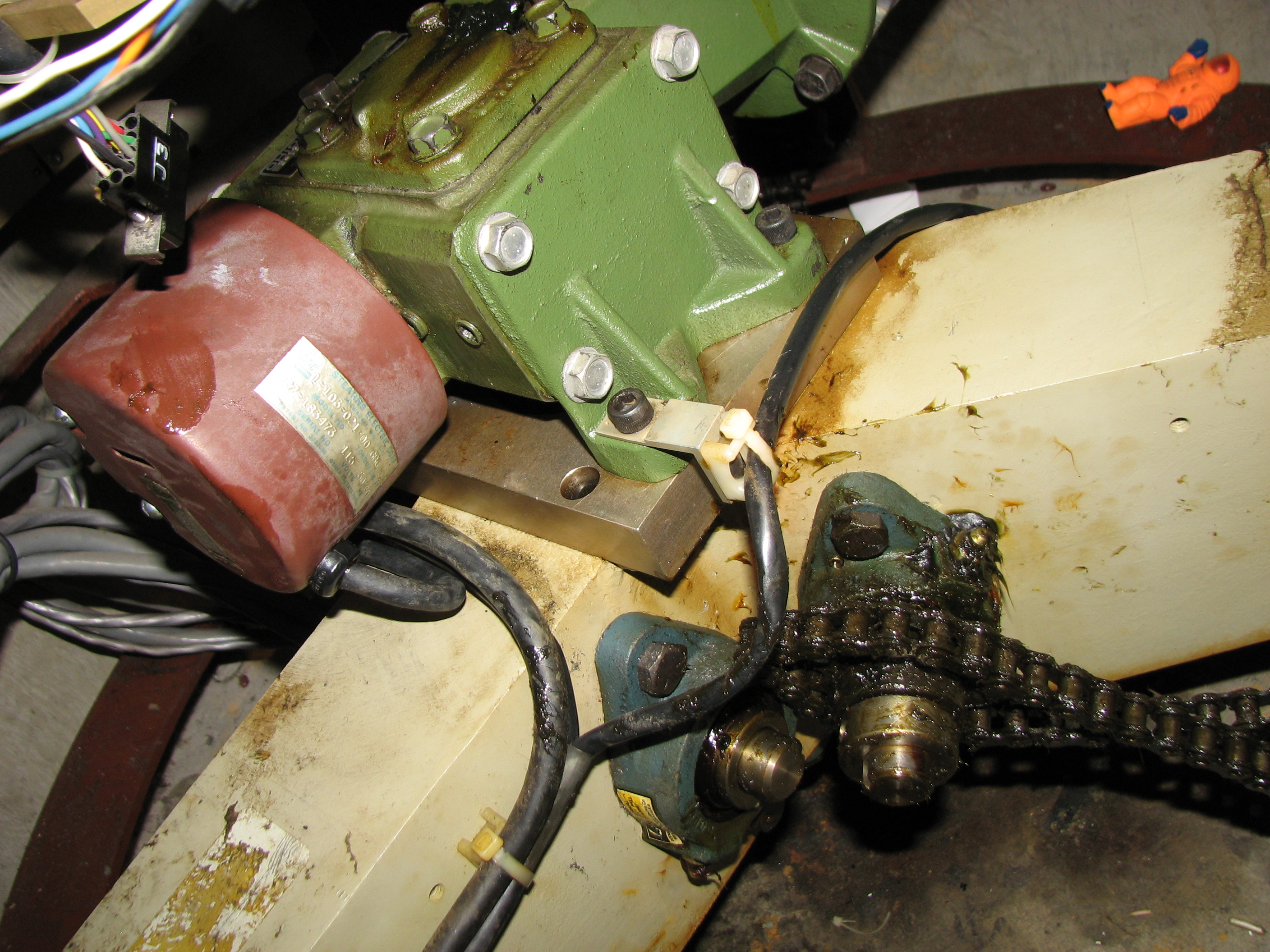
Ah, and then the equipment just seemed to fight back:


This is not the handrail that Astronaut Mike Massimino had to break off, but it looks very similar and I can’t find a photo online of the broken one.


This chain and sprocket caused a day and a half of work for several people. Arrrgh! But, we succeeded!

Specialized Tools


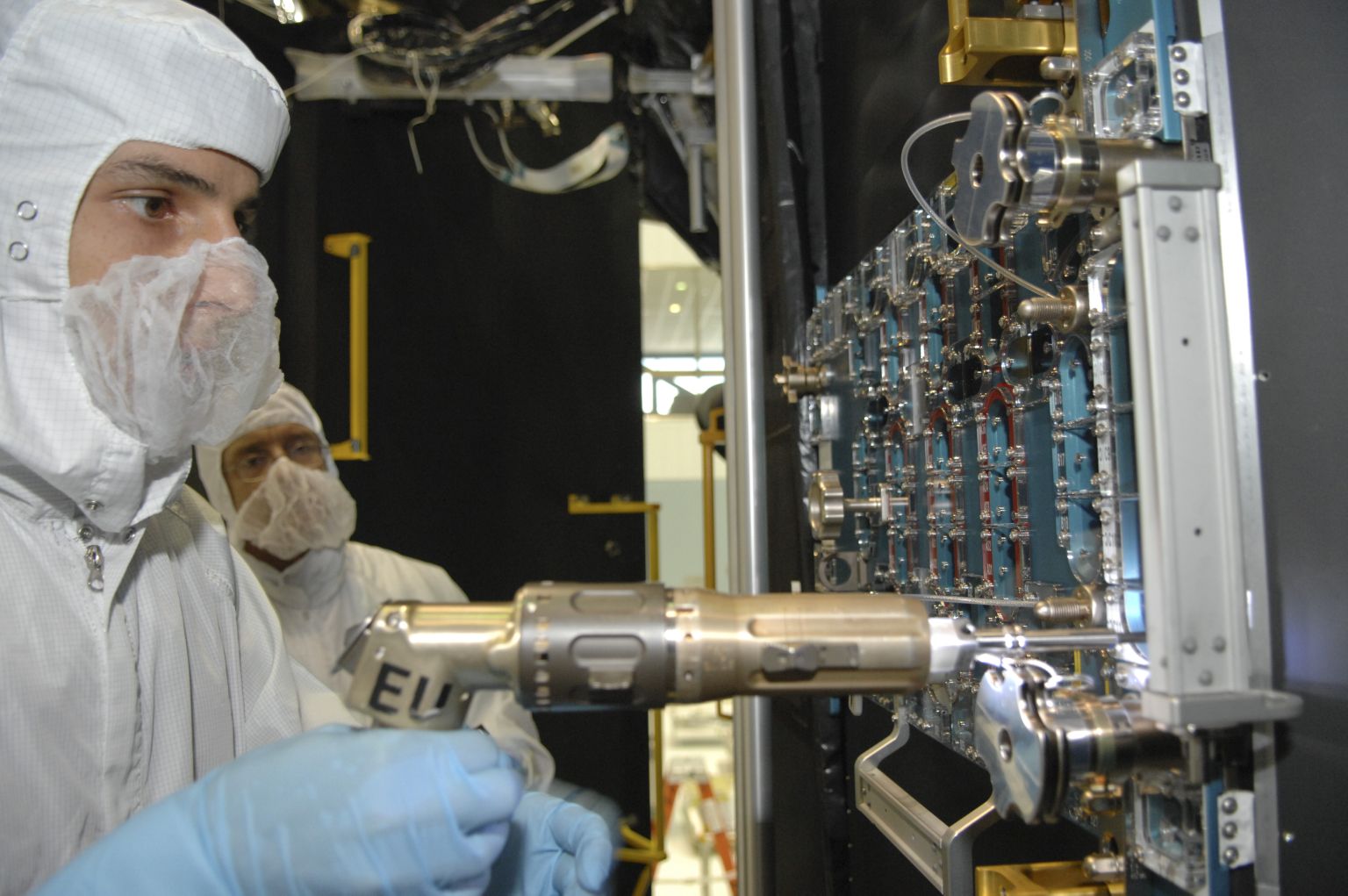
In order to safely remove small screws in space, and be able to manipulate power tools while wearing gloves, they developed some very specialized tools for the Hubble repair missions.
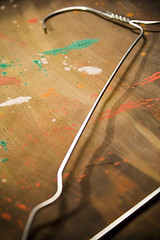
Well, we were inspired by this – but  Mark made a tool very similar, but with a slightly pointier point. Unfortunately, that tool is at the bottom of the elevator shaft now, so I can’t show you a real picture.


(Coat Hanger credit: Demion on Flickr)

Teamwork


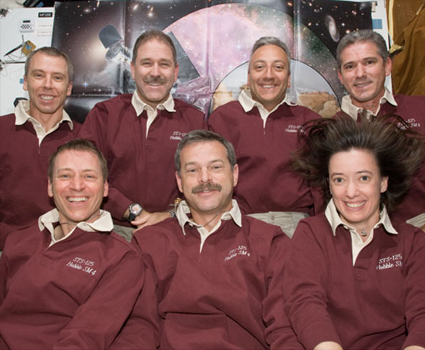
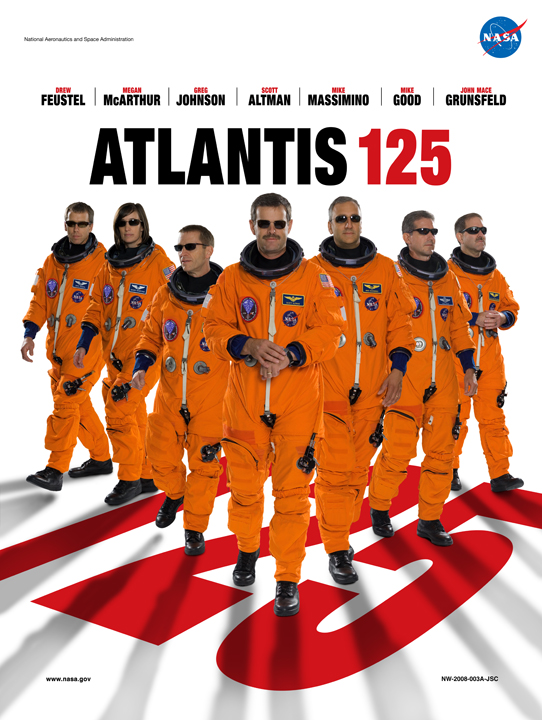
This is the team, and this is their poster:
I love it.
Well, we may not have a movie poster, but we couldn’t have lifted the projector without the work of a large number of people, not the least of whom were Mark Rogers, Kim Chinn, Sarah Huschle, Chuck Hanna-Myrick, and the planetarians!


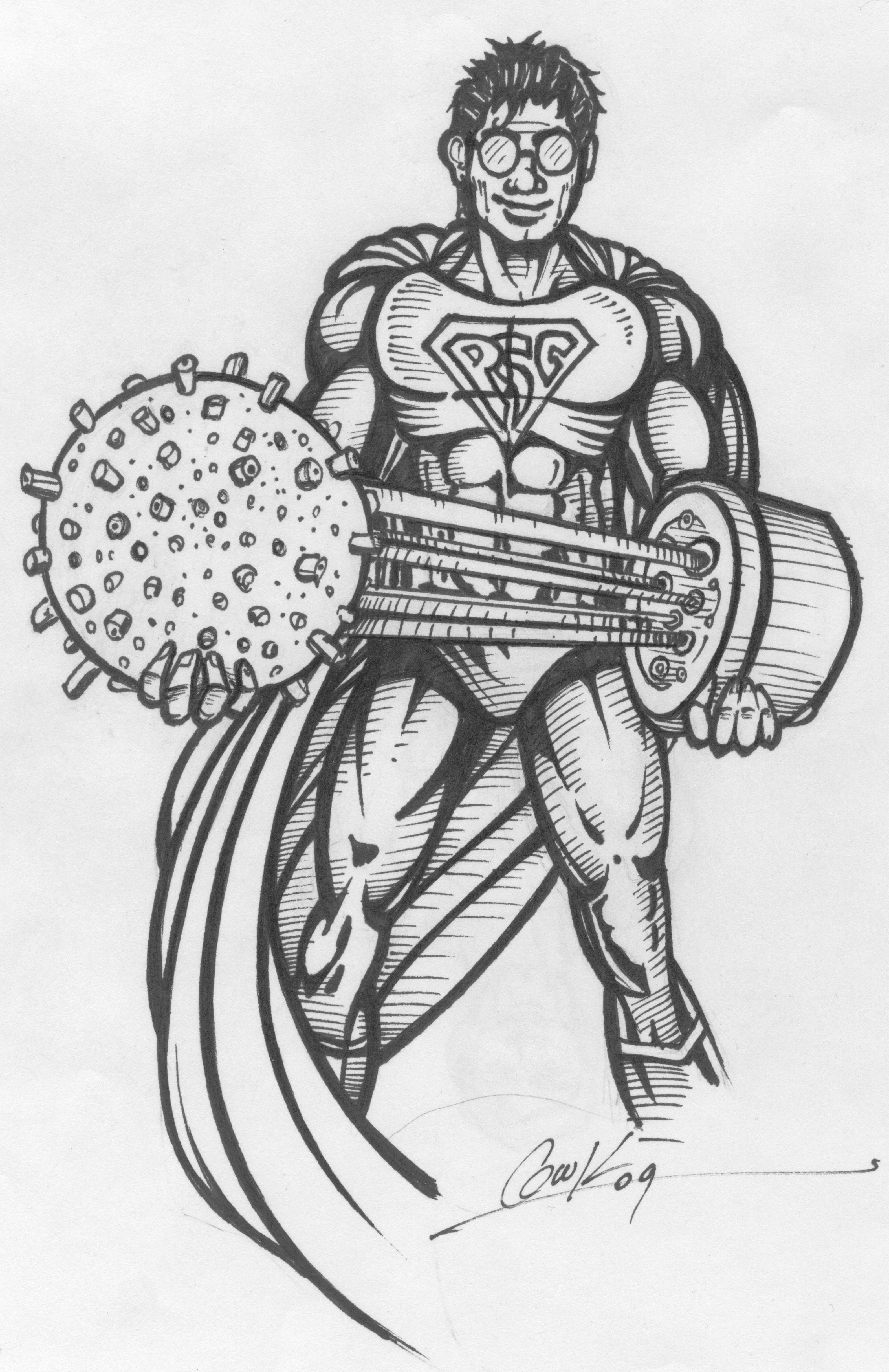
Gary Kezele made the commemorative sketch.

Want More?

Hubble

STS-125 (the repair mission)

Hubble 3D in IMAX – the newest IMAX space movie.

See it in Seattle (Use this link until March 19th) (Use this link after March 19th)

~ A l i c e !

P.S. All astronaut photos are from NASA. As you might expect.

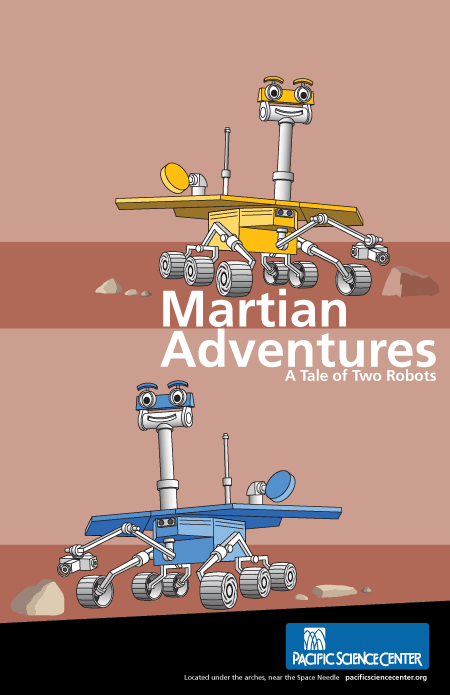
Martian Adventures: A Tale of Two Robots

Opening today!

To go along with Pacific Science Center’s Facing Mars exhibit and Roving Mars IMAX film, we’ve created a new planetarium show.

Come hear stories about the adventures of NASA’s Mars Rovers, Spirit and Opportunity. Make your own decisions regarding some of the challenges they’ve faced and learn to find Mars in tonight’s sky. View photos of the Martian surface that are less than a week old, and root for the rovers to keep on roving! Ticket required (FREE tickets for Pacific Science Center members!) 40 minutes – ages 4 and up. Children under 4 are not admitted.

Go to pacificsciencecenter.org for plenty more information about the exhibit and both shows.

RSVP to our Facebook event, and show your support!

When is it Showing?

<iframe src="https://www.google.com/calendar/embed?title=Planetarium%2FLive%20Science%20Schedule&showTabs=0&showCalendars=0&mode=AGENDA&height=450&wkst=1&bgcolor=%23FFFFFF&src=dcle5i4ol982f5t7vmotmn3ito%40group.calendar.google.com&color=%2388880E&ctz=America%2FLos_Angeles" style="border-width:0" width="450" height="350" frameborder="0" scrolling="no"></iframe>

Some further notes on the show:

Since we wanted a show to complement Facing Mars, I tried to write a show that encompassed the experience of the journey to Mars and what you might face while there – just as the exhibit does. Unfortunately, we have not yet sent people to Mars so I decided to focus on the two robots, Spirit and Opportunity, who seem to have captured the hearts and imaginations of people all over the world. Somehow Spirit and Opportunity (or “Oppy” as we call her) have become beloved pets through whom we can visit a small portion of this alien world.

We were also trying to avoid just another “Red Planet” show, a show listing the most commonly-known facts about Mars: it’s red, it’s got the largest volcano in the solar system, it has the largest valley in the solar system, it has seasonal dust storms, etc. Even if you didn’t already know those facts, you’ll find them in almost any book, TV show, or movie about Mars. We wanted our show to be different.

I also recently attended a storytelling workshop with Jay O’Callahan, who wrote the incredibly moving story of NASA’s first 50 years, “Forged in the Stars”. Good storytelling transports us into the story, and Jay is a master at that. I was inspired by the workshop to begin writing “fact-tales” as my co-worker Michael Bowers calls them; thus “Martian Adventures: A Tale of Two Robots” was born. I cannot claim to be anything like the master that Jay O’Callahan is, but the planetarium staff have taken the stories I outlined and turned them into exciting adventure stories, weaving their words so you hope along with mission control that the rovers will persevere.

The show isn’t all fact-tales though, this is Pacific SCIENCE Center, and “interactive” is one of our watchwords. During a portion of the show guests get to conduct their own analysis of the surface of Mars. We update the show every week with the very newest pictures from the rovers, pictures so new there aren’t usually press releases from the scientists explaining them. So, you get to be the scientist. The planetarians will lead you through the photos asking you to make scientific observations and put forth your own hypotheses about what you see in the pictures. A warning about this for people who need to know “the” answer: the planetarian will not be able to tell you what the best answer is. As I said above, the scientists haven’t had a chance to release their findings about these pictures. That’s what I love about this portion, if you want an answer you have to think of one that matches all the clues you see, you have to be a scientist. You can always check NASA’s website in a few weeks and see what conclusions the scientists have come up with.

I intended this show to appeal to young and old alike, but the story sections might be a little long for children under six or seven. Also, as usual, children under four are only admitted to Preschool All-Stars – our short show expecially for preschoolers and their families. I recommend Martian Adventures: A Tale of Two Robots for anyone who likes discovering and stories.

Oh, and of course we show you where to find Mars in tonight’s sky!

~ A l i c e !

January-February 2010 Sky

Check out this month’s starmap.

Notable Sky Objects

HEY ALICE, I SAW …

Believe it or not, the answer this month is either Sirius or Mars – and they are in the same part of the sky.

PLANETS

Jupiter is up at sunset, setting around 7pm.
Mars will be up all night, and beautiful. Look midway up in the east around 10pm.
Saturn will be rising in the east around 10:30pm.
Venus will not be visible; it is in the same place as the Sun.
Mercury will also be very hard to find, but it rises just before the Sun, so you have a chance.

EVENTS

January 2 – Perihelion. At 7pm the Earth will be at its closest point to the Sun.
January 4 – Latest sunrise of the year, also Spirit’s 6th anniversary on Mars.
January 25 – Mars Planetarium show opens at Pacific Science Center, also Opportunity’s 6th anniversary on Mars.
January 29 – Mars is at opposition, the best time to observe it.
January 27 – Mercury at greatest elongation, best time to observe Mercury.
January 30 – Facing Mars exhibit opens at Pacific Science Center.

New Constellations

CANIS MAJOR – The Big Dog

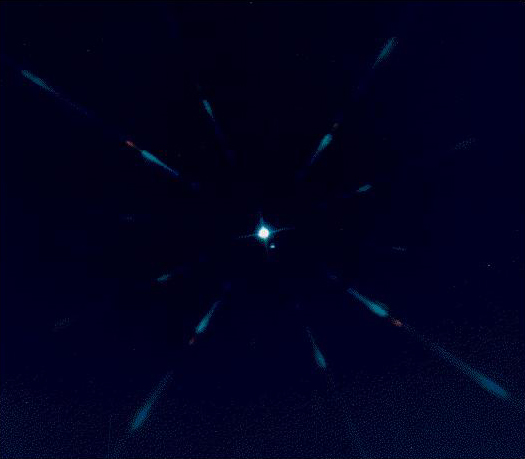
SCIENCE: Obviously you’ll need to notice Sirius, the brightest star in the night-time sky, and if you’re wondering about that other one nearby, that’s Procyon. It’s not in Canis Major, it’s in Canis Minor (the little dog), but it’s nearby. If you have a new telescope (or an old one), Sirius might be a fun target, it’s bright enough to find with your scope semi-easily, and it’s a double star, so once you find it look for the teeeeensy-tinsey companion star. (I say “semi-easily” because learning to point a scope takes practice).

Sirius A & B from McDonald Observatory

Sirius A & B from McDonald Observatory

MYTH: Traditionally Canis Major and Minor are known as Orion’s hunting dogs, but children today will recognize something else in this constellation. The star Sirius is the inspiration behind the name of J.K. Rowling’s character Sirius Black in the Harry Potter series. Sirius Black is an animagus, a man who can turn himself into an animal. Guess what animal he becomes? Yup – a dog. A big, black dog. She knew her stuff.

According to Dr. Snowder at the Western Washington University Planetarium, the Chinook Tribe sees a canoe race in this part of the sky:

“A big canoe (Orion’s belt) and a small canoe (Orion’s dagger) are in a race to see who can be the first to catch a salmon in the Big River (Milky Way). The little canoe is winning the race. Can you tell which star is the fish? It is the very bright star in the middle of the river (Sirius).”

CANCER – The Crab

SCIENCE: Oh beautiful M44! Messier Object #44, the Beehive Cluster, is in the middle of Cancer. I have been told it’s called the Beehive because it’s full of little triangles of stars which look like bees swarming around.

M44 - The Beehive Cluster by Lowdes

M44 - The Beehive Cluster by Lowndes

MYTH: The ancient Egyptians saw Cancer as a scarab beetle – a symbol of life and immortality.

LEO – The Lion

SCIENCE: The star Wolf 359 is in Leo. It’s the third closest star to the Sun – and you might remember it from Star Trek fame – the Battle of Wolf 359, where the Federation attempts to hold off a Borg attack. The other closest stars are Alpha Centauri and Barnard’s Star. It’s too dim to see without a telescope or a camera, but it would be between Leo’s front and back feet.

Gliese 436 (I know, terrible names) is ALSO in Leo. There may be a small Earth-ish-like planet around this one – there’s definitely a Neptune-ish-like planet. We talked about a similar discovery a while ago – and this discovery is by the same team.

Gliese 436 - Not visible to the naked eye - from Stellarium

Gliese 436 - Not visible to the naked eye - from Stellarium

MYTH: The Khoisan people of South Africa call Regulus the “Fire Finisher.” It is a star that marks the time of night in the winter. Unfortunately, in the paper I read, the Fire Finisher might also be Antares or Arcturus – depending on which tribe you ask. Regulus is called “G/wi” – and I’m sorry, I can’t help you pronounce that, the “/” is an actual part of the anglicized spelling, because the Khoisan languages are the “clicky” languages of the San (Bushman) people. (This is from Astronomy Across Cultures, a book of scientific papers on traditional astronomy around the world. It’s an awesome book, and VERY hard to get a hold of).

“Tiny” Guys

Going for the Gold? Here’s this month’s itty-bittys.

LEPUS – The Hare

ERIDANUS – The River (Actually, it’s huge, but dim)

CANIS MINOR – The Little Dog

LEO MINOR – The Small Lion (Between the Big Dipper and Leo)

CAMELOPARDALIS– The Giraffe

TRIANGULUM – The Triangle

ARIES – The Ram

SEXTANS – The Sextant

HYDRA – The Sea Serpent (Also big and dim, so big that it may be the biggest Northern Hemisphere constellation)

MONOCEROS – The Unicorn

LYNX – The Lynx

LACERTA – The Lizard

Returning Constellations

ORION – The Hunter

TAURUS – The Bull

GEMINI – The Twins

PISCES – The Fish

ANDROMEDA – Princess Andromeda

PEGASUS – The Winged Horse

CEPHEUS – King Cepheus

DRACO – The Dragon

URSA MAJOR – The Great Bear

URSA MINOR – The Little Bear

CASSIOPEIA – The Queen

Happy Sky Viewing!

Where’d I get my Info?

My memory, and Zeta Strickland

Selin, Helaine ed. Astronomy Across Cultures. Kluwer Academic Publishers. 2000.

~ A l i c e !

Earth Revealed: Astronomy Day 2009 at Pacific Science Center

Come one, come all to Pacific Science Center’s celebration of Astronomy on May 2, 2009 from 10am-6pm.

Here’s the quote from our website:

Earth Revealed

This spring, Pacific Science Center celebrates local scientific research focusing on all of the amazing things scientists learn by looking at Earth from satellites circling our planet in space. This series of programs showcases local scientists, allowing our visitors to meet and participate in hands-on activities with the people who conduct this cutting edge research.

[Our] month long celebration [Earth Revealed] culminates with a Special Event, Saturday, May 2, 10:00 a.m. – 6:00 p.m. Join Pacific Science Center as we showcase Earth as you have never seen it before. Over twenty hands-on activity stations will be ready to explore, all facilitated by local scientists. Additionally, KING 5 meteorologist, Jeff Renner will make a special presentation! This event is targeted to families with elementary and middle school aged children although will be most appropriate for kids 8-years-old and up.

Awesome Science!

Our ability to look back at Earth from space, using satellites and other space craft, has transformed what we know about our home planet over the last fifty years. From space, we can see weather patterns such as hurricanes and features such as glaciers, volcanoes and oceans in a whole new way. For the first time in human history, we can see ourselves living on and altering a dynamic planet. Discover this fascinating area of research during Pacific Science Center’s Earth Revealed: A View Of Our Planet From Space events!

Learn how scientists:

  • Understand and predict hurricane intensity by combining satellite data with information gathered during flights into real storms!
  • Study the beautiful and awe inspiring Northern Lights!
  • Determine the make-up of Earth’s atmosphere, and then look for similar planets outside of our own solar system!
  • Discover how fires affect our forests!
  • Gather information about the location and thickness of sea ice and glaciers!

Partners:

University of Washington participants include Applied Physics Lab, College of Forestry Resources, Department of Astronomy, School of Oceanography, Department of Atmospheric Sciences, Department of Earth and Space Sciences and Department of Electrical Engineering. Other event participants include Microsoft, JISAO, Central Washington University, KING 5 News and NOAA National Weather Service.

In addition we’ll have planetarium shows (first come, first seated, and seating is LIMITED!) every hour on the hour, astronomy crafts and activities scattered throughout the buildings.

I got to meet a couple of these scientists last week at one of the events that have been going on all month. They’re fun to talk to, have cool stuff to show you, and best of all make it easy to understand!

~ A l i c e !

New Home! Welcome!

Hi! Welcome to my new home … but bear with me, I’m still moving in.

P.S. If you’re new, and don’t know who I am or why I’m here, I run the Pacific Science Center’s planetarium in Seattle, WA. Come and visit, we’re the only planetarium in Washington that has regular public shows – and we’ve got shows EVERY DAY!