September 22 Fall Equinox Sunset Watch–2017

It’s time for the 34th seasonal sunset watch!

We’ll also share eclipse stories and favorite moments or pictures from Cassini (RIP, now part of Saturn). If you drew a picture of the eclipse, either before or after I would absolutely love to see it.

  • When: Friday, September 22 at 6:55pm (so come at 6:35pm)

    • Actual sunset is supposed to be at 7:06pm, but we have noticed that the Sun sets about 10 minutes earlier than the USNO says, because of the horizon altitude.
    • The equinox moment is Friday, September 22 at 1:02pm
  • Where: Solstice Park – all the way up the hill from the tennis courts (or, if you’re not in Seattle, wherever you have a view of the western horizon!)
  • Who: Everyone welcome, as usual. (Please do leash your dogs as we usually have a good number of people, kids, and other dogs around.)
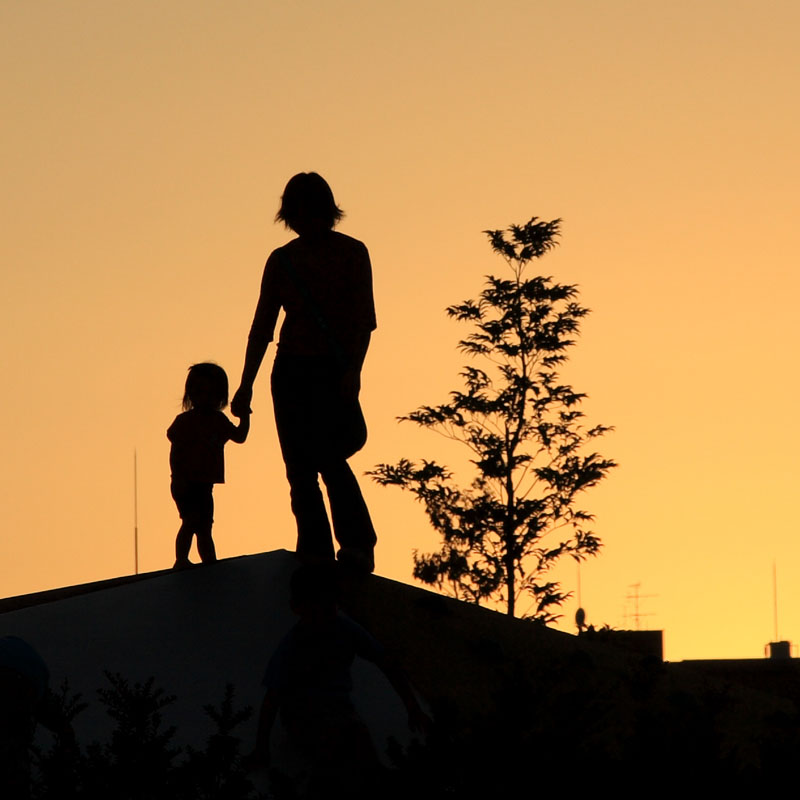
Parent and Child at Sunset by Kazuhiko Teramoto

Parent and Child at Sunset by Kazuhiko Teramoto, skyseeker

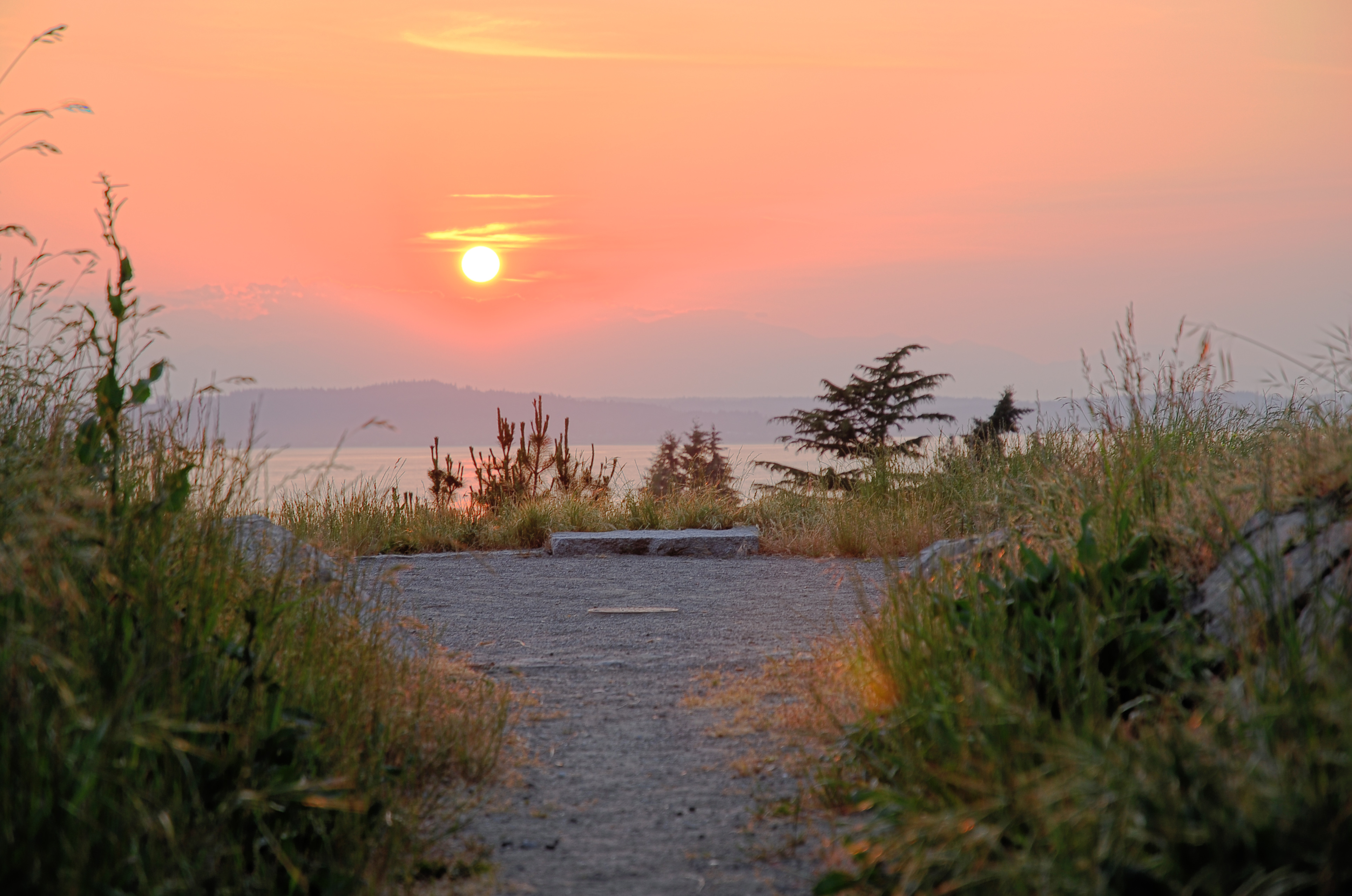
Come watch the sunset at Solstice Park in West Seattle. I’ll be there even if it is cloudy because sometimes the Sun peeks through just as it begins to set, but if it is driving rain or a thunderstorm I’m staying home with some tea!

If you’re interested – here’s the timing of various celestial events  from Seattle, courtesy of the U.S. Naval Observatory Astronomical Applications Department:

Sun and Moon Data for One Day

Equinox Moment (Seattle): Tuesday, Sept 22 1:02pm
Equinox Moment (UTC): Sept 22 20 02

Seattle, King County, WA (Longitude W122° 20′, Latitude N47° 38′)

Friday, September 22, 2017 Pacific Daylight Time
Sun
Begin civil twilight 6:26 a.m.
Sunrise 6:57 a.m.
Sun transit 1:02 p.m.
Sunset 7:06 p.m.
End civil twilight 7:37 p.m.
Moon
Moonrise 9:29 a.m.
Moon transit 3:09 p.m.
Moonset 8:40 p.m.
Closest Primary Moon Phase: New Moon on September 19, 2017 at 10:30 p.m. (local daylight time)

Phase of the Moon on September 22, 2017: Waxing Crescent with 7% of the Moon’s visible disk illuminated.

This event is my part of the NASA’s Solar System Ambassador program, and thanks to West Seattle Blog for publicizing all of them!

Everyone is welcome, see you there!

~ A l i c e !

Storm on Saturn – with a Tail

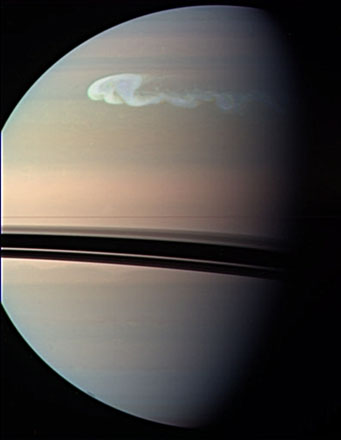
Storm on Saturn by Cassini from NASA/JPL/Space Science Institute.

There is a gigantic beautiful storm on Saturn, noticeable through amateur telescopes, but even more spectacular through Cassini’s instruments.

Quickies:

  • It’s new – discovered in early December 2010.
  • It’s changing a lot from picture to picture
  • It’s comparably sized to the Great Red Spot on Jupiter
  • It is an atmospheric storm
  • It was discovered by amateurs
  • You can see Saturn early in the morning right now.

Discovery and Info

There’s not that much to be said for this storm at the moment, though it is so cool I’m surprised to find so few articles about it. It was discovered by amateurs, and Cassini just happened to be in the right place to take a picture on December 24 (2010). That doesn’t leave time for analysis, what with holiday breaks, and the American Astronomical Society Conference starting today in Seattle.

Dr. Carolyn Porco of the Cassini imaging team did mention that Saturn has quite the exciting atmosphere, just as Jupiter does, but we see less of the excitement due to Saturn’s haze. (Well, she said “complex” and I said “exciting.”)

At this point it is reasonable to compare this storm to others in the Solar System – hurricanes on Earth, Jupiter’s Great Red Spot, and the storm on Neptune. I can’t say which ones are actually related types of storms, but they’re definitely all atmospheric events for their respective planets. Gases have this habit of not staying in one place, they get stirred up, mixed up, blown around. They rise and sink, move as large masses, or blend into the surrounding materials.

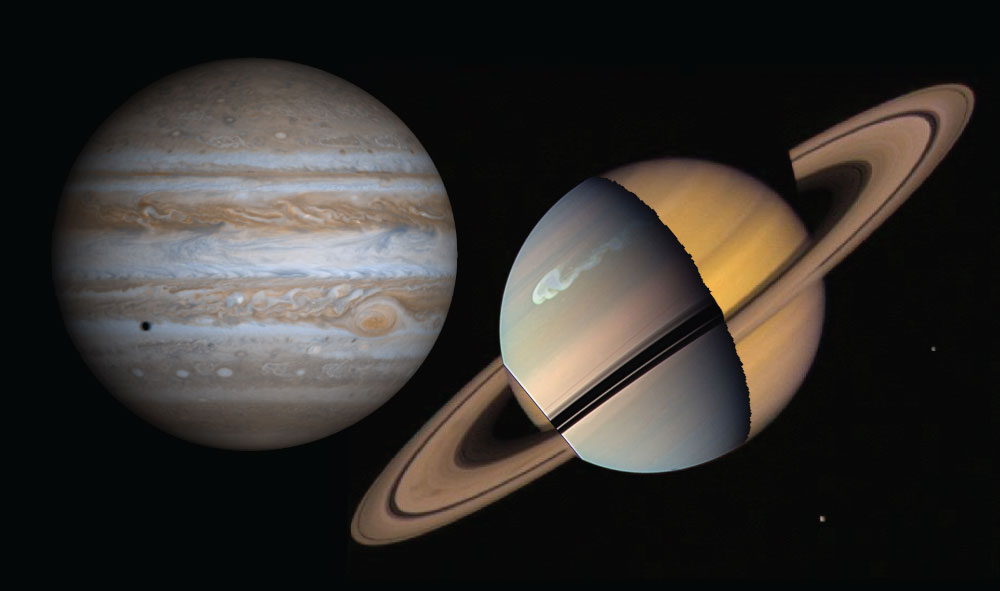
The storm is still developing – and to help you get a handle on visualizing how big this storm on Saturn is, I cobbled together a terrible-looking scaled image of Jupiter and Saturn, including Jupiter’s Red Spot and Saturn’s new storm. This is generally to scale, I did measure rather than just eyeballing, but I didn’t have the computer scale it for me or anything that sophisticated. Sorry, I know it is ugly, but I thought it would be useful.

Ugly Scaled Jupiter and Saturn and their Storms - Distance NOT to scale - Images from Cassini and Voyager, compositing by Alice Enevoldsen

As you can see, the storms are comparably sized, with Saturn’s being a little smaller and longer.

Tie It In

Both Jupiter and Saturn are easily visible in tonight’s sky –  Jupiter after sunset, high in the West, and Saturn a bit before sunrise, midway up in the East. So, depending on if you’re an early riser or a night owl  (who stays up past 5pm here in the winter …) – you can see at least one of the gas giants tonight.  Yes, even from Seattle! Take your chances when there’s a little gap in the clouds and look!

Want More?

Raw Cassini CICLOPS Images

Sky and Telescope – December 27, 2010

Wired – December 27, 2010

Universe Today – December 27, 2010

~ A l i c e !

Summer Solstice Sunset – 2010

  • When: Monday, June 21, 2010 at 9:11pm (so come at 8:30pm)
  • Where: Solstice Park (or, if you’re not in Seattle, wherever you have a view of the western horizon!)
  • Who: Everyone welcome, as usual.

Sunset on June 11, 2009 Credit: Jason Gift Enevoldsen

Come watch the summer solstice sunset at Solstice Park in West Seattle on Monday. We’ll see if the sunset lines up with the placed marker. I’ll be there even if it is cloudy because sometimes the Sun peeks through just as it begins to set, but if it is driving rain I’m staying home with a cup of tea.

If it is clear we’ll bring a telescope or two to take a look at the Moon after the Sun goes down – and Mars and Saturn if we stay until it is dark enough. We will not be able to see the comet – that rises a little before 3am, and I plan to get some sleep before Tuesday. You’re welcome to look for the comet on your own though!

If you’re interested – here’s the timing of various celestial events on Saturday from Seattle, courtesy of the U.S. Naval Observatory Astronomical Applications Department:

Sun and Moon Data for One Day

The following information is provided for Seattle, King County, Washington (longitude W122.3, latitude N47.6):

Monday   21 June 2010          Pacific Daylight Time

SUN
Begin civil twilight       4:31 a.m.
Sunrise                    5:11 a.m.
Sun transit                1:11 p.m.
Sunset                     9:11 p.m.
End civil twilight         9:52 p.m.

MOON
Moonrise                   3:29 p.m. on preceding day
Moonset                    1:36 a.m.
Moonrise                   4:45 p.m.
Moon transit               9:29 p.m.
Moonset                    2:05 a.m. on following day

This event is my part of the NASA’s Solar System Ambassadors program, and thanks to West Seattle Blog for publicizing the last few!

Everyone is welcome, see you there!

~ A l i c e !

Iapetus and the Cassini Regio: 365 Days of Astronomy

By now my second podcast for 365 Days of Astronomy should be live, and here is the post to support it – containing links I mentioned in the podcast. So go listen already!

In this podcast I tell a story about Iapetus and the mystery shrouding her. And yes, I mean tell a story. I was inspired by Jay O’Callahan and his fact-tales.

By the way, this is the only thing I’ve put out on the internet that I haven’t licensed under Creative Commons. (Things that aren’t mine, but are posted by me may be excepted as well. For example, NASA retains the rights to their images though they allow generous usage of them, Jason retains the rights to his photographs, and there are others). I do, in fact, hold the copyright on this story. I’ve granted 365 Days of Astronomy the rights to replay it – and you can replay it as well and use it for personal and educational purposes, but don’t claim it as your own. Let me know if you want to use it for something else, I’ll probably says yes and be flattered.

Want More?

Emily Lakdawalla about Iapetus

NASA’s Cassini Homepage

The Story

Once upon a time there was a moon named Iapetus. She orbited Saturn at a distance of over 3 and a half million kilometers, and there were only two larger moons of Saturn, but still all the other moons made fun of her.

They made fun of her because her front hemisphere was a lot darker than her back hemisphere. This darker area was called the Cassini Regio, but the other moons laughed at her and said she looked like a spherical Oreo. Iapetus thought this wasn’t really fair, since she wasn’t even spherical herself, more lumpy in places.

One July, the Cassini Spacecraft showed up. He noticed how the other moons wouldn’t let Iapetus play with them, and how they always made fun of her. “Come over here, Iapetus,” he said, “I have a story to tell you.”

“Me?” asked Iapetus, “You have a story to tell me?”

“Yes, but only for you, your other friends don’t get to listen to this story.”

Suddenly the play-space became silent. The other moons stopped their games, their hula-hoops fell off, the ones running on the track slowed down, and they all turned around to look at Cassini and Iapetus talking quietly as they orbited around Saturn.

“Once upon a time there was a moon named Iapetus,” started Cassini.

“No, no! We already did that part, Cassini!” protested Iapetus, “get to the good part!”

“Well,” said Cassini, “the first time anyone from Earth saw Iapetus was in 1671, and that man’s name was Cassini.”

“Hey, that’s your name too! Wait, which one is Earth, is that the third or the fourth one out from the Sun?” asked Iapetus.

“Fourth, silly!” said Titan, one of the other moons, stepping closer to Cassini. “Don’t you know anything?”

“I’m not silly!” yelled Iapetus.

“Titan, Earth is the third one. Now if you’re going to listen you both need to sit down and be quiet like Phoebe,” said Cassini gently. “Back then no one knew what mysteries awaited them on the surface of Iapetus.”

“See? I’m not silly, I’m mysterious!” said Iapetus, sticking out her tongue at Titan.

“Shh! No more interruptions.” Cassini frowned at the two of them.

“Since Voyagers 1 and 2 first glimpsed Iapetus’s interesting surface there has been much speculation by scientists all over Earth about how Iapetus came to be this way. I will tell you a few of these ideas, and then Iapetus can tell us what really happened.

“The first idea involves Phoebe. Where is Phoebe? Ah, there she is. A scientist named Hamilton proposed that micrometeors could have knocked some dark dust off Phoebe, then Iapetus could have swept up this material such that it all collected on the front hemisphere.”

“But Cassini, I’m a different color than either Iapetus’s dark side or Iapetus’s light side. I don’t think we’re related!” protested Phoebe.

“Yes, that’s a problem with this idea, as the Earth scientists found out in 1998,” said Cassini.

“What about me?” asked Hyperion, “I’m close to Iapetus too, maybe I’m part of this.”

“That was the very next idea I was going to mention, Hyperion, thank you for bringing it up. There are two different theories relating to you. The first thing though is to find out if the dust can actually get from Hyperion to Iapetus. The scientist Marchi and his colleagues think that’s pretty easy, but how do you get the dust off Hyperion in the first place?”

“Hit it with something!” chorused all the moons of Saturn, making a terrible racket and almost waking the Sun up from her mid-afternoon nap.

“I see you know the secret,” agreed Cassini. “If you need to get something from one place to another in the Solar System, you usually need to slam two things together.”

“And look,” said Hyperion, holding his arm up next to Iapetus’s dark side, “we’re basically the same color on this side of Iapetus.”

“So you are,” observed Cassini. “That makes this idea seem plausible. One last puzzling idea is that perhaps this dark material is from somewhere else, and was collected on both of you.

“One of my jobs in coming here is to take a better look at you Iapetus, and see if I can provide any useful data for the scientists to use in figuring out where your Cassini Regio came from. Do you know the answer?”

“Wow, everyone’s looking at me?” asked Iapetus, “I dunno, I can’t remember when it happened. I am pretty sure that the light side of me is ice, because my backside is always a little chilly. Anyway, if I did know where the dark stuff came from, shouldn’t I leave it as a puzzle for you to find out?” With that she ran off to play hula-hoop by herself, but Hyperion and some of the smaller moons followed her and they all started a game of Occultation.

The End

~ A l i c e !

The ‘cast
Quick Updates: Kepler, Saturn, Perseids, Jupiter

Perseids:

The Perseids peak tonight after midnight. They’re dust- and sand-sized debris left in our path from comet Swift-Tuttle. The air compressing in front of each meteor generates enough heat that the debris burns up and we see a streak of light.

Kepler:

The Kepler mission (looking for Earth-like planets around other stars) has just proved it definitely can detect planets, with more detail and precision than other methods. Kepler observed the planet HAT-P-7, which orbits its star once every 2.2 days, and was able to detect the atmosphere of the planet, and measure the daytime temperature at 4310 degrees F. Ouch.

Saturn:

Saturn’s rings are edge-on from our point of view, which happens every 15 years when Saturn reaches its equinox. According to JPL that day was yesterday, August 11, though the rings will stay mostly edge-on for a while yet.

Jupiter:

I’m quite late off the mark on this one, but something crashed into Jupiter not too long ago. On July 19th an amateur astronomy (Anthony Wesley) found this extra dark spot on Jupiter, and later professional astronomers followed up on his observations with Hubble. With Hubble they can watch as the debris plume evolves, and make better estimates about the size of the impacting object (several hundred meters across).

There is a standing hypothesis that Jupiter, being large, helps clean up the debris in the solar system. It attracts more asteroids and comets, leaving the inner solar system clearer and thus making impacts on Earth less likely.

Want More?

Meteors
Saturn Images

Where’d I Get My Info?

Kepler
Saturn
Jupiter

~ A l i c e !

Planets and Moons (from the BA)

“Wow, what a day. Great day to get out in the park and meet some new planets in this JANUS YOU STOP THAT RIGHT NOW beautiful solar system. Really, you work all week, on a Saturday you just need to enjoy the TETHYS GET OFF OF PANDORA GET OFF GET OFF TETHYS NO JANUS DON’T YOU GET INVOLVED TETHYS GET OFF GET GET little bit of relaxation. Maybe I’ll get to see that little blue-green number out by COME ON PALLANE COME ON STOP SNIFFING COME ON I HAVE PLACES TO BE Mars. Hope I don’t run into Uranus, though. He’s a nice enough guy but all those toilet jokes, jeez. Wow, I thought it was going to be cold, but the sun is IAPETUS GET OFF THAT COMET I’m so sorry, ma’am IAPETUS NO WAIT TETHYS YOU LEAVE PANDORA ALONE NO JANUS I SAID GET DOWN DIONE TELESTO NO IAPETUS Oh, no, is that Terra, KIVIUQ DO NOT GO OVER THERE NO KIVIUQ IAPETUS DON’T ENCOURAGE JANUS ALL OF YOU STOP THIS RIGHT NOW BEBHIONN SKOLL HYRROKKIN THAT’S IT ALL OF YOU ARE GOING TO THE POUND YOU HEAR ME THE POUN-

Oh, hey, Terra. Moons, huh? But you gotta love ‘em anyway. They’re a planet’s best friend.”

Buy one of your own … or buy one for me (hint hint!)