Crew Dragon Splashdown: Sunday August 2, 11:15am Pacific

I will be hosting live commentary over Zoom during the Splashdown of Crew Dragon (the return to Earth of NASA’s #LaunchAmerica: the first launch of crew to orbit in a commercial spacecraft).

When: Sunday, August 2, 2020 11:15am Pacific Time

Where: Register in advance for this meeting (because it is public): https://zoom.us/meeting/register/tJYkfuqvrz8tHtF1InWLMWB77rwAopWZc8cl

I will probably be livestreaming the splashdown via https://www.nasa.gov/live within the commentary. I will be commentating directly with you, and will attempt not to be talking over the NASA and SpaceX official commentators, but explaining some terms they use and answering your direct questions.

To watch the livestream of the launch on your own go to https://www.nasa.gov/live to get the best links from NASA.

Here’s my Twitter summary of why the launch was historic, and hence the return-to-Earth as well:

This is going to be a very big step. If I’m checking my history correctly, this will be the first crewed orbital flight of a truly-new design of spacecraft since the Space Shuttles first orbited in ~1981. I’m not dismissing SpaceShipTwo’s accomplishment of suborbital human spaceflight in 2018, but orbital is definitely different.

I am also not dismissing 神舟(Shenzhou) in 2003, though you have to admit that 神舟 is very, very, very similar to Сою́з(Soyuz). In trying to capture the significance of this upcoming crewed Dragon launch, the technology of 神舟 didn’t *feel* as new.

I guess I’m trying to say this *feels very different and very new. As we’re living in a time of heightened anxiety with the pandemic, things that *feel like risky new technology can *feel even newer or riskier. Let us not mistake *feelings for quantitative and scientifically-conducted risk assessment in any of our scientific endeavors right now, be they human spaceflight, quarantine advice, or the accelerated development of massive SARS-Cov-2 testing and vaccines.

See you in the morning!

-Alice

#LaunchAmerica Live Commentary: SpaceX Demo-2 test flight of Crew Dragon

I will be hosting live commentary over Zoom during NASA’s #LaunchAmerica: the first launch of crew to orbit in a commercial spacecraft. The launch is currently targeted for Wednesday, May 27, at 1:33pm Pacific time. I will start my commentary at 1:00pm Pacific Time. This will all be rescheduled if the launch gets rescheduled.

When: Wednesday, May 27, 1:00pm Pacific Time

Where: Register in advance for this meeting (because it is public):
https://zoom.us/meeting/register/tJ0rdu6rqTwiGtThxCfYc7rK-UgGcvDTj6qY

I will probably not be livestreaming the launch within the commentary. It’ll be better quality if you open the Zoom link up in one tab, and the launch livestream in another. I will be commentating directly with you, and will attempt not to be talking over the NASA official commentators, but explaining some terms they use and answering your direct questions. If it does seem to work better, then I will try livestreaming the launch also. We’ll see. Technology, yo.

To watch the livestream of the launch go to https://www.nasa.gov/beourguest and register to get the best links from NASA. I will also post more links here and in the Zoom chat once we’re rolling tomorrow.

Here’s my Twitter summary of why this is historic:

This is going to be a very big step. If I’m checking my history correctly, this will be the first crewed orbital flight of a truly-new design of spacecraft since the Space Shuttles first orbited in ~1981. I’m not dismissing SpaceShipTwo’s accomplishment of suborbital human spaceflight in 2018, but orbital is definitely different.

I am also not dismissing 神舟(Shenzhou) in 2003, though you have to admit that 神舟 is very, very, very similar to Сою́з(Soyuz). In trying to capture the significance of this upcoming crewed Dragon launch, the technology of 神舟 didn’t *feel* as new.

I guess I’m trying to say this *feels very different and very new. As we’re living in a time of heightened anxiety with the pandemic, things that *feel like risky new technology can *feel even newer or riskier. Let us not mistake *feelings for quantitative and scientifically-conducted risk assessment in any of our scientific endeavors right now, be they human spaceflight, quarantine advice, or the accelerated development of massive SARS-Cov-2 testing and vaccines.

See you tomorrow!

Watch the MAVEN Launch With Me: Monday at 10am Pacific

Hey everyone, I’ll be live-Google-Hangouting from the MAVEN launch (next mission to Mars) in Florida on Monday morning (November 18th. The launch is at about 10:20 Pacific Time, so tune in around 10am.). That’s right, you get me as an on-location reporter for this launch for the first time ever … I’ve never been to a real in-person launch before. I’ll be watching from the Causeway.

I’ll be co-hosting with Shannon Hall and Sarah Culp, who will be Hangouting from Pacific Science Center. Turn on NASA TV in one browser, and join our Hangout in another. Can’t wait to see you! I’ll be posting links here as I get them, and if all else fails check in on my Twitter and Pacific Science Center’s Twitter to get the full scoop that morning!

You can also join Shannon and Sarah in person at Pacific Science Center, details to follow later this afternoon.


Edit to add: You can listen to my interview on KOMO about the MAVEN launch if you missed this hangout or the interview on the actual day of launch.

~ A l i c e !

Worlds of Stone, Worlds Unknown: NASA Investigates Mercury and the Asteroid Belt

We opened a new show in the Willard Smith Planetarium at Pacific Science Center. It’s all about NASA’s current missions in the inner solar system: MESSENGER to Mercury and Dawn to Vesta and Ceres.

As part of that show we’re updating the images we show from MESSENGER and Dawn on a weekly basis. I’ll try to show them to you the week after we use the in the planetarium.

Dawn

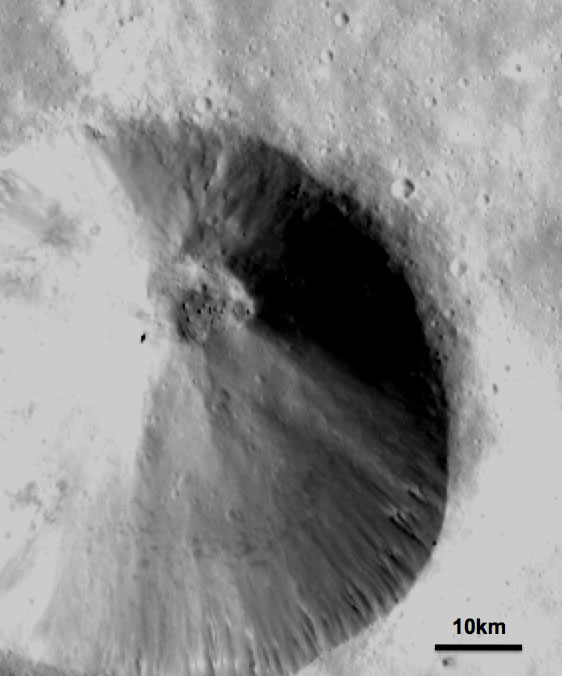
Boulders on Vesta Image Credit: NASA/ JPL-Caltech/ UCLA/ MPS/ DLR/ IDA

NASA Caption

Released October 12, 2011

PASADENA, Calif. — This detail of a Dawn FC (framing camera) image shows a fresh scarp rimmed crater with many boulders on the crater floor. These boulders have diameters of 100-200m, which is roughly the size of many asteroids! Also evident in this image are linear mass movement features, which originate from the rim of the crater (bottom of image) and are due to material slumping towards the center of the crater. There are also many smaller, and presumably younger, impact craters on the walls of this crater.

NASA’s Dawn spacecraft obtained this image with its framing camera on September 20th 2011.

Alice Says

Let me unpack what NASA said for you:

  • “Fresh scarp rimmed crater “ – This crater is new, and it has a sharp edge, like a cliff (a scarp).
  • “Boulders on the crater floor. These boulders have diameters of 100-200m,” – That’s those tiny black dots in the middle there.
  • “Linear mass movement features” – Dirt moved. It moved in a straight line. The lines you see that go from the edge of the crater in towards the middle are these “linear features.” And technically I shouldn’t call it dirt. Regolith is better, but dirt gives you the right idea.
  • “Due to material slumping towards the center of the crater.” – slumping is like sliding. Imagine yourself sitting against a wall. You sit straight at first and then get tired so you scootch down a little, and maybe lean over on your elbow. Slumping is dirt doing the same thing, it’s just … slumped. It’s different that sliding because when you slide you end up all in a completely different place. Slumping you just compact in place, maybe spreading out a little at the bottom.
  • “Presumably younger” – when one crater is on top of another you can assume the crater on top is younger.

The boulders (dots) are my favorite part of this image.

MESSENGER

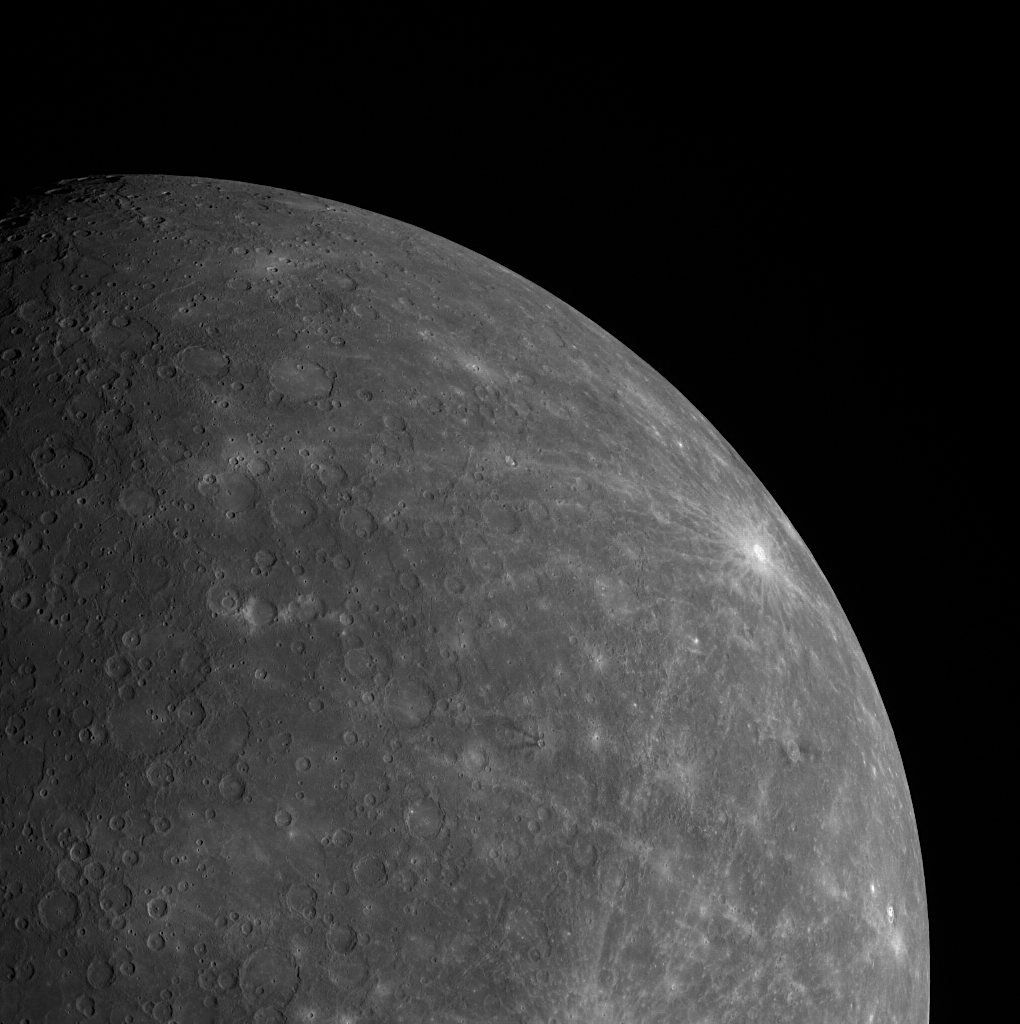
Mercury in Limb-O Credit: NASA/Johns Hopkins University Applied Physics Laboratory/Carnegie Institution of Washington

NASA Caption

Date acquired: September 19, 2011
Instrument: Wide Angle Camera (WAC) of the Mercury Dual Imaging System (MDIS)
Of Interest: This image provides us with a beautiful view of a portion of Mercury’s southern hemisphere. The bright rayed crater near the limb is Debussy.. Also visible, near the center of the image, is Matabei, a small crater distinguishable by its unique dark rays.
These limb images provide information about Mercury’s shape.

Alice Says

I love bright craters – they’re bright because they’re new, not because their composition is different. So rocks are made of minerals, and minerals are usually crystals: they have a lattice of atoms very perfectly aligned. If you just leave a crystal out on a planet it gets scratched up, banged around and the surface gets marred or weathered. If you crack that crystal open, it cracks (cleaves) along those perfect lattice boundaries, between atoms, exposing a new surface. This surface is perfectly flat –flat at the molecular level!! – and therefore reflective like a mirror. This is a cleavage plane. When you smack a meteorite into a planet, you kick up a bunch of rocks and minerals, cracking them all open along those cleavage planes. These fall back down to the planet, reflective, pretty, and unmarred – which looks from space like a bright white crater and rays.

Want More?

Worlds of Stone at Pacific Science Center

MESSENGER

Dawn

~ A l i c e !

Snow Falling on … Mars

The Main Idea:

The Phoenix Mars Lander’s weather instrument (a LIDAR – like radar, only with a laser) detected snow falling from clouds above the Phoenix Lander on 9/29/2008. The snow sublimed before it hit the ground, but we’re in Seattle, we’re used to celebrating snow that doesn’t hit the ground.

More?

I know, I’m sorry, I’m really late posting this. But this is a “Mars has Water!!” discovery that I actually think merits some kerfuffle (of the last eight I think there have been about two of discoveries that do).

So here’s the thing – we’ve known for since forever that there is ice on Mars (though we verified it in 1970), and in 2006 we saw evidence of water that had actually been flowing within the last year. All the other announcements are varying levels of confirmation of these facts. For instance just a month or two ago, Phoenix watched ice subliming. Before that, the various rovers and landers have imaged clouds (that include H2O) in Mars’s atmosphere.

This is DIFFERENT. This is the missing section of the water cycle – not water on the surface, not water evaporating or subliming, not water in clouds, but water falling back down again!

So, if that closed the water cycle what are we still waiting to find? We still want to see liquid water, and I wouldn’t mind seeing some of that falling snow actually hit the ground, but I’m not going to hold my breath for that one.

More Posts About the Snow:

Bad Astronomy: Snow Place like Mars
Universe Today: Snow is Falling From Martian Clouds
Martian Chronicles: Phoenix Sees Snow and Carbonates on Mars!

The Press Release:

NASA Mars Lander sees Falling Snow

NEW Images from Mercury!!

The Key Stuff:

Woo hoo! New images of Mercury!
The way I’d introduce this and interpret it in the planetarium is just to ask questions about it, and collect visitor hypotheses. That’s all the scientists have right now: questions. They also have some hypotheses about bits of it, but they haven’t had time to think of ideas for everything, and even less to test or analyze those ideas.

MESSENGER

Mercury Credit: MESSENGER

What’s up with those longitudinal lines?
Why are those rayed craters so bright?
Some of those craters are on the lines, why?
Is that Mercury’s North pole at the top?
What causes lines like that on other planets?

Here’s some background to help you with your analysis.

Rays:

As we know from the Moon, rays often emanate from craters – especially new craters. When the meteor impacts, it sprays up a bunch of regolith (surface rock/dirt) that falls down in a rayed pattern. Go stomp in a puddle. Watch what happens – that’s what I’m talking about.

Bright Craters:

Brighter craters are almost always newer. The rock is newly broken, showing “shiny” un-weathered, un-covered, un-eroded faces to the sunlight which bounces back at us.

North and South:

According to the MESSENGER press release, that is the North Pole of Mercury up there at the top with a crater on it.

Longitudinal Lines:

The MESSENGER team has floated the idea that these are rays from that Northern crater. They know more than me, but that seems to me like a long way for ejecta (the kicked up regolith) to go. A really long way. How hard would that impact have had to be? Would Mercury’s gravity be enough to pull that ejecta back?

Want More?

Emily promises to have a post up soon.
Phil’s already chatting about it.

My Source.

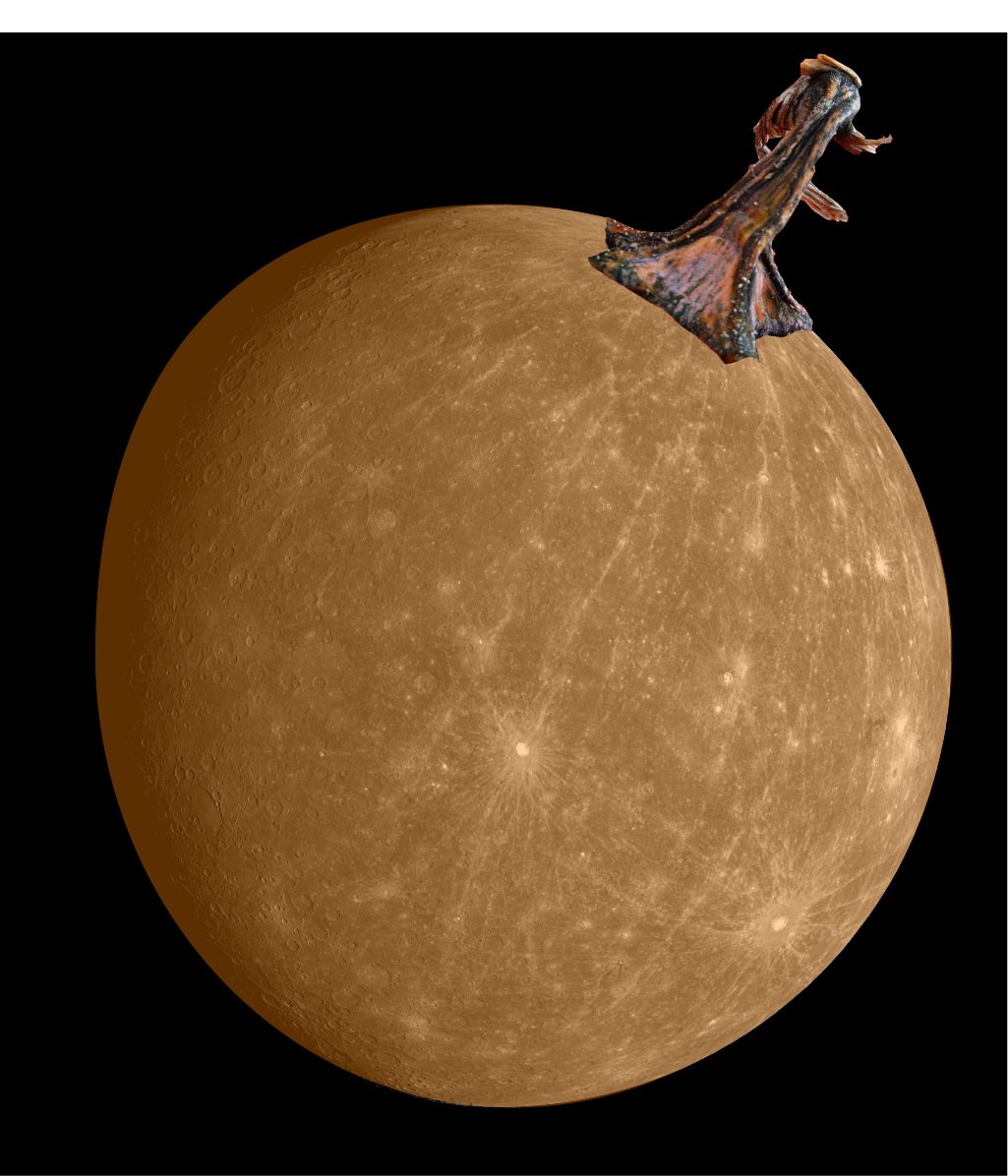
P.S. Phil’s wrong. It’s not a watermelon. It’s a pumpkin, and I have incontrovertable proof:

Mercury is a Pumpkin

Mercury is a Pumpkin

Rockets Bursting in Air

Why do I keep hearing news about rockets exploding, crashing, and generally not doing what is hoped for? I’m glad I’m not a rocket scientist right now.

Here’s the rundown of what I’ve seen:

August, 22, 2008

NASA tried to launch a couple hypersonic suborbital experiments. It didn’t go so well.

August 19, 2008

NASA tried out their new parachutes for the Orion crew vehicle (the one that will be going to the Moon soon). Um. Watch eighteen-million parachutes not deploy in this hilarious video. From what I can tell from the press release, the first parachute failed, and everything depended on that. The following parachutes failed because the lander wasn’t at the correct speed or in the correct position.

August 18, 2008

There’s no video of the Ares 1 tests that I can find, so here’s an old test (2006) instead.

And then there’s NASA’s Ares 1 Engine Tests. While not a failure, they’ve got some issues left to work out. Basically, due to the design, the rocket vibrates so much that people on board the Orion Crew Vehicle would probably not survive. They’re going to install shocks, and they’ve got years to figure this out.

August 2, 2008

SpaceX (a private commercial space company) tried to launch their Falcon 1 rocket for the third time. Basically the second stage doesn’t blast off enough faster than the first stage rocket was already going, so the stages do not separate. This is bad. This causes an explosion.
Launch takes place 4 minutes into the video.

July 28, 2008

The one thing that seems to be running as planned is Virgin Galactic‘s SpaceShip Two. On July 28 they unveiled the carrier for SpaceShip Two: White Knight Two. It’s named EVE.

I’m glad we are in the testing phase. In fact, I’m glad we HAVE a testing phase.

No people or animals were harmed in the making of this post.

Mars Has Water – Yes, Again

Yup. Phoenix found water. For sure. Yup.

A complete table of the multiplicitous discoveries of water on Mars: my post from 2006.

The cool thing about this discovery, as compared to all the rest? We’ve actually picked up and touched this water. We are absolutely certain that it’s water. Very awesome, but not new news.