Worlds of Stone: 11/08/2011

As part of the current show (Worlds of Stone) at Pacific Science Center we’re updating the images we show from NASA’s MESSENGER and Dawn missions on a weekly basis. I’ll try to show them to you the week after we use the in the planetarium.

Dawn
Vesta

NASA Caption

Released November 7, 2011

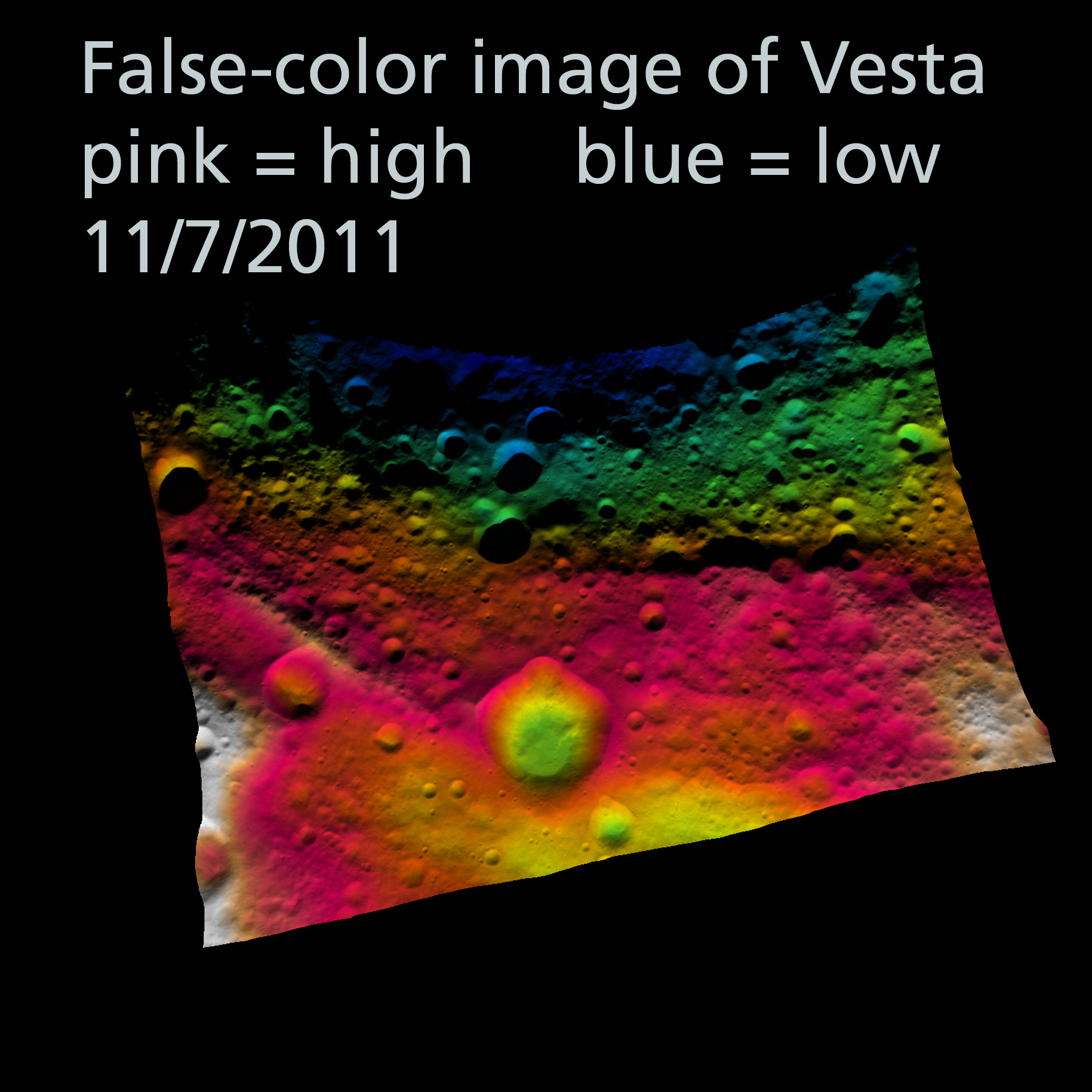
PASADENA, Calif. — These Dawn FC (framing camera) images show part of Vesta’s equatorial region, which contains a prominent, deep impact crater (lower center of image) and large troughs (linear depressions). The various colors correspond to the height of the area that they color. For example, the white areas in the bottom corners of the image are the highest areas and the blue areas along the top of the image are the lowest. The prominent impact crater is set into a topographically high area defined by the red and white color-coding. Above this area there are a number of deep troughs represented by green and blue color-coding. A conspicuous trough on the left, which looks like it could be quite deep in the albedo image, is shown by the color-coding in the topography image to be only a little shallower than the area surrounding it.
Image Credit: NASA/ JPL-Caltech/ UCLA/ MPS/ DLR/ IDA

Alice Says:

This is a standard terrain image with rainbow colors corresponding to elevation. Pink and white are high elevations, blue and green are low. There’s a weirdness in this one though – the colors go in this order: blue, green, yellow, orange, pink, brown, white. Orange and brown look almost the same.
My favorite feature here is the line running up to the left from the big crater in the middle. Due to the weirdness with the scale, I can’t tell if this is a ridge or a valley. What do you think? I have an e-mail out to JPL.

MESSENGER
Mercury, or a puddle?

NASA Caption

Released November 8, 2011

Date acquired: October 31, 2011

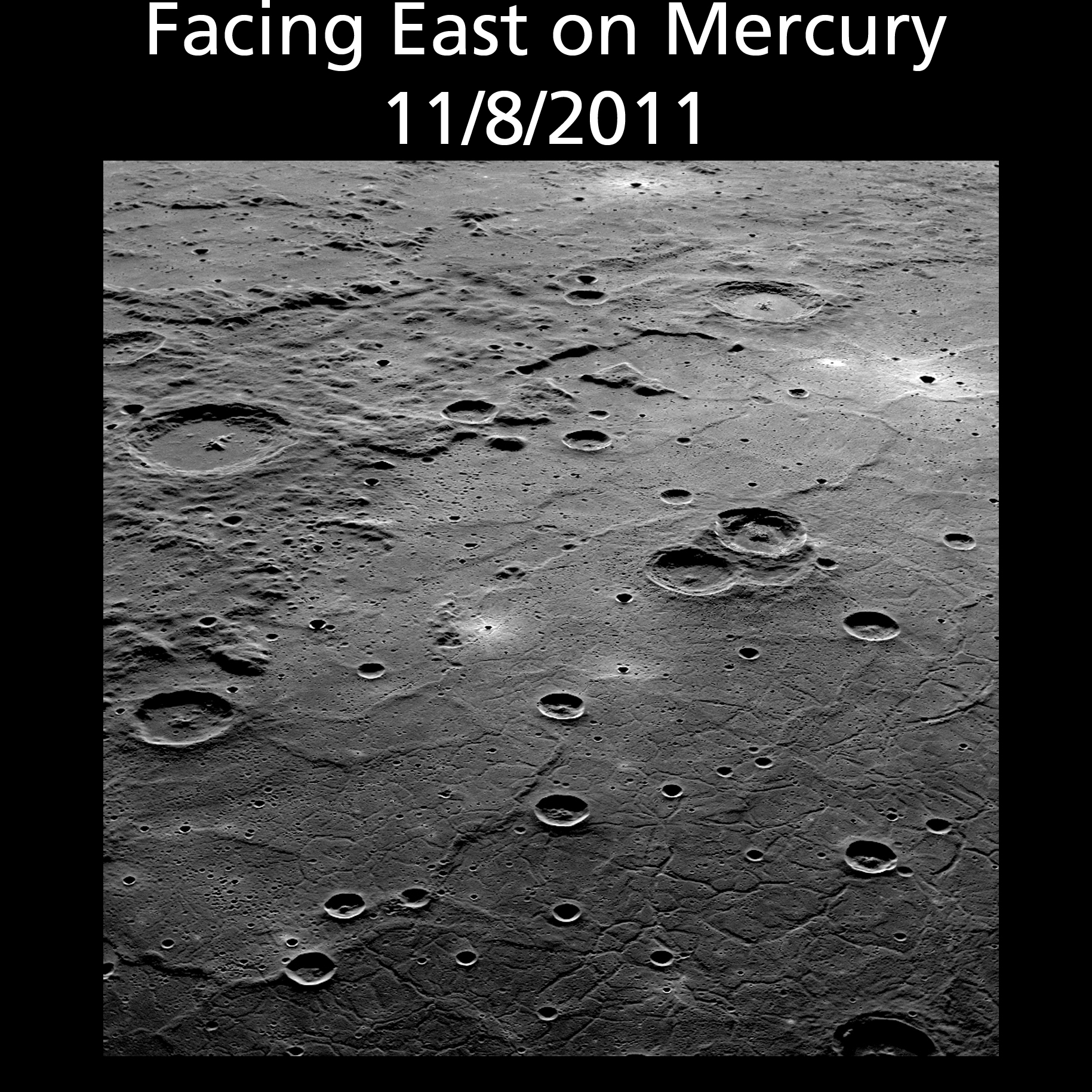
Of Interest: This eastward-looking image shows a wider view of the beautiful unnamed crater highlighted in yesterday’s featured image (center). The complicated folds and fractures that deform the once smooth floor of the Caloris basin can also be seen.
This image was acquired as a high-resolution targeted observation. Targeted observations are images of a small area on Mercury’s surface at resolutions much higher than the base maps. It is not possible to cover all of Mercury’s surface at this high resolution during MESSENGER’s one-year mission, but several areas of high scientific interest are generally imaged in this mode each week.

Credit: NASA/Johns Hopkins University Applied Physics Laboratory/Carnegie Institution of Washington

Alice Says:

If this image doesn’t take your breath away I can’t help you. Those craters look like raindrops in a puddle to me. This picture is so beautiful. Mercury looks like a PLANET here, not just a desolate collection of black-and-white photos. Of note: the bright areas are not highlights, they are crater rays – new dirt (“regolith”) kicked up by recent impacts.

Want More?

Worlds of Stone at Pacific Science Center

MESSENGER

Dawn

~ A l i c e !

Worlds of Stone, Worlds Unknown: NASA Investigates Mercury and the Asteroid Belt

We opened a new show in the Willard Smith Planetarium at Pacific Science Center. It’s all about NASA’s current missions in the inner solar system: MESSENGER to Mercury and Dawn to Vesta and Ceres.

As part of that show we’re updating the images we show from MESSENGER and Dawn on a weekly basis. I’ll try to show them to you the week after we use the in the planetarium.

Dawn

Boulders on Vesta Image Credit: NASA/ JPL-Caltech/ UCLA/ MPS/ DLR/ IDA

NASA Caption

Released October 12, 2011

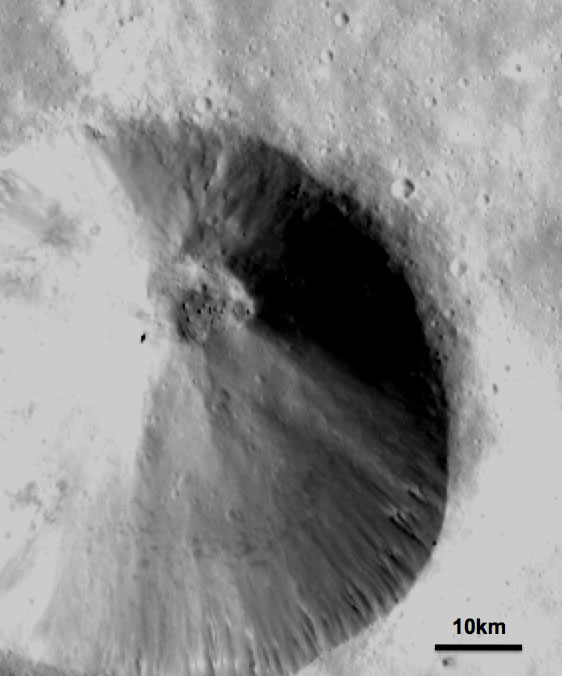
PASADENA, Calif. — This detail of a Dawn FC (framing camera) image shows a fresh scarp rimmed crater with many boulders on the crater floor. These boulders have diameters of 100-200m, which is roughly the size of many asteroids! Also evident in this image are linear mass movement features, which originate from the rim of the crater (bottom of image) and are due to material slumping towards the center of the crater. There are also many smaller, and presumably younger, impact craters on the walls of this crater.

NASA’s Dawn spacecraft obtained this image with its framing camera on September 20th 2011.

Alice Says

Let me unpack what NASA said for you:

  • “Fresh scarp rimmed crater “ – This crater is new, and it has a sharp edge, like a cliff (a scarp).
  • “Boulders on the crater floor. These boulders have diameters of 100-200m,” – That’s those tiny black dots in the middle there.
  • “Linear mass movement features” – Dirt moved. It moved in a straight line. The lines you see that go from the edge of the crater in towards the middle are these “linear features.” And technically I shouldn’t call it dirt. Regolith is better, but dirt gives you the right idea.
  • “Due to material slumping towards the center of the crater.” – slumping is like sliding. Imagine yourself sitting against a wall. You sit straight at first and then get tired so you scootch down a little, and maybe lean over on your elbow. Slumping is dirt doing the same thing, it’s just … slumped. It’s different that sliding because when you slide you end up all in a completely different place. Slumping you just compact in place, maybe spreading out a little at the bottom.
  • “Presumably younger” – when one crater is on top of another you can assume the crater on top is younger.

The boulders (dots) are my favorite part of this image.

MESSENGER

Mercury in Limb-O Credit: NASA/Johns Hopkins University Applied Physics Laboratory/Carnegie Institution of Washington

NASA Caption

Date acquired: September 19, 2011
Instrument: Wide Angle Camera (WAC) of the Mercury Dual Imaging System (MDIS)
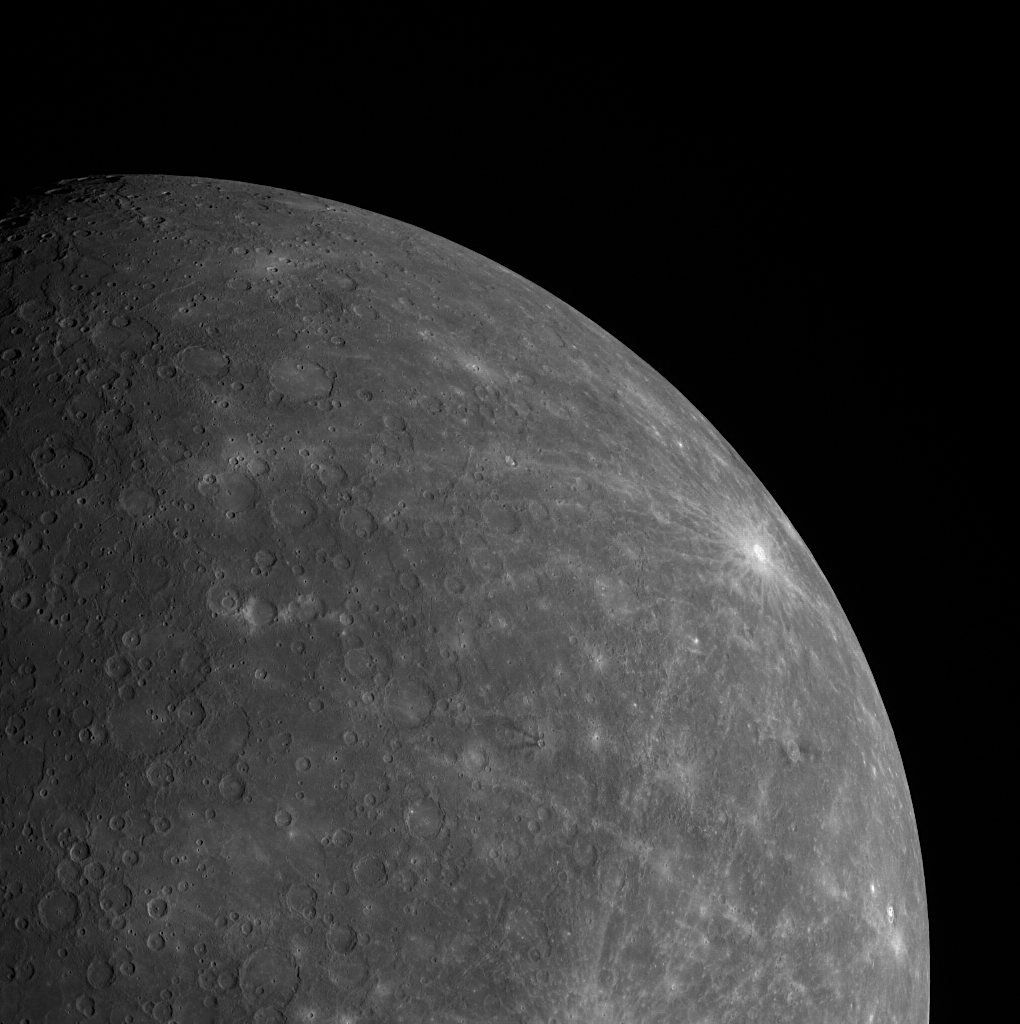
Of Interest: This image provides us with a beautiful view of a portion of Mercury’s southern hemisphere. The bright rayed crater near the limb is Debussy.. Also visible, near the center of the image, is Matabei, a small crater distinguishable by its unique dark rays.
These limb images provide information about Mercury’s shape.

Alice Says

I love bright craters – they’re bright because they’re new, not because their composition is different. So rocks are made of minerals, and minerals are usually crystals: they have a lattice of atoms very perfectly aligned. If you just leave a crystal out on a planet it gets scratched up, banged around and the surface gets marred or weathered. If you crack that crystal open, it cracks (cleaves) along those perfect lattice boundaries, between atoms, exposing a new surface. This surface is perfectly flat –flat at the molecular level!! – and therefore reflective like a mirror. This is a cleavage plane. When you smack a meteorite into a planet, you kick up a bunch of rocks and minerals, cracking them all open along those cleavage planes. These fall back down to the planet, reflective, pretty, and unmarred – which looks from space like a bright white crater and rays.

Want More?

Worlds of Stone at Pacific Science Center

MESSENGER

Dawn

~ A l i c e !