Iapetus and the Cassini Regio: 365 Days of Astronomy

By now my second podcast for 365 Days of Astronomy should be live, and here is the post to support it – containing links I mentioned in the podcast. So go listen already!

In this podcast I tell a story about Iapetus and the mystery shrouding her. And yes, I mean tell a story. I was inspired by Jay O’Callahan and his fact-tales.

By the way, this is the only thing I’ve put out on the internet that I haven’t licensed under Creative Commons. (Things that aren’t mine, but are posted by me may be excepted as well. For example, NASA retains the rights to their images though they allow generous usage of them, Jason retains the rights to his photographs, and there are others). I do, in fact, hold the copyright on this story. I’ve granted 365 Days of Astronomy the rights to replay it – and you can replay it as well and use it for personal and educational purposes, but don’t claim it as your own. Let me know if you want to use it for something else, I’ll probably says yes and be flattered.

Want More?

Emily Lakdawalla about Iapetus

NASA’s Cassini Homepage

The Story

Once upon a time there was a moon named Iapetus. She orbited Saturn at a distance of over 3 and a half million kilometers, and there were only two larger moons of Saturn, but still all the other moons made fun of her.

They made fun of her because her front hemisphere was a lot darker than her back hemisphere. This darker area was called the Cassini Regio, but the other moons laughed at her and said she looked like a spherical Oreo. Iapetus thought this wasn’t really fair, since she wasn’t even spherical herself, more lumpy in places.

One July, the Cassini Spacecraft showed up. He noticed how the other moons wouldn’t let Iapetus play with them, and how they always made fun of her. “Come over here, Iapetus,” he said, “I have a story to tell you.”

“Me?” asked Iapetus, “You have a story to tell me?”

“Yes, but only for you, your other friends don’t get to listen to this story.”

Suddenly the play-space became silent. The other moons stopped their games, their hula-hoops fell off, the ones running on the track slowed down, and they all turned around to look at Cassini and Iapetus talking quietly as they orbited around Saturn.

“Once upon a time there was a moon named Iapetus,” started Cassini.

“No, no! We already did that part, Cassini!” protested Iapetus, “get to the good part!”

“Well,” said Cassini, “the first time anyone from Earth saw Iapetus was in 1671, and that man’s name was Cassini.”

“Hey, that’s your name too! Wait, which one is Earth, is that the third or the fourth one out from the Sun?” asked Iapetus.

“Fourth, silly!” said Titan, one of the other moons, stepping closer to Cassini. “Don’t you know anything?”

“I’m not silly!” yelled Iapetus.

“Titan, Earth is the third one. Now if you’re going to listen you both need to sit down and be quiet like Phoebe,” said Cassini gently. “Back then no one knew what mysteries awaited them on the surface of Iapetus.”

“See? I’m not silly, I’m mysterious!” said Iapetus, sticking out her tongue at Titan.

“Shh! No more interruptions.” Cassini frowned at the two of them.

“Since Voyagers 1 and 2 first glimpsed Iapetus’s interesting surface there has been much speculation by scientists all over Earth about how Iapetus came to be this way. I will tell you a few of these ideas, and then Iapetus can tell us what really happened.

“The first idea involves Phoebe. Where is Phoebe? Ah, there she is. A scientist named Hamilton proposed that micrometeors could have knocked some dark dust off Phoebe, then Iapetus could have swept up this material such that it all collected on the front hemisphere.”

“But Cassini, I’m a different color than either Iapetus’s dark side or Iapetus’s light side. I don’t think we’re related!” protested Phoebe.

“Yes, that’s a problem with this idea, as the Earth scientists found out in 1998,” said Cassini.

“What about me?” asked Hyperion, “I’m close to Iapetus too, maybe I’m part of this.”

“That was the very next idea I was going to mention, Hyperion, thank you for bringing it up. There are two different theories relating to you. The first thing though is to find out if the dust can actually get from Hyperion to Iapetus. The scientist Marchi and his colleagues think that’s pretty easy, but how do you get the dust off Hyperion in the first place?”

“Hit it with something!” chorused all the moons of Saturn, making a terrible racket and almost waking the Sun up from her mid-afternoon nap.

“I see you know the secret,” agreed Cassini. “If you need to get something from one place to another in the Solar System, you usually need to slam two things together.”

“And look,” said Hyperion, holding his arm up next to Iapetus’s dark side, “we’re basically the same color on this side of Iapetus.”

“So you are,” observed Cassini. “That makes this idea seem plausible. One last puzzling idea is that perhaps this dark material is from somewhere else, and was collected on both of you.

“One of my jobs in coming here is to take a better look at you Iapetus, and see if I can provide any useful data for the scientists to use in figuring out where your Cassini Regio came from. Do you know the answer?”

“Wow, everyone’s looking at me?” asked Iapetus, “I dunno, I can’t remember when it happened. I am pretty sure that the light side of me is ice, because my backside is always a little chilly. Anyway, if I did know where the dark stuff came from, shouldn’t I leave it as a puzzle for you to find out?” With that she ran off to play hula-hoop by herself, but Hyperion and some of the smaller moons followed her and they all started a game of Occultation.

The End

~ A l i c e !
The ‘cast

No Podcasts

In case you hadn’t noticed, I’m suspending podcasting for a while. If I hear an outcry I may bring it back, but until then you’ll have to call the planetarium hotline for your audio fix: 206-443-2920.

Note: this is NOT the same audio as AstroInfo, and it’s updated less often, but it’s something!

July-August Sky

Podcast for July-August Sky

A guide for what’s coming up this month. I tried to include a fact and a lesser-known story for each object. I didn’t completely succeed. This guide is written to give hints to people who already know approximately what they’re looking at. For a good beginner’s guide to the sky, try StarDate, Sky and Telescope’s Stargazing Basics, or Sky and Telescope’s links to lots of beginning topics. (Or, if you know a better beginning stargazing site, put a link to it in a comment below!

New Constellations

ANDROMEDA – Princess Andromeda

Alpheratz is the star that connects Pegasus to Andromeda.
The Andromeda Galaxy is located in the constellation of Andromeda. It’s 2.2 million light years away, and the furthest thing you can see with your eyes. Period.
MYTH: Saudi Arabians called Andromeda “the sea lion”.

PEGASUS – The Winged Horse

Alpheratz is the star that connects Pegasus to Andromeda.
MYTH: The Greek Myth of Pegasus is long, complicated, and involves 6 constellations in the night sky. Queen Cassiopeia and King Cepheus weren’t all that great at being king and queen. Stuff happened, and they decided to sacrifice their daughter Andromeda to the sea monster Cetus. Perseus, returning from slaying Medusa, was riding on the back of Pegasus, who sprang from Medusa’s neck. Perseus killed Cetus, rescued Andromeda, and they lived happily ever after.

CEPHEUS – King Cepheus

Delta Cephei is a variable star, a whole type of variables are named after it.
Delta Cephei (Cepheid) variables are really useful stars. You can use them to judge distance, since the time between pulses is directly related to how bright the star actually is (the period-luminosity relationship).
MYTH: More of the Cassiopeia stuff.

PERSEUS – Perseus

The Perseid Meteor Shower (Perseids) will appear to radiate out of the constellation Perseus. This point is called the “radiant.”
MYTH: The Tale of the Hungry Skunk, A story about Auriga and Perseus: Salish tribe of the high plateau country of Washington, Oregon, and Idaho.
Once, when darkness was marching across the sky, the women of the sky country were preparing the evening meal. The men, who were sky fisherman, would be hungry when they returned and they were due home soon.
The women had built a large pit and placed some roots on hot rocks where the roots began to steam. A skunk smelled the cooking roots and followed the scent to see if it could get an easy meal.
It wasn’t long before the skunk found the village where the women were busy cooking and doing other evening chores. It walked toward the pit where the roots were steaming. A small child saw the skunk and asked his mother what that animal was. The mother screamed “Aieeee!”, grabbed her child, and ran away. Many of the other women soon did the same. But some of the women stayed behind to protect their hard work. They encircled the cooking pit and stared at the skunk. The skunk stopped and stood very still. It thought that if it stayed still long enough, perhaps the women would forget that it was there. The skunk is still in the sky, standing motionless, and the women are still standing around the pit, protecting their work.
(Sounds to me like Auriga is the circle of women, and Perseus is the skunk.)

SAGITTARIUS – The Centaur Archer

The center of our galaxy: if you see Sagittarius as a teapot, then the center of our galaxy, the Milky Way is right where the tea pouring out of the teapot would be.
MYTH: The Chinese see a dipper in Sagittarius. This dipper is part of the Black Tortoise. From: Chinese Constellations

CAPRICORNUS – The Sea Goat

This constellation is a decent-sized triangle. There aren’t really many interesting objects, and I can’t find any non-Greek myths. This is not my favorite constellation.
MYTH: Capricorn is a sea goat: half fish, half goat.

OPHIUCHUS – The Serpent Bearer

Ophiuchus is the 13th Zodiac constellation. It’s not part of the astrological zodiac, but it is along the ecliptic, and the sun spends a couple weeks passing through this constellation around November 30th through December 17th.
MYTH: Going for the gold? Find Serpens Caput (serpent’s head) and Serpens Cauda (serpent’s tail) beside either side of Ophiuchus to complete the story of the serpent bearer.

DELPHINUS – The Dolphin

In 1967 a nova went off in this constellation, and it could be seen with the naked eye. Now you need a telescope.
MYTH: The Chinese see this constellation as a gourd.

JUPITER

Don’t miss Jupiter in tonight’s sky!

“Tiny” Guys

Going for the Gold? Here’s this month’s itty-bittys.

SCUTUM – The Shield

CAMELOPARDALIS– The Giraffe

LACERTA – The Lizard

SERPENS CAPUT – Serpent Head

SERPENS CAUDA – Serpent Tail

EQUULEUS – The Little Horse

SAGITTA – The Arrow

VULPECA – The Fox

CANES VENATICI– The Hunting Dogs

Returning Constellations

I tried to include new stuff about most of these.

AQUILA – The Eagle

MYTH: The Japanese see Altair as a Cowboy and Vega as a Weaver girl. They are very much in love, but due to circumstances are separated – except for one day a year (the 7th day of the 7th month of the lunar calendar) the lovers get to be together, but only if it’s clear.

CYGNUS – The Swan or the Northern Cross

Albireo (the head star) is a beautiful double star
MYTH: To the Saudi Arabians, Cygnus was alternatively a hen or a swan. To the Chinese, the creature was a magpie.

LYRA – The Harp

Vega will be our North Star in about 14,000 years.
MYTH: to the natives of Bohemia, Lyra is “the fiddle in the sky”

SCORPIUS – The Scorpion

BOOTES – The Farmer

MYTH (From Zeta): This constellation is often seen as a grapevine (think “cluster of hanging grapes”).

CORONA BOREALIS – The Northern Crown

MYTH: The Housatonic Native Americans believed Corona was the cave home of Ursa Major.

HERCULES – Hercules

M13 Hercules Globular Cluster
Globular Clusters are gravitationally-bound groups of 1000s to 10s of 1000s of stars. They tend to be outside of the galactic plane, and are the oldest stars in a given galaxy.

URSA MAJOR – The Great Bear

URSA MINOR – The Little Bear

CASSIOPEIA – The Queen

MYTH: The Arabs also saw hand imagery in the constellation, referring to it as “the large hand stained with henna”. In viewing this constellation as a hand, each of the five prominent stars in it would represent a fingertip.

Happy Sky Viewing!

Stargazing Opportunities

Podcast for Summer Stargazing in Seattle

Summer Stargazing in Seattle

Looking for stars in Seattle? The further you can get from streetlights, the better. Darkness is what you need for the best stargazing.* If you’d like to join other astronomy enthusiasts, try one of these local events!

Star Parties:

The Seattle Astronomical Society hosts stargazing parties in two locations in Seattle. http://www.seattleastro.org

Green Lake Star Party: Green Lake star parties are on the north shore at a grassy area west of the Bathhouse Theater, near the fishing piers on the lake.
July 12th and August 9th at 7pm

Paramount Park Star Party: The park address is NE 155th and 8th NE in Shoreline.
July 12th and August 9th at 7pm

UW Observatory Open House:

Look through the UW’s 110-year-old refracting telescope, and listen to a short talk. The observatory is located in the northwest corner of the campus. http://www.astro.washington.edu/observatory/

July 2nd and 16th at 9pm
August 6th and 20th at 9pm

*Please use caution walking in the city in the dark. Also, be aware that many of Seattle’s Parks close at sunset.

Further Afield

Getting out of the city makes for even better views of the sky. Here are some of my favorite stargazing locations within a few hours of Seattle. Most of these are fee-based public areas.

Campground on Lake Kachess

In the Cascades just off I-90. The boat ramp has a good view towards the Northeast (perfect for Perseid viewing). Be sure to talk to the ranger beforehand though, the boat ramp is in the “Day Use Only” section of the park. Info: www.reserveamerica.com

Lake Ozette in Olympic National Park

Near the tip of the Olympic Peninsula, has a good reputation. Stay near the water (out of the trees) for the best sights. Info: www.nps.gov , Brochure

Bowman Bay Campground

The Boeing Employee’s Astronomical Society recommends Bowman Bay Campground in Deception Pass State Park on Whidbey Island. Info: www.parks.wa.gov

Staircase Campground

My favorite stargazing location, Staircase Campground in Olympic National Park, is closed due to road-washout and should reopen sometime this summer. If you get there, sit on the bridge for the best views. Info: www.nps.gov , Brochure

The Perseid Meteor Shower

If you spend any time stargazing this summer, be sure not to miss the Perseid meteor shower.

Dates: July 17-August 24th
Time: After midnight
Best Viewing: August 12 12am-3am

To see the Perseids, turn to face the constellation Perseus, which will be rising in the Northeast a bit before midnight.

Pacific Science Center’s Starmap for July and August

July-August Starmap

Where’d I Get My Info?

UW Observatory:
http://www.astro.washington.edu/observatory/

Seattle-Area Astronomy Events:
http://www.seattleastro.org

AstroInfo – Now Served in Audacious Audio!

As is only appropriate for astronomy – the science of many wavelengths – you can now download podcasts of select AstroInfos.

I’ll try to work backward and fill in the gaps, and I hope to keep recording the new ones for those of you who prefer a voice. Till then, you get what you’ve got. Links to each podcast are embedded in the individual posts, but here’s one to start you off:

Podcast of the Uranus Post

I’ve done some basic testing, and the three podcasts (Uranus, SWIFT, and About AstroInfo) seem to work okay. Let me know if you have troubles, and I’ll see what I can see.

If you’re one of those people who cares: I’m recording using QuickTime, boosting the volume, exporting as avi, converting to mp3 using Super, changing the metadata with ITunes, and uploading to Internet Archive (archive.org) – all for free. Well, I guess I bought QuickTime last year. If you don’t have it, my husband recommends Goldwave – that’s free.

These podcasts are Creative Commons – Attribution – NonCommercial – ShareAlike, because I want the info out there for people to learn from, and if it’s on the internet there’s no real way to guarantee that people don’t copy it. So – if you use stuff, let me know, and don’t sell it: I’m not making any money off this, and some portion of it belongs to Pacific Science Center.

The Ugly Ducklings: Composition of Uranus and Neptune

Podcast of The Ugly Ducklings: The Composition of Uranus and Neptune

Uranus and Neptune are not what I thought: they’re mostly made of fluid ices, not gasses.

A Brief Story

So, last week I was sitting in an invited talk by Dr. David Charbonneau at the American Astronomical Society’s summer conference. David is looking for exoplanets, and has found many. He’s the kind of person who should really know what he’s talking about when it comes to planets. When he uttered a sentence that went something like this: “Uranus isn’t really a gas giant, it’s an ice giant,” my ears perked up and I started thinking.

Oddly, I had just done a bunch of low-level research into Uranus for my post A Series of Questions II. I ran across a few untrustworthy sites that called Uranus a “slush planet,” but when I went to NASA’s planetary data sheets, which I figured would be solid references, they said Uranus’s atmosphere was 82% Hydrogen, 15% Helium, etc (which I said in my other post). What I completely missed was the word “atmosphere.” So, I joyously wrote that Uranus was mostly Hydrogen and Helium, just like Jupiter and Saturn, and moved on with my life. Until I heard Dr. Charbonneau. Then I got confused. So I talked to both my Astronomy professors from Whitman College (one of whom was there in the audience too!) and did a bunch of web research, since we need to get this right in our Planets Show.

What I Learned

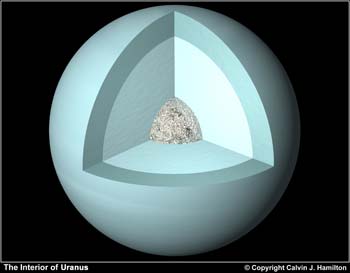
Uranus has three layers: a tiny “rock” core, a thick “ice” “ocean”, and a thin gaseous atmosphere much like most of Jupiter and Saturn’s composition. Let me go on, and explain why there are so many quoted words in that sentence. Note that Uranus is 14.5 times the mass of Earth, and you could fit 63 Earths inside it. Also, only Voyager 2 has flown by it, so our data is limited.

Uranus’s Core

The core of Uranus is between half and four times the mass of the Earth. It is made of something you might call rock – since it’s mostly silicates (that’s what rocks on Earth are) and metals. It is likely that although the rock part is probably molten, the metals could be solid.

The “Icy” “Ocean” Layer

There is a gigantically thick layer between the core and the atmosphere. About 80% of the mass of Uranus (so 11 to 14 times the mass of Earth) is wrapped up in this layer. There’s a bunch of water, some methane, ammonia, nitrogen, and hydrogen sulfide. This layer is termed “ice.” And it is fluid (I didn’t say liquid). And it is hot.

Wait, How Can You Have a Fluid Ice?!

A Note on Phases: It’s ice because of how high the pressure is that deep in a planet. You can change the phase (solid to liquid to gas) of something in two ways: change the temperature, or change the pressure. This is why snow on mountaintops often sublimates (goes straight from solid to gas) rather than melting and then evaporating, and why water boils at a different temperature in Denver than it does in Seattle. (You may have seen “High Altitude Cookbooks” – that’s why). At high enough pressure, no matter what the temperature, water will be ice.

Paraphrasing/Quoting Dr. Andrea Dobson: Why are we using the word “ice”? If you’re talking about rock, you wouldn’t flip out if I said “liquid rock” or “solid rock”, would you? One is specifically called magma, but you can still call it “liquid rock” if you want. Andrea’s “sense of ices is that we’re talking about things that are relatively volatile,” (easy to change the phase of) “but not as volatile as hydrogen or helium.” Some examples are water, methane, N2, ammonia, CO, and sulfur compounds. So the word ice is really being used to say “stuff that’s not rock or gas.”

When it comes to “fluid ice”, Andrea reminded me that, as I learned in my Planetology and Geology classes, you can have plastic/ductile deformation of solids. Whooeee – let me explain a little better there.

Think about a rubber band. Solid, liquid, or gas? Solid, pretty definitely. Can you change the shape of a rubber band? Yes, but it always bounces back. That’s an elastic deformation. You just changed the shape of a solid. Elastic materials always return to their original shape.

Now think about a paperclip. Solid, liquid, or gas? Solid, duh. Can you change the shape of a paperclip? Yes! And it stays that way. That is a plastic deformation of a solid. Plastic materials do not automagically return to their original shape.

Did either the rubber band or the paperclip break? No. So they’re fairly ductile. If you keep changing the shape of them though, which will break first? Probably the paperclip (but try it and let me know your results). The paperclip is less ductile than the rubber band. Ductility is a measure of how much something can be deformed before it breaks.

So, if you take some very basic geology, you learn that below the Earth’s crust is lots of hot rock: magma etc. If you take some medium-level geology classes, you learn that rock is not all liquid, in fact, much or most of it is solid. It still flows around, mixes, etc. because it’s plastic and ductile. It’s still a solid, but it’s acting fluid.

Remember: phase changes are pretty messy. We often think they’re not, because we’re used to the liquid water/solid water phase change, which happens pretty neatly at 0 degrees. Even that’s not as simple as you think though: glaciers flow like very slow rivers, and they’re made of solid ice. Also, the liquid water/gas water transition isn’t all that easy. We think of steam (the white clouds expelled from a boiling tea kettle) as water in gas form, but really, the part you see is tiny droplets of liquid water suspended in the air (a liquid water aerosol). The gas is completely invisible – so right next to the tea kettle spout, where you don’t see anything, is probably pure steam. Try this at home – but don’t burn yourself by looking too closely, and if you’re under a certain age, have a grown-up help you.

The Atmosphere

The atmosphere, like I said before, is mostly Hydrogen and Helium. But here’s the thing – the atmosphere is only 5-15% of the radius of Uranus. It’s probably also half the mass of the Earth, or maybe a little more – so overall, not much of the composition comes from the atmosphere.


2008_06_09 UranusInterior

Picture copyright Calvin Hamilton, from: http://explanet.info/Chapter11.htm

In conclusion, Uranus is mostly made of fluid ices, not gasses.

Neptune

Neptune’s composition is similar to that of Uranus, with slightly different-sized layers, and slightly different compositions.

Some Good Illustrations:

University of Washington’s Comparative Planetology
Phase Diagram of Water (advanced)

Where’d I Get My Info?

Andrea Dobson, Whitman College
Lunine, Jonathan I. The Atmospheres of Uranus and Neptune in the Annual Review of Astronomy and Astrophysics Volume 31, Pages 217-263. 1993.
dePater and Lissaur. Planetary Sciences, Page 2, 245-248. Cambridge. 2001.
Guillot. Interiors of Giant Planets, Annual Review. Earth and planetary Science. 2005.
And, believe it or not, Wikipedia. As of 6/9/2008 the list of references was very good.

We Caught One! SWIFT Sees a Supernova!

Podcast of We Caught One! SWIFT Sees a Supernova

Caught in the Act …

Alicia Soderberg and her colleagues (I’ve since read that she was on a plane, and her friend actually noticed this) got very lucky. She had NASA’s Swift X-Ray Telescope pointed at a galaxy (NGC 2770 in the Northern constellation Lynx) when a supernova exploded right where she was looking.

2008_05_21 Swift Supernova
Credit: NASA
Caption: SWIFT X-ray image (left) of Supernova 2008D, Visible image (right) of NGC 2770

Although there are historically recorded observations of supernovae (1987A, Tycho’s Star, SN1054), never before has a telescope recorded the actual beginning of the outburst. Usually we see the remnant of the supernova, or catch just the middle or the end of the bright explosion.

More Detail, More Accurate:

What Alicia saw is actually sort of the pre-signal for the supernova. We’ve seen the other stages of the supernova a few times before.

Scientists have been predicting that the first event as a star collapses into a supernova should be a humongously bright flash of X-Rays. Unfortunately, by the time we detect a supernova in progress, this flash has already finished. No matter how fast our telescopes turn, we can’t catch the X-Ray flash – though we can get most of the rest of the supernova, including most of the visible-light flash, the brightening of the area, and the dimming away.

Alicia and her team observed the bright flash lasting for about 5 minutes at 9:30 in the morning on January 9th of this year.

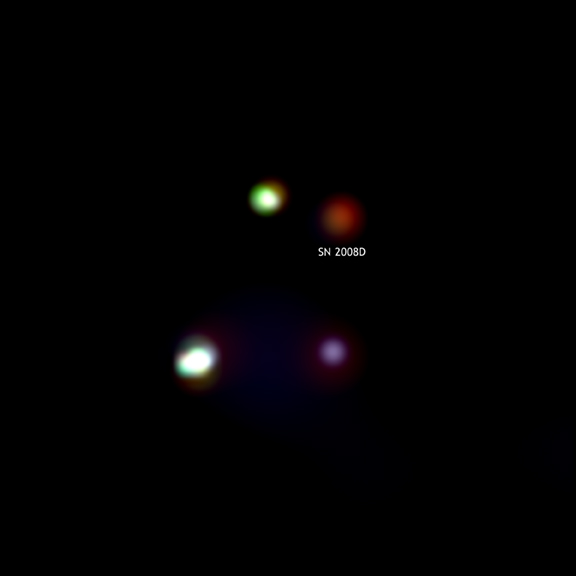
2008_05_21 Chandra Supernova
Credit: NASA/CXC/Wisconsin/ D.Pooley et al.
Caption: Chandra X-ray Observatory image of the region around SN 2008D, obtained about 10 days after the supernova explosion. The faint red source in the upper right is SN 2008D. The other 3 X-ray sources are unrelated to this supernova.

Did you want statistics?

Constellation: Lynx
Observation Dates: 01/19/2008
Observation Time: 5 hours
Instrument: ACIS
References: Soderberg et al. 2008, Nature, in press.
Distance Estimate: 90 million light years.

Want More?

The Supernova: http://chandra.harvard.edu/photo/2008/sn2008d/
SWIFT: http://www.nasa.gov/mission_pages/swift/main/index.html