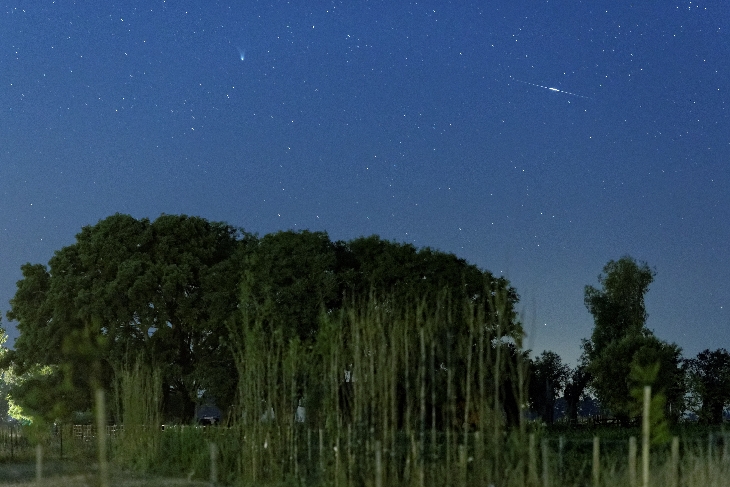
Comet NEOWISE (C/2020 F3) from West Seattle

This comet is visible a couple hours before sunrise for the next few days (July 9, 10, 11) and shortly after sunset after July 12 or so. All dates and times I mention are for West Seattle, Washington, USA. We’re in Pacific Time and at latitude 47.5°. Most of the times will be approximately true for your local time if you’re between 30-50° latitude in the Northern Hemisphere.

The problem with Comet NEOWISE is, even though it is fairly bright for a comet, it is still very close to the Sun from our point of view. When the Sun is in the sky, or even not in the sky but near the horizon, the sky itself is bright, washing out dimmer stars and sky objects. So you have to find the balance point between the peak of the comet’s brightness (which seems to be today July 9) and its distance from the Sun in the sky. Starting July 12 it will get farther and farther from the Sun in our sky, and be visible later and later after sunset.

NEOWISE is currently approximately visual magnitude 2 (smaller numbers are brighter), which is easily visible in a semi-dark sky. You can use these star charts to estimate whether or not a magnitude 2 object will be visible where you are. If you can see as many stars as are in the magnitude 3 chart, or more, then the comet will be visible. If you’re reading this after July 10, check the current magnitude of the comet, and look for the chart for stars dimmer than that.
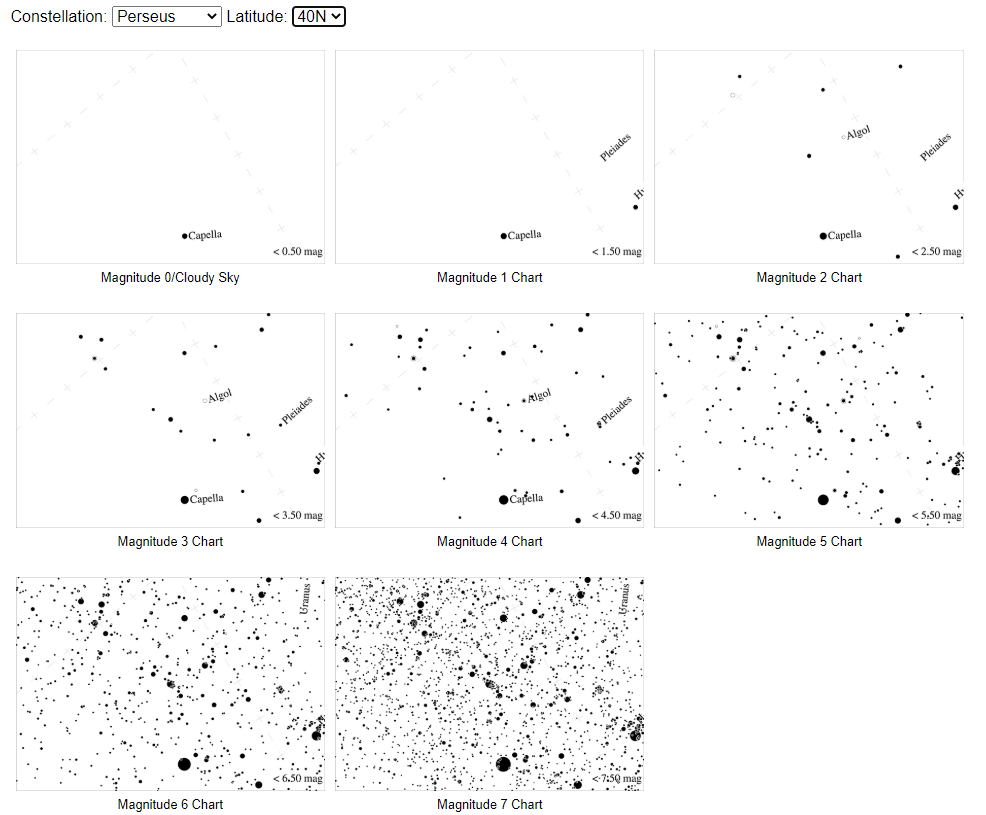
an image of 8 different sky maps showing different numbers of stars. Magnitude 0 shows only one star, Magnitude 1 shows a few. Magnitude 7 is very dense with stars.

Image from Globe at Night

Morning Sky

Your best chance for July 10 and July 11, 2020 will be around 3-3:40 am looking towards the Northeastern horizon.
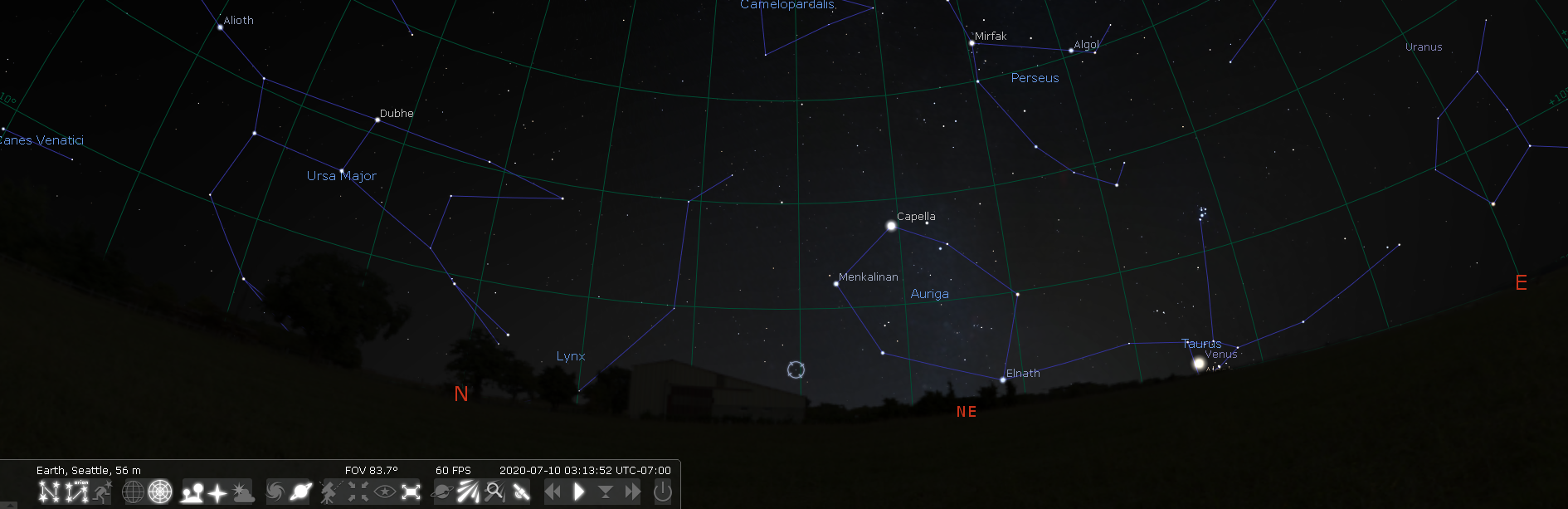
a Seattle horizon view from Stellarium here for July 10th at 3am. It will show a small marker next to the Northeast horizon between the constellations of Auriga to the right/North and Ursa Major (the Big Dipper) to the left/South. The marker is about 1/4 of the from Auriga to Ursa Major, it is much closer to Auriga.

Image from Stellarium

The Northeast horizon is our worst horizon in West Seattle, because that’s directly over Seattle proper. Lots of light pollution. If you want to see this comet, you’ll have to go to the other side of the city. Consider the peninsula or the East side of the Cascades. Wherever you choose, please wear a mask and stay more than 6 feet away from stargazers who aren’t part of your household.

Evening Sky

In a few days, after July 12, it will start to be visible after the Sun sets. You’re welcome to try for it before July 12, but since it sets just an hour after sunset, the odds aren’t good. You’ll be looking north of the Northwest horizon.
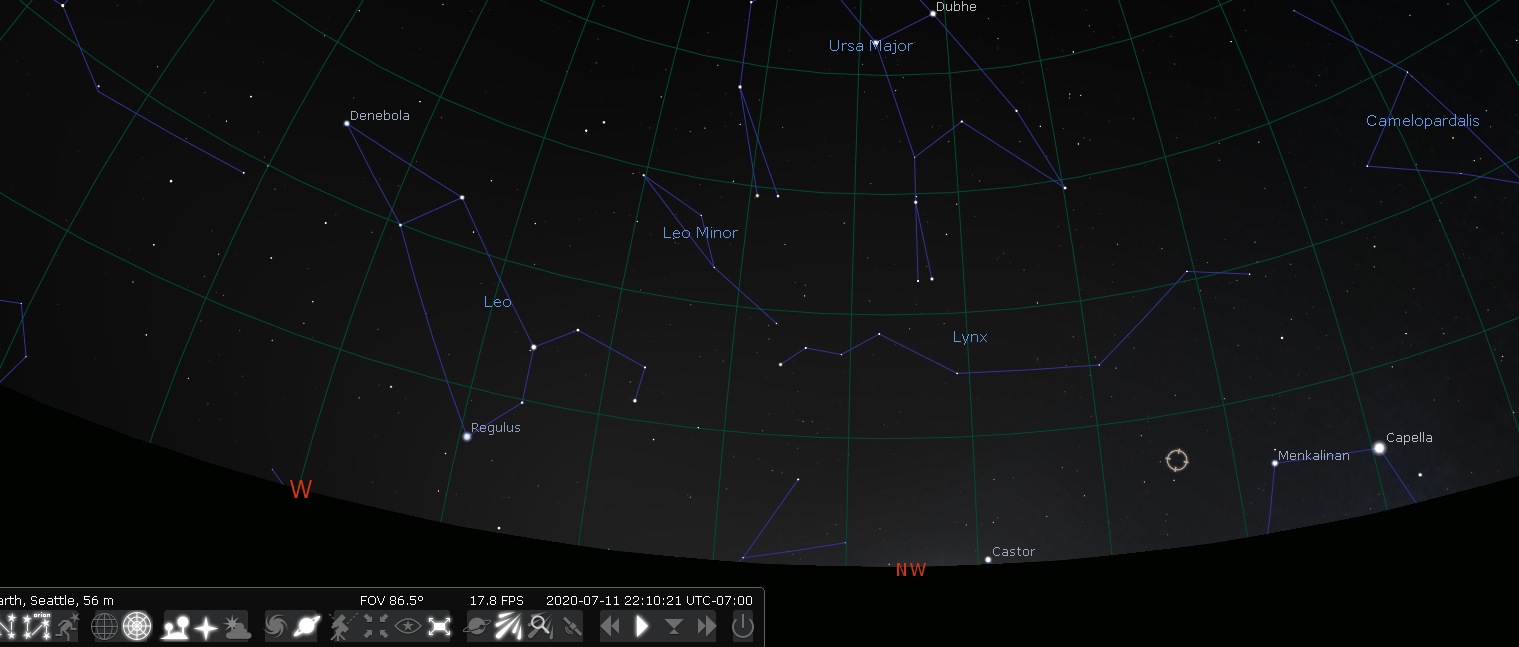
a Seattle horizon view from Stellarium here for July 11 at 10pm. It will show a small marker next to the Northwest horizon between the constellations of Auriga to the right/North, Ursa Major (the Big Dipper) above, and Leo to the left/South. The marker is about an eighth of the from Auriga to Leo, it is much closer to Leo. It is about a quarter of the way from Auriga to Ursa Major, closer to Auriga

Image from Stellarium

This is a much better horizon from West Seattle, you can view it from most place on the West side of West Seattle. I recommend trying for this one starting July 12 or so, and watch the news to see if other Northern Hemisphere folks have sighted it in their evening skies yet. Wherever you choose, please wear a mask and stay more than 6 feet away from stargazers who aren’t part of your household.

Binoculars

STOP! READ THIS!

If you use binoculars to see this, you must promise me you’ll put them down about 20 minutes before sunrise is predicted to happen. Please. This object is too close to the Sun for me to risk your eyes. Similarly, don’t begin looking for it until at least 5 minutes after you see the Sun finally set below the horizon.

This comet is going to be much more spectacular in binoculars or if you take a long-exposure photograph. A number of phones have “night sight” settings in the camera now, that will also bring out a little more detail, but you’ll need to hold the phone still: rest it on a stable surface.

Any old binoculars will work, they don’t need to be specific to astronomy.

Some useful sources:

  • Sky and Telescope has a map of NEOWISE’s positions over the course of July, and some photos by amateur astronomers.
  • Globe at Night has some reference star charts so you know how bright the stars are that you’re able to see.
  • Earth and Sky has tips on comet viewing, and the picture from Alexander Krivenyshev in Guttenberg, New Jersey is the most like what you’ll see.
  • Aerith.net by Seiichi Yoshida is full of detailed information about this comet, along with its most recent brightness.

Keep Looking Up!

-Alice

Comet PanSTARRS

It’s been a while since we had a good comet. Long enough that children in North America probably haven’t seen one, and you might have forgotten just how amazing they can be.

Comets Are Awesome

Comet Huyakutake spanned 100 degrees in the sky.

Comet Huyakutake spanned 100 degrees in the sky.

I know you don’t believe me, but comets can be spectacular objects to view without any magnification at all. No binoculars, no telescope, no squinting. This one might take a little magnification though, we’ll see. Comets are also unpredictable.

In 1996 Comet Huyakutake‘s tail spanned 100 degrees across the sky. Hold your arms at right angles to each other, then lift them up over your head, still at right angles. That’s 90 degrees. Look from one hand to the other- the tail was longer than the distance between your two hands (approximately). Now, Comet PanSTARRS (C/2011 L4) will probably not be like Huyakutake. All the evidence recently points to it being a bit of a dud, but it could still surprise us.

Comet Hale-Bopp (in 1997), which you likely remember had two tails, and under the best conditions that tail was about 10 degrees long. Hold your fist at arm’s length, and from knuckle to knuckle is about 10 degrees. The Moon is half a degree.

As of February 9th, PanSTARRS had a 2 degree gas and ion tail, visible in long-exposure photography from the Southern Hemisphere.

Can I See PanSTARRS?

This is what you all want to know, right? According to Sky and Telescope it is on track to being visible here in the northern hemisphere.

  • When? March 12-24, 2013 is your best bet from the Northern Hemisphere (West Seattlites, this is you!). Look just after sunset. Lucky for us, West Seattle has a GREAT western horizon for stargazing. I’ll meet you at Lincoln Park, okay?
  • Where? In the west, low on the horizon. Since it is just after sunset you won’t see many stars, but it is in the constellation Pisces in early March, and Andromeda in later March. Astronomy has a good finder chart.
  • How? As of now, you’ll need binoculars. If it brightens up considerably you might not, but plan on bringing binoculars.
  • What? Comet PanSTARRS currently has a 2 degree tail (two pinkie-finger widths), and should max out at a little brighter than the dimmer stars visible from the city of Seattle. With good viewing, the tail will be longer than the full Moon. If you can see the tail, observe how it is directed away from where the Sun just set.
  • Is it close? We’re all about the close approaches right now. Comet PanSTARRS “will pass about 100 million miles from Earth as it briefly dips inside the orbit of Mercury.” according to NASA. That’s about the same as the distance from the Earth to the Sun. Not so close.

What Will It Look Like?

I found this image, and I like the context. This is more that you would see with your eyes. This is PanSTARRS on February 11 by Luis Argerich in Argentina (and a satellite on the right).

Comet PanSTARRS is the smear on the left. The dotted line on the right is an Iridium satellite.

Comet PanSTARRS is the double-tailed smear on the left. The dotted line on the right is an Iridium satellite in this 10-second exposure.


Want More?

Sky and Telescope–great updated viewing information.

Weekly Info on Bright Comets

NASA’s story

~ A l i c e !